Showing posts with label exercise. Show all posts

Thursday, April 4, 2024

Stolen Focus (Johann Hari)


This is a great book. The author did a great job of researching and sharing the research many have worked on with focus. I will definitely implement some of his suggestions.

1. Stop multitasking. It doesn't work. Switching from one task to another takes much longer for our brain to reconfigure than we realize.

2. Read more books. I probably didn't need to read this to make that goal - but he certainly does make a good argument for why this is so important. Comprehension, focus and empathy are what we lose when we don't read.  I can resolve to take more time with a book though. Speed-reading is a detriment to comprehension and causes us to miss something.

3. Walk more...and without a podcast or book playing in headphones. Taking time to wander and to let our minds wander is key to creativity. He also has a really good argument for more unstructured play time and recess. I will definitely make sure there are more movement breaks and that everyone gets out for recess in my class.

4. Try to understand. Have conversations with people who believe totally different than you and try to really understand their perspective on an issue.

5. Limit Social Media and take big breaks from it. I've often heard people, especially church leaders in our church, tell us to do a social media fast. I've never been a big fan because so much communication happens in my circles with social media. His explanation of data tracking, AI and more was the most convincing thing I've read. He tells a really interesting story about a conversation with a scientist who shared with him about seeing a room full of people all wearing VR headsets....all but Mark Zuckerberg (who was at the front of the room speaking to the group). He said this is a metaphor for our future. We are being led, tracked and manipulated by social media. 

One part I wasn't sold on was his chapters on ADHD. He summarizes that the reason children have ADHD is because of stress imposed upon them in certain periods of life.

Some of my favorite take-aways:


Anne Mangan, a professor of literacy at the University of Stavanger in Norway, explained to me that in two decades of researching this subject, she has proved something crucial. Reading books trains us to read in a particular way - in a linear fashion, focused on one thing for a sustained period. Reading from screens, she has discovered, trains us to read in a different way - in a manic skip and jump from one thing to another...this [reading on screens] creates a different relationship with reading. It stops being a form of pleasurable immersion in another world and becomes more like dashing around a busy supermarket to grab what you need and then get out again. When this flip takes place - when our screen reading contaminates our book-reading - we lose some of the pleasures of reading books themselves  and they become less appealing.

It has other knock-on effects. Anne has conducted studies that split people into two groups, where one is given information in a printed book and the other is given the same information on a screen. Everyone is then asked questions about what they just read. When you do this, you find that people understand and remember less of what they absorb on screens. There's broad scientific evidence for this now, emerging from fifty-four studies, and she explained that it's referred to as "screen inferiority". This gap in understanding between books and screens is big enough that in elementary school children, it's the equivalent of two-thirds of a year's growth in reading comprehension. 

 --

When you read a novel, you are immersing yourself in what it's like to be inside another person's head. You are simulating a social situation. You are imagining other people and their experiences in a deep and complex way. So maybe, he said, if you read a lot of novels, you will become better at actually understanding other people off the page. Perhaps fiction is a kind of empathy gym, boosting your ability to empathize with other people - which is one of the most rich and precious forms of focus we have. Together, they decided to study this question scientifically.

--

We internalize the texture of the voices we're exposed to. When you expose yourself to complex stories about the inter lives of people over long periods of time, that will repattern your consciousness. You will become more perceptive, open, and empathetic. If, by contrast, you expose yourself for hours a day to the disconnected fragments of shrieking and fury that dominate social media, your thoughts will start to be shaped like that. Your internal voices will become cruder, louder, less able to hear more tender and gentle thoughts. Take care of what technologies you use, because your consciousness will, over time, come to be shaped like those technologies.

-- 

If enough people are spending enough of their time being angered, that starts to change the culture, ....it "turns hate into a habit." You can see this seeping into the bones of our society. When I was a teenager there was horrific crime in Britain, where two ten-year-old children murdered a toddler named Jamie Bulger. The Conservative prime minister at the time, John Major, responded by publicly saying that he believed we need "to condemn a little more, and understand a little less." I remembered thinking then, at the age of fourteen, that this was surely wrong - that' it's always better to understand why people do things, even (perhaps especially) the most heinous acts. But today, this attitude - condemn more, understand less - has become the default response to almost everyone, from the right to the left, as we spend our lives dancing to the tune of algorithms that reward fury and penalize mercy.

 --

The country that is often judged by international league tables to have the most successful schools in the world, Finland, is closer to these progressive models than anything we would recognize. Their children don't go to school at all until they are seven years old - before then, they just play. Between the ages of seven and sixteen, kids arrive at school at 9 am and leave at 2 pm. They are given almost no homework, and they take almost no tests until they graduate from high school. Free play is at the beating heart of Finnish kids' lives: by law, teachers have to give kids fifteen minutes of free play for every forty-five minutes of instructions. What's the outcome? Only 0.1 percent of their kids are diagnosed with attention problems, and Finns are among the most literate, numerate and happy people in the world.


Goodreads says:
Our ability to pay attention is collapsing. From the New York Times bestselling author of Chasing the Scream and Lost Connections comes a groundbreaking examination of why this is happening--and how to get our attention back.

In the United States, teenagers can focus on one task for only sixty-five seconds at a time, and office workers average only three minutes. Like so many of us, Johann Hari was finding that constantly switching from device to device and tab to tab was a diminishing and depressing way to live. He tried all sorts of self-help solutions--even abandoning his phone for three months--but nothing seemed to work. So Hari went on an epic journey across the world to interview the leading experts on human attention--and he discovered that everything we think we know about this crisis is wrong.

We think our inability to focus is a personal failure to exert enough willpower over our devices. The truth is even more disturbing: our focus has been stolen by powerful external forces that have left us uniquely vulnerable to corporations determined to raid our attention for profit. Hari found that there are twelve deep causes of this crisis, from the decline of mind-wandering to rising pollution, all of which have robbed some of our attention. In Stolen Focus, he introduces readers to Silicon Valley dissidents who learned to hack human attention, and veterinarians who diagnose dogs with ADHD. He explores a favela in Rio de Janeiro where everyone lost their attention in a particularly surreal way, and an office in New Zealand that discovered a remarkable technique to restore workers' productivity.

Crucially, Hari learned how we can reclaim our focus--as individuals, and as a society--if we are determined to fight for it. Stolen Focus will transform the debate about attention and finally show us how to get it back.

Sunday, March 31, 2024

The Fitness Curveball (Tim Borys)


I had hopes that this book would talk about how to always be an exercises, even when life throws you curveballs. It doesn't really do that though. It does have some good information on habits and belief systems although some of the practices he suggests are a little weird and a waste of time, if you ask me. Having a good foundation of habits definitely is helpful though for when things go sideways, so I'll give him some credit. There is a lot on proper form for exercise too - which is hard to soak in through reading. I bet he's a good personal coach. He book was just so so if you ask me though. 

Goodreadsa says:

Nothing!! There's nothing on Goodreads and mind was the first review. Now that's new! 

Monday, July 12, 2021

No Sweat: How the Simple Science of Motivation Can Bring You a Lifetime of Fitness (Michelle Segar)


This is a great book! Years ago I decided to start a walking streak after reading a number of books on aging. I realized how important daily exercise is and the key for me to doing it every day was to quit trying to exercise to lose weight. That changed everything. My best attempts at being active daily have been when I figured out a way to walk to work.

This book is a keeper....one to review again and again. It could be used for all sorts of goals, to be honest!

Goodreads syas:

We start out with the best intentions. We're going to exercise more and get in shape! Then five days a week at the gym turns into two... then becomes none. We hit the snooze button and skip the morning run.

We really do want to be healthy and fit, but we're over whelmed and overextended—and exercise feels like another chore to complete. Is it any wonder we don't stick with it? Behavior expert Michelle Segar has devoted her career to the science of motivation. In No Sweat, she reveals that while "better health" or "weight loss" sound like strong incentives, human beings are hardwired to choose immediate gratification over delayed benefits. In other words, we're not going to exercise unless it makes us happy right now.

So what's the solution? To achieve lasting fitness, we have to change our minds—before we can change our bodies. In No Sweat, Segar shows us how. Translating twenty years of research on exercise and motivation into a simple four-point program,she helps readers broaden their definition of exercise, find pleasure in physical activity, and discover realistic ways to fit it into their lives. Activities we enjoy, we repeat--making this evidence-based system more sustainable in the long run than a regimen of intense workouts. Even if we don't sweat, we really benefit.

The success of the clients Segar has coached testifies to the power of her program. Their stories punctuate the book, entertaining and emboldening readers to break the cycle of exercise failure once and for all. Complete with worksheets, tips, and techniques, getting in shape has never been so easy—or so much fun.

Saturday, July 20, 2019

Better Than Before (Gretchen Rubin)

Strangely, I haven't blogged this book! This is a book I try to re-read every six months. I just finished a re-read and I still love it. It is a good review of how to get good habits into my life and to help them be routine...you know, like a habit should be!

What I like about Gretchen Rubin is that she accounts for differences in personalities. Everyone has their own personality quirks (although, she does put people into categories) that make it so that what works for one person does not work for another. The first part of the book is about recognizing what kind of a person you are. She has a sorting called The Four Tendencies but she doesn't just stop there. She talks about other traits:

Larks versus Owls
Marathoners, sprinters and procrastinators
Under buyers and over buyers
Simplicity and abundance lovers
finishers and openers
Familiarity lovers and novelty lovers
Promotion versus prevention focused
Small steps versus big steps.

After that, she talks about many different strategies for implementing habits:
- monitoring
- Foundation
- Scheduling
- Accountability
- Abstaining versus moderating
- Pairing
etc

She also discusses things that we do to sabotage our new good habits....
- convenience versus inconvenience
- safeguards
- loop-holing

The chapter about rewards was really interesting. It really reminded me of a lot of what I've read on children and rewards for behavior. We need to be careful about rewards.

She cites a lot of research and this time I noticed that she organizes her notes about this research in a reader friendly way.

I totally recommend this book!

Goodreads says:

The author of the blockbuster New York Times bestsellers, The Happiness Project and Happier at Home, tackles the critical question: How do we change? 
 
Gretchen Rubin's answer: through habits. Habits are the invisible architecture of everyday life. It takes work to make a habit, but once that habit is set, we can harness the energy of habits to build happier, stronger, more productive lives.
 
So if habits are a key to change, then what we really need to know is: How do we change our habits?
 
Better than Before answers that question. It presents a practical, concrete framework to allow readers to understand their habits—and to change them for good. Infused with Rubin’s compelling voice, rigorous research, and easy humor, and packed with vivid stories of lives transformed, Better than Beforeexplains the (sometimes counter-intuitive) core principles of habit formation. 
 
Along the way, Rubin uses herself as guinea pig, tests her theories on family and friends, and answers readers’ most pressing questions—oddly, questions that other writers and researchers tend to ignore: 

• Why do I find it tough to create a habit for something I love to do? 
• Sometimes I can change a habit overnight, and sometimes I can’t change a habit, no matter how hard I try. Why? 
• How quickly can I change a habit? 
• What can I do to make sure I stick to a new habit? 
• How can I help someone else change a habit? 
• Why can I keep habits that benefit others, but can’t make habits that are just for me? 

Whether readers want to get more sleep, stop checking their devices, maintain a healthy weight, or finish an important project, habits make change possible. Reading just a few chapters of Better Than Before will make readers eager to start work on their own habits—even before they’ve finished the book

Saturday, December 30, 2017

Slim for Life (Jillian Michaels)

16700261

I listened to the audio book. Jillian Michaels is hilarious. I love how real she is.

This is a great book. It is one that I should buy a copy of because it is one to read every six months and to get a plan for new habits to add to healthy living. This book is full of great ideas. I like that she doesn't expect you to wipe out any food groups or take any weird pills or starve. Bonus!

New habits I will incorporate:
1. Always have a plan
2. Carry healthy snacks
3. Eat every four hours

Goodreads says:

Stop battling your weight and slim down for life with this no-nonsense, insider's plan from America's health, wellness, and weight-loss guru: Jillian Michaels. She has helped millions lose weight and feel great, and now she can help you, too.

Bestselling author and Biggest Loser trainer Jillian Michaels swore she'd never write another diet book. But she realized that with all of the conflicting, overly complicated information being thrown at you each day, what you need is a clear, simple plan that cuts through all the confusion to deliver amazing results, fast. This book distills all she's learned about diet, fitness, and a healthy lifestyle to provide anyone seeking to be slim, strong, and healthy with an easier path to achieving dramatic body transformation.

No nonsense, no gimmicks, just actionable advice that gets incredible results fast!

Friday, December 29, 2017

Healthy Brain, Healthy Life (Wendy Suzuki)

22635869

I'm fascinated at how exercise is such a big part of every brain book I read. It makes all the difference. I can testify to that! I loved her research on how exercise helps with creativity, problem solving, mood and more. It made me want to recommit to getting my students to move more. I also think that when the school day ends, I should go for a walk around the block and think about what went great and what I need to follow up on the next day before I sit down. Perhaps I'd be more productive if I did. Her stories of voicing intentions while exercising made a lot of sense. I have read recently how important it is to use all the senses to increase memory - see it, read it, write it, say it. This fits well with what she talked about.

I really enjoyed the mix of science and personal experiences in this book. It made it much more relate-able than just straight science research.

This book made me want to work on adding meditation to my life.

I listened to this as an audio book and I have to admit I found the voice a little irritating. It was a little too bouncy and chipper (which I feel silly saying...but it's true). I liked the brain hacks (ways to implement the topics of the chapter) at the end of each chapter.


Goodreads says:

Dr. Wendy Suzuki one day woke up and realized she didn’t have a life. As an almost-40-year-old award-winning college professor, world-renowned neuroscientist, she had—what many considered—everything: tenure as a professor at New York University; her own very successful neuroscience research lab; prizes for scientific discoveries on cognition and memory; articles published in prestigious scientific journals. As a woman and a scientist, she was the envy of her peers and lauded by her superiors. On paper, she had a stellar career and an impeccable record. 

What could she possibly be missing? Everything else. 

Suzuki was overweight. She was tired. She was lonely, had strained work relationships, and for the first time in her life, completely without direction. So she resolved to change her life. The first step--get moving. 

Everyone knows that exercise makes you feel better—that when you hit the gym despite the dread, you leave in a better mood. Healthy Brain, Happy Life offers the real science of how exercise effects your mind. 

Using Wendy’s journey from frumpy, fat and frustrated to fit and fabulous as a guide, Healthy Brain offers not just the HOWS of making exercise an important part of life, but the WHYS of the benefits it brings. But movement is just the first step to being Brain Healthy. Once you get your body and mind hooked on exercise, you bring in practices in mindfullness to calm stress and allow your minds to wander to unlock creativity. As your brain begins to change (something called neuroplasticity), the benefits build--you get fitter, improve your memory, increase your ability to work quickly and move from task to task easily. 

Along with Dr. Suzuki’s 4 minute Brain Hacks, Healthy Brain, Happy Life offers a simple program for changing your life, straight from a leading scientist’s personal experience.

Monday, January 30, 2017

Grumpy Bird (Jeremy Tankard)


We seem to have a lot of books about grumpiness lately in our classroom. Not sure why this trend. Maybe I need to analyze my interests. :)  

I like the theme in this book that shows that when you get up and get going there is less grumpiness.

Goodreads summary:

Bright and fresh with an innovative art style, this debut picture book from a huge new talent is sure to win lots of fans!

Bird wakes up feeling grumpy. Too grumpy to eat or play -- too grumpy even to fly. "Looks like I'm walking today," says Bird. He walks past Sheep, who offers to keep him company. He walks past Rabbit, who also could use a walk. Raccoon, Beaver, and Fox join in, too.

Before he knows it, a little exercise and companionship help Bird shake his bad mood. This winsome, refreshingly original picture book is sure to help kids (and grown-ups) giggle away theirs, too!

Saturday, July 16, 2016

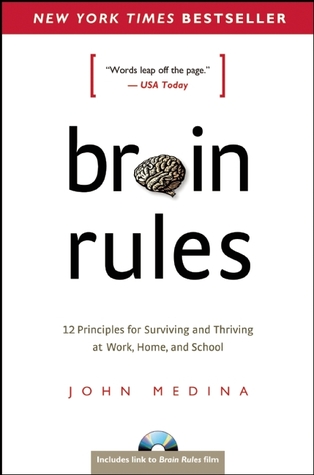
Brain Rules: 12 Principles for Surviving and Thriving at Work, Home, and School (John Medina)

2251306


The brain fascinates me. I loved this book because it explains the science in ways I can understand (I'm really not a science person!) I also liked how he added ideas for ways to implement these ideas in regular work, home and school life.


The 12 rules are:
EXERCISE | Rule #1: Exercise boosts brain power.
SURVIVAL | Rule #2: The human brain evolved, too.
WIRING | Rule #3: Every brain is wired differently.
ATTENTION | Rule #4: We don't pay attention to boring things.
SHORT-TERM MEMORY | Rule #5: Repeat to remember.
LONG-TERM MEMORY | Rule #6: Remember to repeat.
SLEEP | Rule #7: Sleep well, think well.
STRESS | Rule #8: Stressed brains don't learn the same way as non-stressed
SENSORY INTEGRATION | Rule #9: Stimulate more of the senses.
VISION | Rule #10: Vision trumps all other senses.
GENDER | Rule #11: Male and female brains are different.
EXPLORATION | Rule #12: We are powerful and natural explorers.


Goodreads summary:


Most of us have no idea what’s really going on inside our heads. Yet brain scientists have uncovered details every business leader, parent, and teacher should know—like the need for physical activity to get your brain working its best.

How do we learn? What exactly do sleep and stress do to our brains? Why is multi-tasking a myth? Why is it so easy to forget—and so important to repeat new knowledge? Is it true that men and women have different brains?

In Brain Rules, Dr. John Medina, a molecular biologist, shares his lifelong interest in how the brain sciences might influence the way we teach our children and the way we work. In each chapter, he describes a brain rule—what scientists know for sure about how our brains work—and then offers transformative ideas for our daily lives.

Medina’s fascinating stories and infectious sense of humor breathe life into brain science. You’ll learn why Michael Jordan was no good at baseball. You’ll peer over a surgeon’s shoulder as he proves that most of us have a Jennifer Aniston neuron. You’ll meet a boy who has an amazing memory for music but can’t tie his own shoes.

You will discover how:

Every brain is wired differently
Exercise improves cognition
We are designed to never stop learning and exploring
Memories are volatile
Sleep is powerfully linked with the ability to learn
Vision trumps all of the other senses
Stress changes the way we learn

In the end, you’ll understand how your brain really works—and how to get the most out of it.

Sunday, July 3, 2016

I Feel Bad About My Neck (Nora Ephron)


This lady is hilarious. She is the author of the screenplays When Harry Met Sally, Sleepless in Seattle and You've Got Mail. Can you imagine having writing all those screenplays and having them turned into movies??

She has led a bit of a privileged life and has been successful in her own life. As a result, she talks about some things that I just didn't relate to. She has been divorced more than once and has chapters on face lifts, manicures and interactions with famous people like Martha Stewart, JFK and Bill Clinton. 

However, she also had a lot of stuff that regular people can relate to and get a good chuckle out of. 

Some favourite parts: 

p. 51 My children thought calling Directory Assistance was free, on top of which they always pressed "1" to be connected, for an additional charge of thirty-five cents. This drove me even crazier. (Remember this?? Does 411 even exist anymore??!)

p. 52. Mostly I'm sad about just plain reading. When I pass a bookshelf, I like to pick out a book from it and thumb through it. When I see a newspaper on the couch, I like to sit down with it. When the mail arrives I like to rip it open. Reading is a part of the main things I do. Reading is everything. Reading makes me feel l Iike I have accomplished something, learned something, become a better person. Reading makes me smarter. Reading gives me something to talk about later on. Reading is the unbelievably healthy way my attention deficit disorder medicates itself. Reading is escape, and the opposite of escape; it's a way to make contact with reality after a day of making things up, and it's a way of making contact with someone else's imagination after a day that's all to real. Reading is grist. Reading is bliss. But my ability to pick something up and read it -which has gone unchecked all my life up until now-is not entirely dependent on the whereabouts of my reading glasses. I look around. Why aren't they in this room? I bought six pair of them last week on sale and sprinkled them throughout the house, yet none of them is visible. Where are they?
I hate that I need reading glasses. I hate that I can't read a word in the map, in the telephone book, on the many, in the book or anywhere else without them. And the pill bottle! I forgot to mention the pill bottle. I can't read a word on the pill bottle. Does it say take two every four hours or four every two hours? Does it say good until 12/08/07 or "Expired. Period. End of story"? I have no idea what it says, and this is serious. I could die from not being able to read the print in the pill bottle. In fact, the print on the pill bottle is so small I doubt if anyone can read it. I'm not sure I could read it even when I didn't need reading glasses. Although, who can remember?

p. 83 Why hadn't I realized how much I thought of a love was simply my own highly develop gift for making lemonade?

p. 88 now that I have read the articles about Mimi Fahnestock, it has become horribly clear to me that I am probably the only young woman who ever worked in the Kennedy White Hiuse that the president did not make a pass at. Perhaps it was my permanent wave, which was a truly unfortunately mistake. Perhaps it was my wardrobe, which mostly consisted of multicoloured Dynek dress that looked like distilled Velveta cheese. Perhaps it's because I'm Jewish. Don't laugh; think about it-think about the king list of women that JFK slept with. Were any of them Jewish? I don't think so. 
On the other hand, perhaps nothing happened between us because JFK somehow sensed that discretion was not my middle name. I mean, I assure you that if anything had gone on between us, you would have had to wait this long to find out. 

P. 95 ...there is an expression for what I am-a mouse potato. It means someone who's as connected to her computer as couch potatoes are to their television sets. 

She also has pages with long lists of advice and her life's lesson. It all brought a smile to my face. 

If you need some easy entertainment, this book is a great pick. 

Goodreads summary: 

With her disarming, intimate, completely accessible voice, and dry sense of humor, Nora Ephron shares with us her ups and downs in "I Feel Bad About My Neck, " a candid, hilarious look at women who are getting older and dealing with the tribulations of maintenance, menopause, empty nests, and life itself.
The woman who brought us "When Harry Met Sally . . ., Sleepless in Seattle, You've Got Mail, "and" Bewitched, " and the author of best sellers "Heartburn, Scribble Scribble, " and "Crazy Salad, " discusses everything--from how much she hates her purse to how much time she spends attempting to stop the clock: the hair dye, the treadmill, the lotions and creams that promise to slow the aging process but never do. Oh, and she can't stand the way her neck looks. But her dermatologist tells her there's no quick fix for that.
Ephron chronicles her life as an obsessed cook, passionate city dweller, and hapless parent. She recounts her anything-but-glamorous days as a White House intern during the JFK years ("I am probably the only young woman who ever worked in the Kennedy White House that the President did not make a pass at") and shares how she fell in and out of love with Bill Clinton--from a distance, of course. But mostly she speaks frankly and uproariously about life as a woman of a certain age.
Utterly courageous, wickedly funny, and unexpectedly moving in its truth telling, "I Feel Bad About My Neck" is a book of wisdom, advice, and laugh-out-loud moments, a scrumptious, irresistible treat.
 (less)


Saturday, December 26, 2015

Spark (John J. Ratey, MD)

On p. 245, the author says: personally, researching this book has we doubled my enthusiasm for the benefits of exercise and replaced intuition with hard, scientific fact.

Me too!

Research consistently  shows the more fit you are, the more I resilient your brain becomes and the better it functions both cognitively and psychologically. If you get your body in shape, your mind will follow.

He advises readers to do a varied incident intensity of walking, jogging, running, and sprinting. In broad strokes, then, I think the best advice is to follow our ancestors routine; walk or jog every day, run a couple times a week, and then go for the kill every now and then by sprinting.

He suggests doing aerobic exercise 6 days of the week for 45 minutes to an hour. Four of those days should be on the longer side, I'm at moderate intensity, and two on the shorter side, and high-intensity. On the shorter high-intensity days, include some form of strength and resistance training. These day should not be back to back.

He opens up the book by talking about these concepts in schools. I really want to investigate this further and figure out how I can implement it in my classroom.