Showing posts with label focus. Show all posts

Monday, July 21, 2025

The Siren's Call (Chris Hayes)


This was kind of an adult version of The Anxious Generation (Jonathan Haidt) only, not so much anxiety....but the root of it all is the same...everything fighting for our attention.

In This Age of Information, attention is what everyone is fighting for. We need to be wise about what we give our attention to. He says instead of the information age, we should call it the attention age.  Ironically, I had a hard time following all the time I listened (he's REALLY thorough) but he does make some good points and interesting connections through history. His recommendation is to be really vigilant about how we spend our time and attention - more reading, more walking, more quiet! 

Five key take aways:

1. The Attention Economy Thrives on Distraction and Outrage – The stuff that makes people explode is what gets shared and therefore the majority of our focus. 

2. Our Ability to Focus Has Diminished – Shorter articles, shorter videos, shorter speeches. We have really lost our ability for deep thought, deep reading and deep conversation.

3. Toxic Attention-Seeking Behaviors Dominate Public Discourse – Meaning conversation is thwarted by trolls, conspiracy theories and whataboutism. People like Donald Trump have mastered the art of attracting attention at any cost, using positive or negative outrage to stay in the public consciousness.

4. Attention is Both Exploited and Inherently Human – Businesses are set up to make money off of our focus. Since humans seem to naturally seek attention for validation and connection. Social media exploits this. It makes us think we have connections - but truthfully, it's a shallow and unsatisfying connection and actually is just increasing loneliness and isolation.


5. Fixing this can be done on an individual level but may also require a social shirt – We can make changes in our own life like choosing to read print newspapers or using "dumb phones" as well as spending more time reading and discussing. We may also need systemic changes, like government regulation on social media and other platforms.


Goodreads says:

An Instant #1 New York Times Bestseller

From the New York Times bestselling author and MSNBC and podcast host, a powerful wide-angle reckoning with how the assault from attention capitalism on our minds and our hearts has reordered our politics and the very fabric of our society

“An ambitious analysis of how the trivial amusements offered by online life have degraded not only our selves but also our politics.” —New York Times

“Brilliant book… Reading it has made me change the way I work and think.”—Rachel Maddow


We all feel it—the distraction, the loss of focus, the addictive focus on the wrong things for too long. We bump into the zombies on their phones in the street, and sometimes they’re us. We stare in pity at the four people at the table in the restaurant, all on their phones, and then we feel the buzz in our pocket. Something has changed for most of human history, the boundary between public and private has been clear, at least in theory. Now, as Chris Hayes writes, “With the help of a few tech firms, we basically tore it down in about a decade.” Hayes argues that we are in the midst of an epoch-defining transition whose only parallel is what happened to labor in the nineteenth attention has become a commodified resource extracted from us, and from which we are increasingly alienated. The Sirens’ Call is the big-picture vision we urgently need to offer clarity and guidance.

Because there is a breaking point. Sirens are designed to compel us, and now they are going off in our bedrooms and kitchens at all hours of the day and night, doing the bidding of vast empires, the most valuable companies in history, built on harvesting human attention. As Hayes writes, “Now our deepest neurological structures, human evolutionary inheritances, and social impulses are in a habitat designed to prey upon, to cultivate, distort, or destroy that which most fundamentally makes us human.” The Sirens’ Call is the book that snaps everything into a single holistic framework so that we can wrest back control of our lives, our politics, and our future.

Thursday, April 4, 2024

Stolen Focus (Johann Hari)


This is a great book. The author did a great job of researching and sharing the research many have worked on with focus. I will definitely implement some of his suggestions.

1. Stop multitasking. It doesn't work. Switching from one task to another takes much longer for our brain to reconfigure than we realize.

2. Read more books. I probably didn't need to read this to make that goal - but he certainly does make a good argument for why this is so important. Comprehension, focus and empathy are what we lose when we don't read.  I can resolve to take more time with a book though. Speed-reading is a detriment to comprehension and causes us to miss something.

3. Walk more...and without a podcast or book playing in headphones. Taking time to wander and to let our minds wander is key to creativity. He also has a really good argument for more unstructured play time and recess. I will definitely make sure there are more movement breaks and that everyone gets out for recess in my class.

4. Try to understand. Have conversations with people who believe totally different than you and try to really understand their perspective on an issue.

5. Limit Social Media and take big breaks from it. I've often heard people, especially church leaders in our church, tell us to do a social media fast. I've never been a big fan because so much communication happens in my circles with social media. His explanation of data tracking, AI and more was the most convincing thing I've read. He tells a really interesting story about a conversation with a scientist who shared with him about seeing a room full of people all wearing VR headsets....all but Mark Zuckerberg (who was at the front of the room speaking to the group). He said this is a metaphor for our future. We are being led, tracked and manipulated by social media. 

One part I wasn't sold on was his chapters on ADHD. He summarizes that the reason children have ADHD is because of stress imposed upon them in certain periods of life.

Some of my favorite take-aways:


Anne Mangan, a professor of literacy at the University of Stavanger in Norway, explained to me that in two decades of researching this subject, she has proved something crucial. Reading books trains us to read in a particular way - in a linear fashion, focused on one thing for a sustained period. Reading from screens, she has discovered, trains us to read in a different way - in a manic skip and jump from one thing to another...this [reading on screens] creates a different relationship with reading. It stops being a form of pleasurable immersion in another world and becomes more like dashing around a busy supermarket to grab what you need and then get out again. When this flip takes place - when our screen reading contaminates our book-reading - we lose some of the pleasures of reading books themselves  and they become less appealing.

It has other knock-on effects. Anne has conducted studies that split people into two groups, where one is given information in a printed book and the other is given the same information on a screen. Everyone is then asked questions about what they just read. When you do this, you find that people understand and remember less of what they absorb on screens. There's broad scientific evidence for this now, emerging from fifty-four studies, and she explained that it's referred to as "screen inferiority". This gap in understanding between books and screens is big enough that in elementary school children, it's the equivalent of two-thirds of a year's growth in reading comprehension. 

 --

When you read a novel, you are immersing yourself in what it's like to be inside another person's head. You are simulating a social situation. You are imagining other people and their experiences in a deep and complex way. So maybe, he said, if you read a lot of novels, you will become better at actually understanding other people off the page. Perhaps fiction is a kind of empathy gym, boosting your ability to empathize with other people - which is one of the most rich and precious forms of focus we have. Together, they decided to study this question scientifically.

--

We internalize the texture of the voices we're exposed to. When you expose yourself to complex stories about the inter lives of people over long periods of time, that will repattern your consciousness. You will become more perceptive, open, and empathetic. If, by contrast, you expose yourself for hours a day to the disconnected fragments of shrieking and fury that dominate social media, your thoughts will start to be shaped like that. Your internal voices will become cruder, louder, less able to hear more tender and gentle thoughts. Take care of what technologies you use, because your consciousness will, over time, come to be shaped like those technologies.

-- 

If enough people are spending enough of their time being angered, that starts to change the culture, ....it "turns hate into a habit." You can see this seeping into the bones of our society. When I was a teenager there was horrific crime in Britain, where two ten-year-old children murdered a toddler named Jamie Bulger. The Conservative prime minister at the time, John Major, responded by publicly saying that he believed we need "to condemn a little more, and understand a little less." I remembered thinking then, at the age of fourteen, that this was surely wrong - that' it's always better to understand why people do things, even (perhaps especially) the most heinous acts. But today, this attitude - condemn more, understand less - has become the default response to almost everyone, from the right to the left, as we spend our lives dancing to the tune of algorithms that reward fury and penalize mercy.

 --

The country that is often judged by international league tables to have the most successful schools in the world, Finland, is closer to these progressive models than anything we would recognize. Their children don't go to school at all until they are seven years old - before then, they just play. Between the ages of seven and sixteen, kids arrive at school at 9 am and leave at 2 pm. They are given almost no homework, and they take almost no tests until they graduate from high school. Free play is at the beating heart of Finnish kids' lives: by law, teachers have to give kids fifteen minutes of free play for every forty-five minutes of instructions. What's the outcome? Only 0.1 percent of their kids are diagnosed with attention problems, and Finns are among the most literate, numerate and happy people in the world.


Goodreads says:
Our ability to pay attention is collapsing. From the New York Times bestselling author of Chasing the Scream and Lost Connections comes a groundbreaking examination of why this is happening--and how to get our attention back.

In the United States, teenagers can focus on one task for only sixty-five seconds at a time, and office workers average only three minutes. Like so many of us, Johann Hari was finding that constantly switching from device to device and tab to tab was a diminishing and depressing way to live. He tried all sorts of self-help solutions--even abandoning his phone for three months--but nothing seemed to work. So Hari went on an epic journey across the world to interview the leading experts on human attention--and he discovered that everything we think we know about this crisis is wrong.

We think our inability to focus is a personal failure to exert enough willpower over our devices. The truth is even more disturbing: our focus has been stolen by powerful external forces that have left us uniquely vulnerable to corporations determined to raid our attention for profit. Hari found that there are twelve deep causes of this crisis, from the decline of mind-wandering to rising pollution, all of which have robbed some of our attention. In Stolen Focus, he introduces readers to Silicon Valley dissidents who learned to hack human attention, and veterinarians who diagnose dogs with ADHD. He explores a favela in Rio de Janeiro where everyone lost their attention in a particularly surreal way, and an office in New Zealand that discovered a remarkable technique to restore workers' productivity.

Crucially, Hari learned how we can reclaim our focus--as individuals, and as a society--if we are determined to fight for it. Stolen Focus will transform the debate about attention and finally show us how to get it back.

Thursday, November 2, 2023

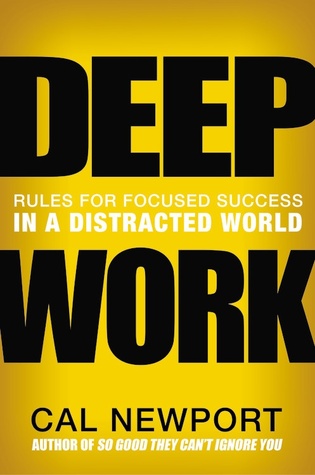
Deep Work (Cal Newport)

25744928


This is seriously good stuff. I totally buy in. The trick for me is how do I find the time to really get into deep work? #momtroubles #RCsolutions

I'm going to start by tracking my time and perhaps seriously slashing social media time as he suggests (well, he suggests to quit it, but I'm not quite ready for that). 

This book is going to go on my list of books to re-read regularly.

Goodreads says:

One of the most valuable skills in our economy is becoming increasingly rare. If you master this skill, you'll achieve extraordinary results.

Deep work is the ability to focus without distraction on a cognitively demanding task. It's a skill that allows you to quickly master complicated information and produce better results in less time. Deep work will make you better at what you do and provide the sense of true fulfillment that comes from craftsmanship. In short, deep work is like a super power in our increasingly competitive twenty-first century economy. And yet, most people have lost the ability to go deep-spending their days instead in a frantic blur of e-mail and social media, not even realizing there's a better way.

In Deep Work, author and professor Cal Newport flips the narrative on impact in a connected age. Instead of arguing distraction is bad, he instead celebrates the power of its opposite. Dividing this book into two parts, he first makes the case that in almost any profession, cultivating a deep work ethic will produce massive benefits. He then presents a rigorous training regimen, presented as a series of four "rules," for transforming your mind and habits to support this skill.

A mix of cultural criticism and actionable advice, Deep Worktakes the reader on a journey through memorable stories-from Carl Jung building a stone tower in the woods to focus his mind, to a social media pioneer buying a round-trip business class ticket to Tokyo to write a book free from distraction in the air-and no-nonsense advice, such as the claim that most serious professionals should quit social media and that you should practice being bored. Deep Work is an indispensable guide to anyone seeking focused success in a distracted world.
 

Monday, February 13, 2023

Grit (Angela Duckworth)


 This is a book to read again and again! It is strongly tied with the ideas of Carol Dweck and growth mindset. Perseverence is key!


Goodreads says:
In this must-read book for anyone striving to succeed, pioneering psychologist Angela Duckworth shows parents, educators, students, and business people both seasoned and new that the secret to outstanding achievement is not talent but a focused persistence called grit.

Why do some people succeed and others fail? Sharing new insights from her landmark research on grit, Angela Duckworth explains why talent is hardly a guarantor of success. Rather, other factors can be even more crucial such as identifying our passions and following through on our commitments.

Drawing on her own powerful story as the daughter of a scientist who frequently bemoaned her lack of smarts, Duckworth describes her winding path through teaching, business consulting, and neuroscience, which led to the hypothesis that what really drives success is not genius, but a special blend of passion and long-term perseverance. As a professor at the University of Pennsylvania, Duckworth created her own character lab and set out to test her theory.

Here, she takes readers into the field to visit teachers working in some of the toughest schools, cadets struggling through their first days at West Point, and young finalists in the National Spelling Bee. She also mines fascinating insights from history and shows what can be gleaned from modern experiments in peak performance. Finally, she shares what she's learned from interviewing dozens of high achievers; from JP Morgan CEO Jamie Dimon to the cartoon editor of The New Yorker to Seattle Seahawks Coach Pete Carroll.

Winningly personal, insightful, and even life-changing, Grit is a book about what goes through your head when you fall down, and how that not talent or luck makes all the difference.