Showing posts with label alzheimers. Show all posts

Wednesday, July 28, 2021

Keep Sharp (Sanjay Gupta)


I've read quite a few books about aging, the brain and dementia. The thing I really like about this one is he gives solid steps for keeping your brain sharp...a 12 week program. I borrowed the book from the library but I will buy it so that I can get a copy of this 12 week program. It is full of great things to focus on for a healthy life!


Goodreads says:

Keep your brain young, healthy, and sharp with this science-driven guide to protecting your mind from decline by neurosurgeon and CNN chief medical correspondent Sanjay Gupta.

Throughout our life, we look for ways to keep our mind sharp and effortlessly productive. Now, globetrotting neurosurgeon Dr. Sanjay Gupta offers insights from top scientists all over the world, whose cutting-edge research can help you heighten and protect brain function and maintain cognitive health at any age.

Keep Sharp debunks common myths about aging and cognitive decline, explores whether there’s a “best” diet or exercise regimen for the brain, and explains whether it’s healthier to play video games that test memory and processing speed, or to engage in more social interaction. Discover what we can learn from “super-brained” people who are in their eighties and nineties with no signs of slowing down—and whether there are truly any benefits to drugs, supplements, and vitamins. Dr. Gupta also addresses brain disease, particularly Alzheimer’s, answers all your questions about the signs and symptoms, and shows how to ward against it and stay healthy while caring for a partner in cognitive decline. He likewise provides you with a personalized twelve-week program featuring practical strategies to strengthen your brain every day.

Keep Sharp is the only owner’s manual you’ll need to keep your brain young and healthy regardless of your age!

Friday, December 29, 2017

Healthy Brain, Healthy Life (Wendy Suzuki)

22635869

I'm fascinated at how exercise is such a big part of every brain book I read. It makes all the difference. I can testify to that! I loved her research on how exercise helps with creativity, problem solving, mood and more. It made me want to recommit to getting my students to move more. I also think that when the school day ends, I should go for a walk around the block and think about what went great and what I need to follow up on the next day before I sit down. Perhaps I'd be more productive if I did. Her stories of voicing intentions while exercising made a lot of sense. I have read recently how important it is to use all the senses to increase memory - see it, read it, write it, say it. This fits well with what she talked about.

I really enjoyed the mix of science and personal experiences in this book. It made it much more relate-able than just straight science research.

This book made me want to work on adding meditation to my life.

I listened to this as an audio book and I have to admit I found the voice a little irritating. It was a little too bouncy and chipper (which I feel silly saying...but it's true). I liked the brain hacks (ways to implement the topics of the chapter) at the end of each chapter.


Goodreads says:

Dr. Wendy Suzuki one day woke up and realized she didn’t have a life. As an almost-40-year-old award-winning college professor, world-renowned neuroscientist, she had—what many considered—everything: tenure as a professor at New York University; her own very successful neuroscience research lab; prizes for scientific discoveries on cognition and memory; articles published in prestigious scientific journals. As a woman and a scientist, she was the envy of her peers and lauded by her superiors. On paper, she had a stellar career and an impeccable record. 

What could she possibly be missing? Everything else. 

Suzuki was overweight. She was tired. She was lonely, had strained work relationships, and for the first time in her life, completely without direction. So she resolved to change her life. The first step--get moving. 

Everyone knows that exercise makes you feel better—that when you hit the gym despite the dread, you leave in a better mood. Healthy Brain, Happy Life offers the real science of how exercise effects your mind. 

Using Wendy’s journey from frumpy, fat and frustrated to fit and fabulous as a guide, Healthy Brain offers not just the HOWS of making exercise an important part of life, but the WHYS of the benefits it brings. But movement is just the first step to being Brain Healthy. Once you get your body and mind hooked on exercise, you bring in practices in mindfullness to calm stress and allow your minds to wander to unlock creativity. As your brain begins to change (something called neuroplasticity), the benefits build--you get fitter, improve your memory, increase your ability to work quickly and move from task to task easily. 

Along with Dr. Suzuki’s 4 minute Brain Hacks, Healthy Brain, Happy Life offers a simple program for changing your life, straight from a leading scientist’s personal experience.

Saturday, July 16, 2016

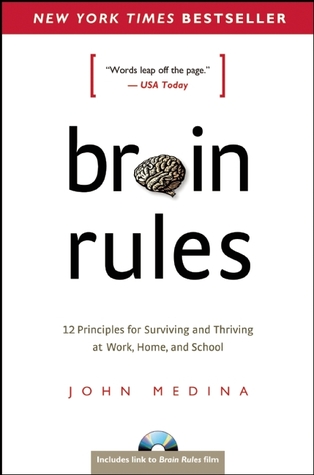
Brain Rules: 12 Principles for Surviving and Thriving at Work, Home, and School (John Medina)

2251306


The brain fascinates me. I loved this book because it explains the science in ways I can understand (I'm really not a science person!) I also liked how he added ideas for ways to implement these ideas in regular work, home and school life.


The 12 rules are:
EXERCISE | Rule #1: Exercise boosts brain power.
SURVIVAL | Rule #2: The human brain evolved, too.
WIRING | Rule #3: Every brain is wired differently.
ATTENTION | Rule #4: We don't pay attention to boring things.
SHORT-TERM MEMORY | Rule #5: Repeat to remember.
LONG-TERM MEMORY | Rule #6: Remember to repeat.
SLEEP | Rule #7: Sleep well, think well.
STRESS | Rule #8: Stressed brains don't learn the same way as non-stressed
SENSORY INTEGRATION | Rule #9: Stimulate more of the senses.
VISION | Rule #10: Vision trumps all other senses.
GENDER | Rule #11: Male and female brains are different.
EXPLORATION | Rule #12: We are powerful and natural explorers.


Goodreads summary:


Most of us have no idea what’s really going on inside our heads. Yet brain scientists have uncovered details every business leader, parent, and teacher should know—like the need for physical activity to get your brain working its best.

How do we learn? What exactly do sleep and stress do to our brains? Why is multi-tasking a myth? Why is it so easy to forget—and so important to repeat new knowledge? Is it true that men and women have different brains?

In Brain Rules, Dr. John Medina, a molecular biologist, shares his lifelong interest in how the brain sciences might influence the way we teach our children and the way we work. In each chapter, he describes a brain rule—what scientists know for sure about how our brains work—and then offers transformative ideas for our daily lives.

Medina’s fascinating stories and infectious sense of humor breathe life into brain science. You’ll learn why Michael Jordan was no good at baseball. You’ll peer over a surgeon’s shoulder as he proves that most of us have a Jennifer Aniston neuron. You’ll meet a boy who has an amazing memory for music but can’t tie his own shoes.

You will discover how:

Every brain is wired differently
Exercise improves cognition
We are designed to never stop learning and exploring
Memories are volatile
Sleep is powerfully linked with the ability to learn
Vision trumps all of the other senses
Stress changes the way we learn

In the end, you’ll understand how your brain really works—and how to get the most out of it.

Thursday, June 30, 2016

Eleven and Holding (Mary Penney)


This is the same author that wrote Counting by 7s. This is a thoughtful and beautiful book, like that one.  

I love the main character, Macy. Books like this always make me wonder if I don't give kids enough credit. They watch and make sense of things they're not told.

P. 43 I took a big, unladylike bite into my cupcake. My taste buds nearly exploded with happiness. 

Her grandmother has passed away and her business was sold to Chuck, who is friends with her mom. In the story we find out he is also mourning the loss of his partner, Phillip. Then there is Ginger, Phillip's mother, who is in and out of senility  and not quite able to process loss. 

P. 226 I guess Ginger knew that somewhere in her head, but her heart wouldn't really let her know it.  So, she kept pretending he was alive if only she could find him. 

Macy's father is away on what she is told is a secret mission in the military and her mother is a probation officer. Macy is facing moving on to middle school without her best friend, who is a year younger. 

P. 227 Sometimes when we're not ready to hear something painful, we have to keep ourselves busy not hearing it. It can look crazy, but it's not. It's just coping. We all do it differently. 

It is called Eleven and Holding because she doesn't want to turn 12 without her dad being there. She teams up with a runaway boy who is actually a client of her mother's, unbeknownst to her. What they find out changes pretty much everything. 


Goodreads summary: 

Like The Thing About Jellyfish and Counting by 7s, this sweet, heartfelt middle grade novel illustrates for readers what it’s like to tackle loss, confront hard truths, and find the courage to begin again.

Macy Hollinquest is eleven years old, and don’t count on her to change that anytime soon.

Her birthday is just days away, but she has no intention of turning twelve without her dad by her side. He’d promised to be there for her big day—and yet he’s been gone for months, away doing some kind of secret “important work” after being discharged from the Marines. So she’s staying eleven, no matter what—that is, until she meets Ginger, a nice older lady who is searching for her missing dog. Could Ginger be the perfect cover for attempting to locate her dad?

Macy’s search puts her on a path to a head-on collision with the truth, where she discovers that knowing can sometimes be a heavy burden. And that change, when finally accepted, comes with an unexpected kind of grace.

Mary Penney’s earnest, heartfelt story of change, loss, and new beginnings will resonate with readers on the cusp of new beginnings, and stay in their hearts long after it’s done.
 

Tuesday, July 29, 2014

Think Smart (Richard Restak, M.D.)

I listened to this on CD while we were traveling. It was quite interesting. The beginning talks about the best things to do for your brain's health: eat well and exercise (why is it always the same thing?!) :)
He also tells of interesting ideas for ways to increase your mental capacity. It inspired me to work on my memory and concentration skills. I have set a goal to memorize six piano songs over the next year and continue learning new words, writing, and memorizing lists.
I was particularly fascinated with his information on Alzheimer's. When people's brains were examined, after death, they discovered that there were grey areas of the brain - as if those areas of the brain were worn out. The interesting thing is they appeared in people's brains who exhibited symptoms of Alzheimer's as well as those who didn't. The difference seemed to be those who worked on brain active brain skills rather than falling into passivity in old age, as well as if they had spent their younger years learning and staying mentally engaged. Fascinating.


Goodreads Summary:

In Think Smart, the renowned neuropsychiatrist and bestselling author Richard Restak details how each of us can improve and tone our body's most powerful organ: the brain.

As an expert on the brain, Restak knows that in the last five years there have been exciting new scientific discoveries about the brain and its performance. So he has asked his colleagues—among them the world's leading brain scientists and researchers—one important question: What can I do to help my brain work more efficiently? Their surprising and remarkably feasible answers are at the heart of Think Smart.

Dr. Restak combines advice culled from cutting-edge research with brain-tuning exercises to show how individuals of any age can make their brains work more effectively. In the same accessible prose that made Mozart's Brain and the Fighter Pilot a New York Times bestseller, Restak presents a wide array of practical recommendations about a variety of topics, including the crucial role sleep plays in boosting creativity, the importance of honing sensory memory, and the neuron-firing benefits of certain foods.

In Think Smart, the man the Smithsonian Institution has called "wise, witty, and ethical" offers audiences helpful suggestions for fighting neurological decline that will put every listener on the path to building a healthier, more limber brain.