Showing posts with label gender roles. Show all posts

Monday, January 1, 2024

Molly's Tuxedo (Vicki Johnson)


This book doesn't mention being anything about LGBTQ kids, but the main character is a great role model for kids who just want to be themselves. I understand not feeling comfortable in scratchy stiff outfits! It's not about dresses....dresses are great. It's about being comfortable. At first she is questioned (girls don't wear tuxedos) but it doesn't last long....and the better we get at that, the better world it'll be, I think.

Goodreads says:

*2024 NCTE Charlotte Huck Award for Outstanding Fiction For Children Recommended Book* Molly has big plans to wear a dashing tuxedo for her school picture day—but Mom’s picked out a dress. With her friends’ support, Molly proves the way to look your best is to be yourself.

Tuesday, July 21, 2020

Nevertheless, We Persisted: 48 Voices of Defiance, Strength and Courage (So many authors)

At  first, I started to feel like this book was a bit of a downer. Every chapter is a story of someone who is an underdog. As I pressed on though, it became more and more compelling to hear their stories. They are stories of people who not only persisted, but accomplished great things despite other people. The more I read, the more inspired I was. I think this book is one of those best taken in full doses. It reminded me of reading a book by Deborah Ellis on First Nations kids called Looks Like Daylight. It wasn't until I had really buried myself in the stories that the feeling took over. This is one of those books that can change you, if you let it.

Goodreads says:

A powerful collection of essays from actors, activists, athletes, politicians, musicians, writers, and teens, including Senator Amy Klobuchar, actress Alia Shawkat, actor Maulik Pancholy, poet Azure Antoinette, teen activist Gavin Grimm, and many, many more, each writing about a time in their youth when they were held back because of their race, gender, or sexual identity--but persisted.

"Aren't you a terrorist?" "There are no roles for people who look like you." "That's a sin." "No girls allowed." They've heard it all. Actress Alia Shawkat reflects on all the parts she was told she was too "ethnic" to play. Former NFL player Wade Davis recalls his bullying of gay classmates in an attempt to hide his own sexuality. Teen Gavin Grimm shares the story that led to the infamous "bathroom bill," and how he's fighting it. Holocaust survivor Fanny Starr tells of her harrowing time in Aushwitz, where she watched her family disappear, one by one.

What made them rise up through the hate? What made them overcome the obstacles of their childhood to achieve extraordinary success? How did they break out of society's limited view of who they are and find their way to the beautiful and hard-won lives they live today? With a foreword by Minnesota senator and up-and-coming Democratic party leader Amy Klobuchar, these essays share deeply personal stories of resilience, faith, love, and, yes, persistence.

"Each tale is a soulful testament to the endurance of the human spirit and reminds readers that they are not alone in their search for self. An unflinchingly honest book that should be required reading for every young person in America."--Kirkus, Starred review

"An invaluable collection of snapshots of American society."--VOYA, Starred review

"[A] gem of a book. . . There's a lot to study here and talk about on the way to becoming kinder, more empathetic, and most important, compassionate."--Booklist

"Readers encountering injustice in their own lives may be compelled to take heart--and even action."--Publishers Weekly

"A powerful collection of voices."--SLJ

"The sheer variation in writing styles, subject-matters, and structure to these narratives provides readers with inspiration in assorted forms and a complex interpretation of what it means to persist."--The Bulletin

Wednesday, October 16, 2019

The Perfect Nanny (Leila Slimani)

This one is a quick read, but a little disturbing! I enjoyed that it was set in Paris since my daughter lives there right now. I found myself looking up places mentioned to see how close they are to where she lives.

The author did a great job of taking a story and turning it into something that really made you think. She is a journalist and this story is based on a real event that happened. I think one of the big themes was that everyone is a little disturbed and if we're not careful and don't follow our gut, we'll all end up dead! Literally. It's all wrapped up in people's inability to deal with problems in their life rather than run away from them. The nanny, whose life is messed up, presents the image of being perfect. However, it isn't long before her problems start to affect her perfect work.

I read this for my book club and most of the people at book club didn't like it, but we sure had a lot to discuss! A lot of people at book club felt like many of the themes and characters weren't developed enough, but I wondered if that was by design. After all, we all form rock-solid opinions based on the little information we get in the news.

Goodreads says:

When Myriam, a French-Moroccan lawyer, decides to return to work after having children, she and her husband look for the perfect nanny for their two young children. They never dreamed they would find Louise: a quiet, polite, devoted woman who sings to the children, cleans the family's chic apartment in Paris's upscale tenth arrondissement, stays late without complaint, and hosts enviable kiddie parties. But as the couple and the nanny become more dependent on one another, jealousy, resentment, and suspicions mount, shattering the idyllic tableau


Saturday, August 18, 2018

Educated (Tara Westover)

I read this book slowly. Sometimes I wanted to soak it up. Sometimes I could only take so much.

Part of what really drew me in was the dysfunctional traits I saw in families I know. Tara's family honors their father and even though he is clearly out of line, mentally ill and puts family members' lives in danger, the unwavering dedication to following him was an extreme example of things I've seen. Tara doesn't follow quite so easily and struggles for years as she goes in and out of feeling comfortable with that expectation. It made me uncomfortable that they were members of the church. However, she is careful to add that this isn`t a story about the church. It`s a story about family and mental illness and dysfunctional relationships. They took what the church teaches to an unhealthy extreme. I felt shame that it could be rooted in something I love but turn into something so terrible. Now she is no longer active in the church. I`m not surprised. It`s pretty impossible to grow up with abuse and have a good relationship with religion and God. Her abuse was too connected and excused by religious teachings and breaking free of that was really the only way to get healthy.

People in the family have a series of terrible accidents that are treated by oils and tinctures. Those were parts I could hardly stand.

Tara has a brother that is abusive and mentally ill. I don't know why the family defended him and let the needs of almost every one else in the family go unmet. I wanted to punch him in the face. The guy needs help and my guess is he'll end up in jail one day. I was angry at her mother for not standing up for her children. All through the book the family is preparing for the Day of Abomination. I felt like the mother was an abomination. She stood by her mentally ill husband even though there are windows of time where she admits he is fallible. She even stands by him when he for some absurd reason, refuses to admit (first I wrote see....but you can't tell me he couldn't see it) the abuse his son, Shawn dealt. Why do some parents do that? It is incomprehensible to me - but then again, it is something I`ve seen to a lesser extreme. Still, it makes me reel.

I loved that Tara is saved by education. Even though she never went to school, she learns to learn and goes to BYU to learn. She had to learn how to take tests, the importance of text books, and she had her mind opened to many things that we take for granted. She was saved by finally becoming educated, along with two of her brothers. It was truly a miracle.

p. 180 I did not think of my brother as that person; I doubt I will ever think of him that way. But something had shifted nonetheless. I had started on a path of awareness, had perceived something elemental about my brother, my father, myself. I had discerned the ways in which we had been sculpted by a tradition given to us by others, a tradition of which we were either willfully or accidentally ignorant. I had begun to understand that we had lent our voices to a discourse whose whole purpose was to dehumanize and brutalize others - because nurturing that discourse was easier, because retaining power always feels like the way forward.
     I could not have articulated this, not as I sweated through those searing afternoons in the forklift. I did not have the language I have now. But I understood this one fact: that a thousand times I had been called Nigger, and laughed and now I could not laugh. The word and the way Shawn said it hadn`t changed; only my ears were different. They no longer heard the jingle of a joke in it. What they heard was a signal, a call through time, which was answered with a mounting conviction: that never again would I allow myself to be made a food soldier in a conflict I did not understand.

Throughout the story, when she is away at BYU and then Cambridge, she doesn`t tell people much about her family. She hides their truths. Her mother abandons and allows her to be in danger when working with her dad and abused by her brother. Instead of feeling rage, Tara feels shame. However, along the way something clicks that causes a change:

p. 273 I told them I`d been poor. I told them I`d been ignorant, and in telling them this I felt not he slightest prick of shame. Only then did I understand where the shame had come from: it wasn`t that I hadn`t studied in a marble conservatory, or that my father wasn`t a diplomat. It wasn`t that Dad was half out of his mind, or that Mother followed him. It had  come from having a father who shoved me toward the chomping blades of the Shear, instead of pulling me away from them. It had come from those moments on the floor, from knowing that Mother was in the next room, closing her eyes and ears to me, choosing, for that moment, not to be my mother at all.

Her brother, Tyler, finally gets it and stands up. In the end, although he recognizes the abuse, he doesn`t distance himself totally from the family. What he said to Tara though was so true:

p. 316 Our parents are held down by chains of abuse, manipulation, and control....They see change as dangerous and will exile anyone who asks for it. This is a perverted idea of family loyalty...they claim faith, but this is not what the gospel teaches. Keep safe. We love you.

Tara has to become a new person to survive. She has to separate herself from her parents and now has no relationship with them. So many times when she`d go back to her family I wanted to scream, `Don`t go!` The compelling ties to family make living a healthy life really difficult for her. I get that. I feel for her. Finally, in the end, she decided she could not live a healthy life with them in it.

p. 328 If there was a single moment when he breach between us, which had been cracking and splintering for two decides, was at least too vast to be bridged, I believe it was that winter night, when I stared at my reflection in the bathroom mirror, while, without m knowing it, my father grasped the phone in his knotted hands and dialed my brothe, Diego, the knife. What followed was very dramatic. But the real drama had already played out in the bathroom.
     It had played out when, for reasons I don`t understand, I was unable to climb through the mirror and send out my sixteen-year-old self in my place.
     Until that moment she had always been there. No matter how much I appeared to have changed - how illustrious my education, ow altered my appearance - I was still her. At best I was two people, a fractured mind. She was inside, and emerged whenever I crossed the threshold of my father`s house.
     That night I called on her and she didn`t answer. She left me. She stayed in the mirror. The decisions I made after that momet were not the ones she would have made. They were the choices of a changed person, a new self.
     You could call this selfhood many things. Transformation. Metamorphosis. Falsity. Betrayal.
     I can it an education.
I found myself googling information about this family after I finished the book. Are they real? Do they really run a health business? Where are her parents now? It looks like they're still denying everything.They also run a huge business.


Goodreads says:

An unforgettable memoir in the tradition of The Glass Castle about a young girl who, kept out of school, leaves her survivalist family and goes on to earn a PhD from Cambridge University

Tara Westover was 17 the first time she set foot in a classroom. Born to survivalists in the mountains of Idaho, she prepared for the end of the world by stockpiling home-canned peaches and sleeping with her "head-for-the-hills bag". In the summer she stewed herbs for her mother, a midwife and healer, and in the winter she salvaged in her father's junkyard.

Her father forbade hospitals, so Tara never saw a doctor or nurse. Gashes and concussions, even burns from explosions, were all treated at home with herbalism. The family was so isolated from mainstream society that there was no one to ensure the children received an education and no one to intervene when one of Tara's older brothers became violent.

Then, lacking any formal education, Tara began to educate herself. She taught herself enough mathematics and grammar to be admitted to Brigham Young University, where she studied history, learning for the first time about important world events like the Holocaust and the civil rights movement. Her quest for knowledge transformed her, taking her over oceans and across continents, to Harvard and to Cambridge. Only then would she wonder if she'd traveled too far, if there was still a way home.

Educated is an account of the struggle for self-invention. It is a tale of fierce family loyalty and of the grief that comes with severing the closest of ties. With the acute insight that distinguishes all great writers, Westover has crafted a universal coming-of-age story that gets to the heart of what an education is and what it offers: the perspective to see one's life through new eyes and the will to change it.

Saturday, June 30, 2018

Meghan: A Hollywood Princess (Andrew Norton)

Let the summer reading begin!! This was a fun and relaxing way to start my summer reading.

I am a royal follower, for sure.  I hope what the author write is true. Meghan sounds like a lovely person who will be a wonderful wife for Harry.

Goodreads says:
 From Andrew Morton, the New York Times bestselling author of Diana: Her True Story, comes a revealing, juicy, and inspiring biography of Meghan Markle, the American actress who won Prince Harry's heart.

When Meghan Markle and Prince Harry were set up by a mutual friend on a blind date in July 201, little did they know that the resulting whirlwind romance would lead to their engagement in November 2017 and marriage in May 2018.

Since then, our fascination with the woman who has smashed the royal mold has rocketed. So different from those coy brides of recent history, Meghan is confident, charismatic, and poised; her warm and affectionate engagement interview won the hearts of the world.

In this first-ever biography of the duchess-to-be, acclaimed royal biographer, Andrew Morton, goes back to Meghan's roots to uncover the story of her childhood growing up in The Valley in Los Angeles, her studies ta an all-girls Catholic school, and her fraught family life - a painful experience mirrored by Harry's own background. Morton also delves into her previous marriage and divorce in 2018, her struggles in Hollywood as her mixed heritage wasa time and again used against her, her big break in the hit TV show Suits, and her work for a humanitarian ambassador - the latter so reminiscent of Princess Diana's passions. Finally, we see how the royal romance played out across two continents but was kept fiercely secret, efore the news finally broke and Meghan was thrust into the global media's spotlight like never before.

Drawing on exclusive interviews with her family members and closest friends, and including never-before-seen photographs, Morton introduces us to the real Meghan as he reflects on the impact that she has already had on the rigid traditions of the House of Windsor, as well as what the future might hold.

Tuesday, March 27, 2018

Daring Greatly (Brené Brown)


Reread March 27, 2018
I listened to the audio tape while driving back from Kelowna. Often when I read, I like to make connections to my studies of the gospel of Jesus Christ. I kept thinking, as I was listening, that this all relates to many lessons I have heard and studied about hope. Then, at the end, she talked about the connections to hope. 

This is a great book: well worth re-reading again.

Originally read June 29, 2016
My sister-in-law has talked a lot about this author and then I started noticing her name pop up in all sorts of different places.  The admiration is well deserved. She definitely has some good stuff in this book. It is the kind of book I should read and re-read. I bought this one because I found a book study group that was discussing it over three months. We went to the discussions. It really held me to think a little deeper about the concepts. 

Great quotes:

P. 8 Connection is why we're here. We are hardwired to connect with others, it's what gives purpose an meaning to our lives, and without it there is suffering."

"P. 25 Lynne Twist (The Soul of Money): For me, and for many of us, our first waking thought of the day is "I didn't get enough sleep." The next one us "I don't have enough time." Whether true or not...We spend most of our days.....worrying we don't have enough....this internal scarcity...lives at the very heart of our jealousies, or greed, our greed, our prejudices, and our arguments with life."

P. 53 Trust is a product of vulnerability that grows over time an requires work, attention, and full engagement. Trust isn't a grand gesture-it's a a marble collection.

P. 113 Masks make us feel safer even when they become suffocating. Armour makes us feel stronger even when we grow weary from dragging the weight around. The irony is that when we're standing across from someone who is hidden or shielded by masks and armour, we feel frustrated and disconnected. That's the paradox here: vulnerability is the last thing I want you to see in me, but the first thing I look for in you. 

P. 133 Don't let perfect be the enemy of the good (Cribbed from Voltaire). A twenty minute wake that I do us better than the four-mike run that I don't do. The imperfect book that gets published us better than the perfect book that never leaves my computer. The dinner party of take-out Chinese food is better than the elegant dinner that I never host.

P. 137 There's a crack in everything. That's how the light gets in. - Leonard Cohen

P. 231 ....fitting in and belonging are not the same thing. In fact, fitting in is one of the greatest barriers to belonging. Fitting in is about assessing a situation and becoming who you need to be in order to be accepted. Belonging, on the other hand doesn't require us to change who we are; it requires us to be who we are. 

P. 243 Sometimes the bravest and most important thing you can do us just show up.

Goodreads Summary:


Researcher and thought leader Dr. Brené Brown offers a powerful new vision that encourages us to dare greatly: to embrace vulnerability and imperfection, to live wholeheartedly, and to courageously engage in our lives.

“It is not the critic who counts; not the man who points out how the strong man stumbles, or where the doer of deeds could have done them better. The credit belongs to the man who is actually in the arena, whose face is marred by dust and sweat and blood; who strives valiantly; . . . who at best knows in the end the triumph of high achievement, and who at worst, if he fails, at least fails while daring greatly.” —Theodore Roosevelt

Every day we experience the uncertainty, risks, and emotional exposure that define what it means to be vulnerable, or to dare greatly. Whether the arena is a new relationship, an important meeting, our creative process, or a difficult family conversation, we must find the courage to walk into vulnerability and engage with our whole hearts.

In Daring Greatly, Dr. Brown challenges everything we think we know about vulnerability. Based on twelve years of research, she argues that vulnerability is not weakness, but rather our clearest path to courage, engagement, and meaningful connection. The book that Dr. Brown’s many fans have been waiting for, Daring Greatly will spark a new spirit of truth—and trust—in our organizations, families, schools, and communities.
 

Wednesday, February 15, 2017

The Storytelling Princess (Rafe Martin)


This was a great read aloud! My students gasped at the right times and chuckled at the right times. They really got a kick out of the story. It kind of reminded me of a Bill Peet story. There are lots of twists and turns and it's longer than you might think a picture book should be - but it sure works well!

I loved that the princess was a strong character. I also loved that they both loved to read and knew many many stories!

At the end, we talked about the lesson from the story. I said perhaps the lesson was that we should always listen to our parents, after all, she ended up marrying the prince that they had picked for her. One student wisely responded that maybe the lesson is that we should trust kids because they'll make the right decision if we let them. Wisdom!

Goodreads summary:

Having survived a shipwreck, a princess tries to tell a prince a story whose ending he does not know and thus qualify for his hand in marriage.

Wednesday, October 26, 2016

I Am Malala (Malala Yousafzai)

I read this book for book club. It was my turn to choose a book and I've dabbled in this one a number of times (Goodreads says I started reading it Aug 20, 2015!) so I decided it was a good one to pick to read and discuss. In the end, I think it was a good book to discuss at book club.

When I read this book, I was struck by her love for education and had to think about how many of us take the opportunities we have for granted.

It was interesting to read an account of what life was like as the Taliban gradually took over.  Honestly, I'm not sure I would have been as valiant a fighter and she and her father have been. They have lived their life in danger simply because they value education, choice, religion and the freedom to choose. I hesitate to be judgmental, but I really wondered about parents who would allow their child to be so outspoken. Clearly, she suffered the consequences. In the end though, she is a hero. I do not know if I'd be as brave as she and her family has been.

Goodreads summary:

I come from a country that was created at midnight. When I almost died it was just after midday.

When the Taliban took control of the Swat Valley in Pakistan, one girl spoke out. Malala Yousafzai refused to be silenced and fought for her right to an education.

On Tuesday, October 9, 2012, when she was fifteen, she almost paid the ultimate price. She was shot in the head at point-blank range while riding the bus home from school, and few expected her to survive. 

Instead, Malala's miraculous recovery has taken her on an extraordinary journey from a remote valley in northern Pakistan to the halls of the United Nations in New York. At sixteen, she has become a global symbol of peaceful protest and the youngest-ever Nobel Peace Prize laureate.

I Am Malala is the remarkable tale of a family uprooted by global terrorism, of the fight for girls' education, of a father who, himself a school owner, championed and encouraged his daughter to write and attend school, and of brave parents who have a fierce love for their daughter in a society that prizes sons.

I Am Malala will make you believe in the power of one person's voice to inspire change in the world.

Saturday, July 16, 2016

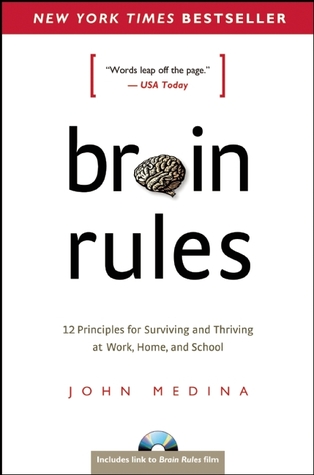
Brain Rules: 12 Principles for Surviving and Thriving at Work, Home, and School (John Medina)

2251306


The brain fascinates me. I loved this book because it explains the science in ways I can understand (I'm really not a science person!) I also liked how he added ideas for ways to implement these ideas in regular work, home and school life.


The 12 rules are:
EXERCISE | Rule #1: Exercise boosts brain power.
SURVIVAL | Rule #2: The human brain evolved, too.
WIRING | Rule #3: Every brain is wired differently.
ATTENTION | Rule #4: We don't pay attention to boring things.
SHORT-TERM MEMORY | Rule #5: Repeat to remember.
LONG-TERM MEMORY | Rule #6: Remember to repeat.
SLEEP | Rule #7: Sleep well, think well.
STRESS | Rule #8: Stressed brains don't learn the same way as non-stressed
SENSORY INTEGRATION | Rule #9: Stimulate more of the senses.
VISION | Rule #10: Vision trumps all other senses.
GENDER | Rule #11: Male and female brains are different.
EXPLORATION | Rule #12: We are powerful and natural explorers.


Goodreads summary:


Most of us have no idea what’s really going on inside our heads. Yet brain scientists have uncovered details every business leader, parent, and teacher should know—like the need for physical activity to get your brain working its best.

How do we learn? What exactly do sleep and stress do to our brains? Why is multi-tasking a myth? Why is it so easy to forget—and so important to repeat new knowledge? Is it true that men and women have different brains?

In Brain Rules, Dr. John Medina, a molecular biologist, shares his lifelong interest in how the brain sciences might influence the way we teach our children and the way we work. In each chapter, he describes a brain rule—what scientists know for sure about how our brains work—and then offers transformative ideas for our daily lives.

Medina’s fascinating stories and infectious sense of humor breathe life into brain science. You’ll learn why Michael Jordan was no good at baseball. You’ll peer over a surgeon’s shoulder as he proves that most of us have a Jennifer Aniston neuron. You’ll meet a boy who has an amazing memory for music but can’t tie his own shoes.

You will discover how:

Every brain is wired differently
Exercise improves cognition
We are designed to never stop learning and exploring
Memories are volatile
Sleep is powerfully linked with the ability to learn
Vision trumps all of the other senses
Stress changes the way we learn

In the end, you’ll understand how your brain really works—and how to get the most out of it.

Sunday, July 3, 2016

I Feel Bad About My Neck (Nora Ephron)


This lady is hilarious. She is the author of the screenplays When Harry Met Sally, Sleepless in Seattle and You've Got Mail. Can you imagine having writing all those screenplays and having them turned into movies??

She has led a bit of a privileged life and has been successful in her own life. As a result, she talks about some things that I just didn't relate to. She has been divorced more than once and has chapters on face lifts, manicures and interactions with famous people like Martha Stewart, JFK and Bill Clinton. 

However, she also had a lot of stuff that regular people can relate to and get a good chuckle out of. 

Some favourite parts: 

p. 51 My children thought calling Directory Assistance was free, on top of which they always pressed "1" to be connected, for an additional charge of thirty-five cents. This drove me even crazier. (Remember this?? Does 411 even exist anymore??!)

p. 52. Mostly I'm sad about just plain reading. When I pass a bookshelf, I like to pick out a book from it and thumb through it. When I see a newspaper on the couch, I like to sit down with it. When the mail arrives I like to rip it open. Reading is a part of the main things I do. Reading is everything. Reading makes me feel l Iike I have accomplished something, learned something, become a better person. Reading makes me smarter. Reading gives me something to talk about later on. Reading is the unbelievably healthy way my attention deficit disorder medicates itself. Reading is escape, and the opposite of escape; it's a way to make contact with reality after a day of making things up, and it's a way of making contact with someone else's imagination after a day that's all to real. Reading is grist. Reading is bliss. But my ability to pick something up and read it -which has gone unchecked all my life up until now-is not entirely dependent on the whereabouts of my reading glasses. I look around. Why aren't they in this room? I bought six pair of them last week on sale and sprinkled them throughout the house, yet none of them is visible. Where are they?
I hate that I need reading glasses. I hate that I can't read a word in the map, in the telephone book, on the many, in the book or anywhere else without them. And the pill bottle! I forgot to mention the pill bottle. I can't read a word on the pill bottle. Does it say take two every four hours or four every two hours? Does it say good until 12/08/07 or "Expired. Period. End of story"? I have no idea what it says, and this is serious. I could die from not being able to read the print in the pill bottle. In fact, the print on the pill bottle is so small I doubt if anyone can read it. I'm not sure I could read it even when I didn't need reading glasses. Although, who can remember?

p. 83 Why hadn't I realized how much I thought of a love was simply my own highly develop gift for making lemonade?

p. 88 now that I have read the articles about Mimi Fahnestock, it has become horribly clear to me that I am probably the only young woman who ever worked in the Kennedy White Hiuse that the president did not make a pass at. Perhaps it was my permanent wave, which was a truly unfortunately mistake. Perhaps it was my wardrobe, which mostly consisted of multicoloured Dynek dress that looked like distilled Velveta cheese. Perhaps it's because I'm Jewish. Don't laugh; think about it-think about the king list of women that JFK slept with. Were any of them Jewish? I don't think so. 
On the other hand, perhaps nothing happened between us because JFK somehow sensed that discretion was not my middle name. I mean, I assure you that if anything had gone on between us, you would have had to wait this long to find out. 

P. 95 ...there is an expression for what I am-a mouse potato. It means someone who's as connected to her computer as couch potatoes are to their television sets. 

She also has pages with long lists of advice and her life's lesson. It all brought a smile to my face. 

If you need some easy entertainment, this book is a great pick. 

Goodreads summary: 

With her disarming, intimate, completely accessible voice, and dry sense of humor, Nora Ephron shares with us her ups and downs in "I Feel Bad About My Neck, " a candid, hilarious look at women who are getting older and dealing with the tribulations of maintenance, menopause, empty nests, and life itself.
The woman who brought us "When Harry Met Sally . . ., Sleepless in Seattle, You've Got Mail, "and" Bewitched, " and the author of best sellers "Heartburn, Scribble Scribble, " and "Crazy Salad, " discusses everything--from how much she hates her purse to how much time she spends attempting to stop the clock: the hair dye, the treadmill, the lotions and creams that promise to slow the aging process but never do. Oh, and she can't stand the way her neck looks. But her dermatologist tells her there's no quick fix for that.
Ephron chronicles her life as an obsessed cook, passionate city dweller, and hapless parent. She recounts her anything-but-glamorous days as a White House intern during the JFK years ("I am probably the only young woman who ever worked in the Kennedy White House that the President did not make a pass at") and shares how she fell in and out of love with Bill Clinton--from a distance, of course. But mostly she speaks frankly and uproariously about life as a woman of a certain age.
Utterly courageous, wickedly funny, and unexpectedly moving in its truth telling, "I Feel Bad About My Neck" is a book of wisdom, advice, and laugh-out-loud moments, a scrumptious, irresistible treat.
 (less)


Wednesday, March 30, 2016

I Know Why the Caged Bird Sings (Maya Angelou)


This is one of those books I had thought I should read for a long time. It's also a book that it's great that we read it for book club because I got so much more out of discussing it than just reading it on my own. Some books do not foster a lot of discussion. This book is the exact opposite! There were so many themes to discuss. At our book club meeting, we didn't really get past segregation and prejudice. Those are big ones! 

Other potential great discussions:

Home: Maya and her brother live in many different homes. They are mainly raised by their grandma but have times where they try living with their mother and with their father, who are not together. Many pivotal moments occur because of their lack of a "home".

Rising from the ashes: Maya isn't penned in by the beliefs of society and the people around her. She is matter of fact about her optimism to do anything anyone else can do.

Matriarchal Society: Men in this story are not positive role models in Maya's life (except for her brother, Brother and her Uncle). Women forge on and succeed despite their place in society.

Literature: Books save Maya. Her first love is William Shakespeare. She is well read and highly influenced by literature.

Beauty: Maya thinks she is ugly. She wishes to be whiter in order to be more beautiful. 


I think we could have had a couple of book club meetings on this book!


Sent by their mother to live with their devout, self-sufficient grandmother in a small Southern town, Maya and her brother, Bailey, endure the ache of abandonment and the prejudice of the local "powhitetrash." At eight years old and back at her mother’s side in St. Louis, Maya is attacked by a man many times her age—and has to live with the consequences for a lifetime. Years later, in San Francisco, Maya learns that love for herself, the kindness of others, her own strong spirit, and the ideas of great authors ("I met and fell in love with William Shakespeare") will allow her to be free instead of imprisoned.

Poetic and powerful, I Know Why the Caged Bird Sings will touch hearts and change minds for as long as people read.
 

Goodreads summary about Maya's life:

Maya Angelou, born Marguerite Ann Johnson April 4, 1928 in St. Louis, Missouri, was an American poet, memoirist, actress and an important figure in the American Civil Rights Movement. In 2001 she was named one of the 30 most powerful women in America by Ladies Home Journal. Maya Angelou is known for her series of six autobiographies, starting with I Know Why the Caged Bird Sings, (1969 which was nominated for a National Book Award and called her magnum opus. 

Saturday, February 13, 2016

Controlling People (Patricia Evans)


Interesting perspective on why some people feel the need to be controllers. Would have liked more insight on how to deal with people who treat you poorly and are controlling. This book was a good one to start on this topic. 

I listened to the audio book.

Goodreads summary:

Learn how to 'break the spell' of control with Patricia Evans' new bestseller. Already hailed by Oprah Winfrey, "Controlling People" deals with issues big and small - revealing the thought processes of those who seek to control in order to provide a 'spell-breaking' mind-set for those who suffer this insidious manipulation. Invaluable insight and advice for those who seek support. (less)


Monday, February 8, 2016

A Telling Time (Irene Watts)


Sometimes you pull a book off the library's shelf and it's a win. Sometimes it's not. This one wasn't so great for our class. The story is quite deep and requires a lot of background knowledge of the story of Purim, Queen Esther and more. My kids were totally lost.

Our read a book a day goal is a real benefit to when we have Reading Buddies with the grade ones. They have many books that have been read to them and they're familiar with and as a result, they do a little better job reading with their  buddies. I don't think I'll put this one on the shelf for that. Just won't work for Reading Buddies.

Quite a beautiful story if you are familiar with those topics though!


This tale is told in three time-frames. On the eve of the Festival of Purim, a grandmother tells her granddaughter how, as a little girl, she heard the story of Queen Esther from her family rabbi. This was in 1939, in Nazi-occupied Vienna, on the eve of WWII. Soon after the rabbi begins the story of the brave queen, soldiers come to arrest him. The young girl begs for the rabbi to finish his story, and the soldiers allow him to do so. When the tale is over, the soldiers permit him to send the children home. But when the children turn to wave goodbye, the rabbi had vanished in the snowflakes, safe from harm, saved by the miracle of a story from long ago. The illustrations by Kathryn Shoemaker perfectly highlight the story's message of hope. 

Wednesday, August 12, 2015

The Wife, The Maid and The Mistress (Ariel Lowhon)


I learned about this book from one of my favourite podcasts, Books on the Nightstand: https://itunes.apple.com/ca/podcast/books-on-the-nightstand/id278076085?mt=2&i=347675868

In the podcast, the author tells a great follow up story to the book. 

I really loved this book. I had trouble, at first, keeping all the characters straight. I am glad I stuck with it though. There were a number of times I responded out loud with gasps or laughter to things happened in the story. This is a great mystery. It is based on a real life account, still unsolved, of someone who went missing in the 1930's.

Goodreads summary:
One summer night in 1930, Judge Joseph Crater steps into a New York City cab and is never heard from again. Behind this great man are three women, each with her own tale to tell: Stella, his fashionable wife, the picture of propriety; Maria, their steadfast maid, indebted to the judge; and Ritzi, his showgirl mistress, willing to seize any chance to break out of the chorus line.

As the twisted truth emerges, Ariel Lawhon’s wickedly entertaining debut mystery transports us into the smoky jazz clubs, the seedy backstage dressing rooms, and the shadowy streets beneath the Art Deco skyline.
(less)


Wednesday, July 15, 2015

Longbourn (Jo Baker)


I really loved this book and it's perspective. This is the story of the servants from Pride and Prejudice. I don't have much patience for people with money who are so concerned about things that really don't matter, especially the women who are so focused on looks and clothes and appearing to be proper and meet the approval of other fancy folk and the biggest goal of all: marriage. I have little patience for it all! I do, though, relate quite well to the feelings, work ethics and opinions of the servants!

The story is called Longbourn because that is the name of the house. The characters from Pride and Prejudice are background in this story. I would say that Mr. Bennett probably has the biggest role, while still remaining in the background. There are entertaining twists that add to the original story of Pride and Prejudice.

All of the story is not chronilogical. It is in the first two parts, but the third part rewinds and tells you the story behind James Smith. I was a little lost there when I read that, but it eventually is clear. You know really have to know Pride and Prejudice well to enjoy this book.

The servants are: 
Mrs. Hill - she basically runs the house
Mr. Hill - kind of an absent and seemily dotty old man. In the end we discover that theirs was a marriage of convenience as Mr. Hill was gay.
Polly - an orphan lucky enough to be spared the bleak fate that otherwise often awaited such girls (the streets, the poorhouse, a life of virtual slavery).
Sarah - a housemaid
James Smith - the footman who joins the "family" 


If Elizabeth Bennet had the washing of her own petticoats, Sarah often thought, she’d most likely be a sight more careful with them.
 
In this irresistibly imagined belowstairs answer to Pride and Prejudice,the servants take center stage. Sarah, the orphaned housemaid, spends her days scrubbing the laundry, polishing the floors, and emptying the chamber pots for the Bennet household. But there is just as much romance, heartbreak, and intrigue downstairs at Longbourn as there is upstairs. When a mysterious new footman arrives, the orderly realm of the servants’ hall threatens to be completely, perhaps irrevocably, upended. 

Jo Baker dares to take us beyond the drawing rooms of Jane Austen’s classic—into the often overlooked domain of the stern housekeeper and the starry-eyed kitchen maid, into the gritty daily particulars faced by the lower classes in Regency England during the Napoleonic Wars—and, in doing so, creates a vivid, fascinating, fully realized world that is wholly her own. 

Passages I want to remember:

There is great excitement about a new servant that has come to Longbourne:

Page 34 He looked at her now. She met his look, and raised her eyebrows. Then she spun away and strode off to help Polly lay the kitchen table. She had succeeded in drawing his attention at last. It gave her surprisingly little satisfaction.

P. 39 Sarah, reflecting on James: He was such an exciting mixture of helpfulness, courtesy and in civility that she could indeed form no clear notion of him. One thing, though, she was certain: he was lying. He as not what he pretended to be. He might have fooled everybody else at Longborurn, but he did not fool her. Not for one minute.

P. 45 But now there was this, the invitation to a Family Dinner, and Mrs. B. was already in a fluster about fish and soup, because a Family Dinner was of course more difficult to get right than a formal one. You had to impress, but at the same time you had to look like you were not trying to impress at all. It had to be excellent, and it also had to seem as though it was how they were all used to dining every day.

The girls who work at Longbourn watch the life their employers have. They work very hard and long for some of the pleasures they see.
P. 55 Sarah dropped her voice, whispered, "That's what I mean: somewhere you could just be, and not be obliged to do, somewhere where you could be alone, and nobody wants or expects anything of you, just for a while, at least."

Love the description of discovering a  gift of time: 
P. 36 Polly sat down at the table and rested her cheek on her folded arms. Sarah, still dozy herself, took up the hearth brush and was about to hunker down and sweep the fallen cinders, but then she stopped short. The hearth was clean, the range gleamed, the fire was bright and crackling with new wood. She glanced at the log basket. It was full.

Someone had been up early.

Water next. She leaned into the scullery to lift her yoke. Candlelight fell through the open doorway, and caught on the inner shelsls of the wide wooden pails. She crouched to touch: her fingers came away wet. Straightening, she brushed her hand down her apron, then crossed over to the water-tank and laid her hand on the lead. She could feel the cold weight of water pressing out against the metal skin. Someone had mended the fire, and then fetched the water; they had filled the tank right up to the brim.

A brownie. A helpful little lubber fiend. They'd never had one if them before....

..and then she take this little gift (from James Smith, by the way!) to enjoy the beauty of the morning


On the handicaps of being too well off:
P. 57  It was one of those handicaps that afflicted gentlefolk, that they could not open a door for themselves nor get in or out of a coach without someone to assist them.

On people who think they are indispensable:
p. 104

....Behind her, in her absence, the house was grinding along, its cogs turning and teeth linking, belts creaking, and there must come a moment - any moment now - when a cog would bite on nothing, and spin on air: some necessary act would go unperformed, some service would not be provided; the whole mechanism would crunch and splinter and shriek out in protest, and come to a juddering halt, because she was not here. All the time she was pulling further and further away, like a spindle twisting out upon a thread of flax. Pull far enough, twist and stretch it too thing, and the thread would snap.

(It doesn't. But she does get a slap upside the head for not being where she was supposed to be.)

....she was off with Ptomely! ...and even tried smoking! :)

Even though their life is hard, the servants seems mostly satisfied with it. Sarah seems to express the most discontent, although, Mrs. Hill does here and there:
p. 108 And yet, and yet, the feeling still could not quite be quelled: there was also the fact of her, herself. Would she, at some time, have the chance to care for his own things, her own comforts, her own needs, and not just for the other people's? Could she one day have what she wanted rather than rely on the glow of other people's happiness to keep her warm?

Later Mrs. Hill says:
p. 269 Life was, Mrs. Hill had come to understand, a trial by endurance, which everybody, eventually, failed.

It's interesting to see the different take by Sarah to things most people consider accepted. She is taking to a minister:
p. 112 "I work hard." she shifted on her feet. "I try to be good. I do as I am told."
"Well, you do your duty then, and that's just as it should be. Work is sanctified and sanctifying. Consider the Parable of the Vineyard."
She nodded, though uncertain. That story was about being as well rewarded for doing very little as you were doing a great deal: it always made Sarah feel dispirited, and hopeless.
"But what about Martha?" she asied. "From Marths' story don't we learn hat there must be pause, that there must be time to listen and be still, and to learn."
"Ah, yes -" His eyes narrowed at her.
"And what about the Lilies of the field, that neither toiled nor spun nor did anything very much at all?"
"Yes, yes, but - you must see that to work is your duty, and like all of us you will find satisfaction in doing your duty."
"But it doesnot make me satisfied -" Sarah wanted to stamp. "It makes me feel tired and sore, and though I work so hard, it seems I cannot even take a moment, even a moment's pleasure, but I am scolded and found to be in he wrong."
"Pleasure?" Mr. Collins moved towards her, eyes wide now. He smelt of bed, and hair-oil and bad teeth. "Have you committed some error, my child?"

He goes on to question her as to what she might have done that wasn't proper. She considers life recently and confesses that she spoke with the neighbour's footman - but he can't seem to find much fault with that.

It wasn't wrong and it wasn't really a pleasure, but it makes her realize that pleasure could be something she could seek. It changes her attitude towards her duty and makes her want more from life.

While delivering a message, she hitches a ride with Ptomely, the neighbor's footman. She has been told to ignore him, so clearly she is not following what she has been told, but she delights in her little rule breaking.
P. 120 She trudged up to the village street, huddled inot herself; it was like a poke of hot chestnuts to carry with her, the knowledge that she had done this. She had done what she had been forbidden to do, and she had got away with it unseen, and nobody at Longbourn would ever know! She was so wrapped up in gleeful contemplation of her misdeed, that she did not notice the figure on the high path through the fields, who stood in a sodden coat, watching her from beneath a dripping hat brim.
(It was James Smith!)

It is interesting how some of these people aren't even noticed by the people of Pride and Prejudice. James Smith is a character that Jo Baker created. In the story he goes away. Sarah longs to know where he went and asks. When she asks the Bennet girls they hardly know who she is talking about.
p. 280 Relaying trays to and from Mrs. Bennet, running into Meryton to leave or collect letters, brushing past the neighbours and the neighbours' servants in the street, all of them looking for a nugget, a crumb, some little thing to help sustain the lumbering gossip-golem that Lydia's actions had conjured into being, and all he time with the loss of James gnawing at her: this had all become quite normal.
"No one even mentions him at all now," she said, one day, to Mrs. Hill. "He may as well have never been here at all."
"This is certainly not true."
"But he was somebody. He was."
"Sarah, I know."
"But you don't do anything." Sarah pushed back her chair. "I'm going looking for him."


Sunday, May 31, 2015

Wild (Cheryl Strayed)

Good Reads summary:

At twenty-two, Cheryl Strayed thought she had lost everything. In the wake of her mother’s death, her family scattered and her own marriage was soon destroyed. Four years later, with nothing more to lose, she made the most impulsive decision of her life. With no experience or training, driven only by blind will, she would hike more than a thousand miles of the Pacific Crest Trail from the Mojave Desert through California and Oregon to Washington State — and she would do it alone.Told with suspense and style, sparkling with warmth and humor, Wildpowerfully captures the terrors and pleasures of one young woman forging ahead against all odds on a journey that maddened, strengthened, and ultimately healed her. 


This book is a story of a woman trying find herself. After her mother's death, breakdown of her marriage and sibling relationships, she decides it is time to go find herself by hiking the Pacific Crest Trail. 


P. 31 Blood is thicker than water, my mother had always said when I was growing up, a sentiment I'd often disputed. But it turned out it didn't matter whether she was right or wrong. They both flowed out of my cupped palms.

It took me way longer to read this book than it should have. I kept having to put it down because Cheryl Strayed stressed me out! 

I was disturbed by things this girl did and I worried about her....I had to take breaks but I also couldn't stop reading. I had to make sure she was going to be okay. From riding with hitch hikers to losing her boot and walking in duct tape to having no money to waking up to being covered in frogs to sex with strangers (although, there isn't as much of that as I originally worried) to losing her toenails. I reeled at the way she chose to make connections:

P. 269  Speaking of her mother: It felt like she was with me always, metaphorically at least. And in a way it was literal too. When we'd finally laid down that tombstone and spread her ashes into the dirt, I hadn't spread them all. I'd kept a few of the largest chunks in my hand. I'd stood for a long while, not ready to release theem to the earth. I didn't release them. I never would.
I put her burnt bones into my mouth and swallowed them whole.


The story starts off with her mother dying. I read that chapter as my mother was in the hospital getting a pacemaker. I had to take a break from reading because the idea of losing one's mother was a little too real in that moment. 

Her stories of what life was like with her siblings seemed so (potentially) real to me. It was heartbreaking. Her mother dying fractured her family.

She talked about getting divorced from her husband even though she loved him. She respected him. He felt the same about her, it seems - but somehow their life fell apart. Her story seemed so real and so relatable. It is frightening how quickly life and marriage can unravel. 

Cheryl Strayed has a great talent for evoking emotion. When I read about how fun her step dad was when they first met him, I smiled and laughed out loud. When I read about her having to put her mother's horse down I felt like I had to turn away. I was horrified. 

There was great symbolism as well. The pack that she carries is way to heavy for her - symbolic, I think of how she carried emotions way too heavy for herself as well.

So much regret in this book. She remembers her mother, on her deathbed, bemoaning the fact that she was always responsible towards someone, whether it was as a daughter, wife or mother:
P. 273 "I never got to be in the drivers seat of my own life," she'd wept to me.....I've never just been me."

Cheryl, in the other hand, learns to be comfortable with and by herself. That was one great triumph of her experience: 
...I liked him perhaps a thousand times.....For once I didn't ache for a companion. For once the phrase a woman with a hole in her heart didn't thunder in my head. That phrase, it didn't even live for me anymore.

Re: drugs and finding herself while on the trail p. 290 I'd finally come to understand that what it had. Been: a yearning for a way out, when actually what I had wanted was to find a way in. I was there now. Or close.

This is a great story. I totally recommend it, if you can hack the journey!

Warning: swearing is kind of commonplace in this book. While the author doesn't describe sex scenes in detail, there are a number of instances of casual sex

Sunday, April 5, 2015

Wheels of Change (Darlene Beck Jacobsen)

This is a great book to introduce to young students. The history of women and women's rights is fascinating. This story exemplifies well how change is difficult for some and simply takes time. It also requires some people to stand up, speak up and go against the norm.

Goodreads Summary:
Racial intolerance, social change, and sweeping progress make 1908 Washington, D.C., a turbulent place to grow up in for 12-year-old Emily Soper. For Emily, life in Papa’s carriage barn is magic, and she's more at home hearing the symphony of the blacksmith’s hammer than trying to conform to the proper expectations of young ladies. When Papa’s livelihood is threatened by racist neighbors and horsepower of a different sort, Emily faces changes she'd never imagined. Finding courage and resolve she didn't know she had, Emily strives to save Papa’s business, even if it means going all the way to the White House.


Favorite Quotes:

  • Emily and her friend, Rose, are talking with Beatrice about the assembly line cars they have heard Henry Ford is building (p. 39):

"Maybe as a toy," I say. I take the tiny automobile from Charlie, turning it over in my hands. Except for the front where Charlie says the engine would be, it doesn't look much bigger than a carriage. Is it possible it can move without a horse pulling it? Who would even want that?


  • The author does a good job of helping the reader understand what words mean. The main character, Emily, often simply asks what a word means:

P. 40 If Miss Carlisle hadn't rung the bell ending recess, I would have given Bea Pea a piece of my mind. Obselete indeed. I wonder what obsolete means.


I ask Papa at supper.


"Obsolete means no longer in use. Out of date. Where did you hear that word, Emily?"


I don't want to hurt Papa's feelings by telling him what Beatrice said. Besides, it was Beatrice after all, and Charlie was right about electricity. "I heard it at school."


  • My favorite moment is when they are having some friends over for tea. The mom says that you just can't trust black people. They're sure to steal from you. Emily is enraged and pours tea all over her lap. Loved it!


Tuesday, February 17, 2015

The Princess in Black (Shannon and Dean Hale)

This book is perfect for those girls stuck inbetween wanting to be a princess and wanting to be a rough and tumble tomboy. You CAN have it all! I love the Goodreads Summary:


Who says princesses don’t wear black? When trouble raises its blue monster head, Princess Magnolia ditches her flouncy dresses and becomes the Princess in Black!

Princess Magnolia is having hot chocolate and scones with Duchess Wigtower when . . . Brring! Brring! The monster alarm! A big blue monster is threatening the goats! Stopping monsters is no job for dainty Princess Magnolia. But luckily Princess Magnolia has a secret —she’s also the Princess in Black, and stopping monsters is the perfect job for her! Can the princess sneak away, transform into her alter ego, and defeat the monster before the nosy duchess discovers her secret? From award-winning writing team of Shannon and Dean Hale and illustrator LeUyen Pham, here is the first in a humorous and action-packed chapter book series for young readers who like their princesses ot only prim and perfect, but also dressed in black.


There are even monsters in this book - but they're pretty cute. It does eat plates of toe nail clippings though!

However, in this story there is a snoopy Duchess around who believes everyone has secrets. She is determined to find the princesses' black secret.

Great blog post on Jen Robinson's book blog: