Showing posts with label language. Show all posts

Friday, July 31, 2026

Cultish: The Language of Fanatism (Amanda Montell)


I have a fascination with cults and I feel sympathy for those who get involved. Often they're just people looking for community. Life is hard. They want companionship. But they get swept up in the unhealthy environment without even realizing what is happening. This was so good I listened to it twice. As soon as it was finished, I started it again. 
She has a broad definition of cults but also cautions about being too quick to label things as cults. 
She quotes Casper Ter Kuile again and again. Love his book.

Notes:

Part 1 talks about her experience and how the word cult has changed over time. It was once a neutral term for religious worship but gradually became associated with manipulation, extremism, and dangerous groups. She argues that many popular ideas about cults are oversimplified.

- the author's father was part of a cult called Synanon

Part 2 Congratulations - You have bene chosen to join the next evolutionary level above human (or in other words, how the recruiting works)

- the first steps are creating an "us versus them" language

- confirmation bias (look for what you agree with and ignore the rest)

- she talks about Trumps similarities to Jim Jones (nicknames, zealous deliveries, populous language, insider terminology/loaded language where they twist the meaning of familiar language to create dog-whistles, semantic stop signs like "don't believe what you see, believe me", "it is what it is", "boys will be boys" to alleviate cognitive dissonance). Jones also villainized the media (as does Trump, Putin, Erdoğan in Turkey, Xi Ping in China and in the past Nixon, Stalin and Hitler also did this). She also admits that it isn't always helpful to point this things out to people who love Trump. 

- talk is vague to leave space for change and followers can project whatever they want on to the languages to 

- Cults she explains: Heaven's Gate, Jim Jones, Tia Swan


I had a big lightbulb moment when she discussed QAnon in the last chapter. I've always wondered how so many women I know became obsessed with saving children from trafficking. It was a big thing for a while with Women Changers groups. Now they seem to have gone quiet....along with QAnon. It seems QAnon warned about child trafficking and said that Trump would fix the problem. Ah ha!! Many of the women I know who were involved with this are right wing Maga people. Make sense now!

- good recruits are service minded, good natured and sharp, not people with psychological problems.


Goodreads says:
What makes “cults” so intriguing and frightening? What makes them powerful? The reason why so many of us binge Manson documentaries by the dozen and fall down rabbit holes researching suburban moms gone QAnon is because we’re looking for a satisfying explanation for what causes people to join—and more importantly, stay in—extreme groups. We secretly want to know: could it happen to me? Amanda Montell’s argument is that, on some level, it already has . . .

Our culture tends to provide pretty flimsy answers to questions of cult influence, mostly having to do with vague talk of “brainwashing.” But the true answer has nothing to do with freaky mind-control wizardry or Kool-Aid. In Cultish, Montell argues that the key to manufacturing intense ideology, community, and us/them attitudes all comes down to language. In both positive ways and shadowy ones, cultish language is something we hear—and are influenced by—every single day.

Through juicy storytelling and cutting original research, Montell exposes the verbal elements that make a wide spectrum of communities “cultish,” revealing how they affect followers of groups as notorious as Heaven’s Gate, but also how they pervade our modern start-ups, Peloton leaderboards, and Instagram feeds. Incisive and darkly funny, this enrapturing take on the curious social science of power and belief will make you hear the fanatical language of “cultish” everywhere.

Monday, March 4, 2024

The Iheards (Emily Kilgore)


We have a Mason in our class so we had to change the name of the main character. Ivan! 

This book struck a chord. We ran out of time so we will have a discussion about it tomorrow. The good news was right after we read it, some boys decided to spread positive iheards. It warmed my heart! 

Goodreads says:

Mason is struggling with his Iheards in this picture book about gossip from the author/illustrator team behind The Whatifs .


It didn't matter if the Iheards were true or made-up, harmless or hurtful.
As soon as Mason thought about them, the Iheards burst out.

Mason is constantly gossiping about everyone. Because of this, the Iheards love him. They sneak up to him and whisper all kinds of rumors in his real things or pretend, innocent or mean. As he prepares for an upcoming history presentation, the Iheards buzz all around, making him blurt out more rumors than usual. Will he be able to change from spreading gossip to sharing something more positive?

Wednesday, January 10, 2024

My Mother's Tongues (Uma Menon)


Great book for International Mother Tongue Day.


Goodreads says:

In a sparkling debut authored by a sixteen-year-old daughter of immigrants, this ode to the power of multilingualism gives voice to the lasting benefits of speaking with more than one tongue.

Sumi’s mother can speak two languages, Malayalam and English. And she can switch between them at the speed of sound: one language when talking to Sumi’s grandmother, another when she addresses the cashier. Sometimes with Sumi she speaks a combination of both. Could it be she possesses a superpower? With awe and curiosity, young Sumi recounts the story of her mother’s migration from India and how she came to acquire two tongues, now woven together like fine cloth. Rahele Jomepour Bell’s inviting illustrations make playful use of visual metaphors, while Uma Menon’s lyrical text, told astutely from a child’s perspective, touches lightly on such subjects as linguistic diversity and accent discrimination (“no matter how they speak, every person’s voice is unique and important”). This welcome debut, penned when the author was still a teenager, is an unabashed celebration of the gift of multilingualism—a gift that can transport people across borders and around the world.

Monday, July 29, 2019

Two Dogs in a Trench Coat Start a Club by Accident (Julie Falatko)

One of my students gave me this book to read. He said, "This is really good. You have to read it."

I can see why he thought it was really good. It's silly and fun. Ever wondered what your dog is thinking? This book will give you insight into that! These dogs love their owners, meat, cheese and running in circles. Seems legit!

Goodreads says:

Sassy and Waldo love school! Everything smells like meat and dirty socks! And they love being able to help Stewart.

When Stewart has to stay late after school for a Junior Office Supply Enthusiasts meeting, Sassy and Waldo are left alone to raid the cafeteria's refrigerator. As Sassy and Waldo's after school antics escalate, hilarity ensues as the two dogs start a club...by accident.
 

Friday, December 15, 2017

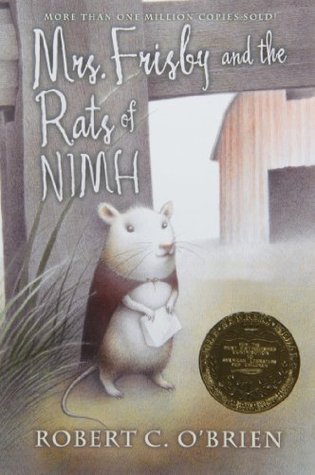
Mrs. Frisby and the Rats of Nimh (Robert C O'Brien)

233817

I must have read this book when I was younger. It was all vaguely familiar and comfortable. However, I couldn't remember enough of the story to justify not continuing to the end - and I'm glad I did. I loved it. We read it for our grade 3 book club and it was a hit! The books we've read so far this year were pretty easy. This one had much more substance. It made for a smaller crowd at book club, but a great discussion. Some were troubled to not know who the rats were that didn't make it out. Maybe that comes up in the next books? Not sure. I am definitely interested in reading more.

I love the theme of reading and learning. For the rats, reading brings them hope and freedom so they can escape their evil Nimh captors. It changes their life forever....even makes them unable to enjoy their social circles the same as they did in the past. Life changes because they learned to read. If they hadn't learned to read they would have been content to live in their cages forever and have someone look after them. Because they could read, they created a whole new social structure where they really got into a rat race (err, people race??) and dissatisfaction was created.  I also liked that rats are positive characters. That doesn't often happen with rats. They are very smart creatures so I was glad to see someone give them a little respect!

Goodreads says:

Mrs. Frisby, a widowed mouse with four small children, is faced with a terrible problem. She must move her family to their summer quarters immediately, or face almost certain death. But her youngest son, Timothy, lies ill with pneumonia and must not be moved. Fortunately, she encounters the rats of NIMH, an extraordinary breed of highly intelligent creatures, who come up with a brilliant solution to her dilemma. And Mrs. Frisby in turn renders them a great service.

Sunday, September 18, 2016

Punished! (David Lubar)


This book took me about 25 minutes to read. It would be a great book for middle elementary kids who aren't super strong readers yet. The puns are entertaining. It teaches some great parts of language that would make for a great classroom discussion. It would be fun to build a wall full of puns,  oxymorons, anagrams and palindromes. We have talked about using this book for our Battle of the Books. Perhaps there could be an additional contest where teams could earn points by taking on the challenge that Logan finds himself absorbed in. I think this would also make a great read aloud. 


October 2021: Read aloud to my class. Sometimes it was hard for them to get the puns and plays on language because they couldn't see the words. Would be good as a novel study with everyone having a book. We enjoyed it, nonetheless.

Goodreads summary: 

Logan and his friend Benedict run into the wrong guy at the library--literally. When Logan slams into the reference guy in the basement and gives him a little lip, Logan gets punished, really and truly punished. He has three days to complete three tasks before Professor Wordsworth will lift the magical punishment that keeps getting Logan in even more trouble.


Saturday, July 16, 2016

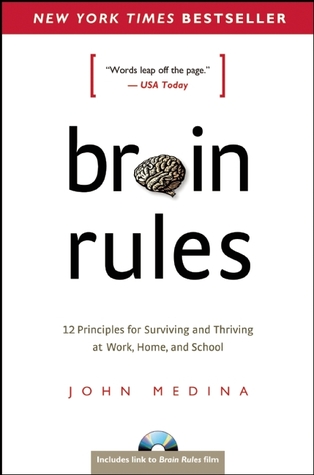
Brain Rules: 12 Principles for Surviving and Thriving at Work, Home, and School (John Medina)

2251306


The brain fascinates me. I loved this book because it explains the science in ways I can understand (I'm really not a science person!) I also liked how he added ideas for ways to implement these ideas in regular work, home and school life.


The 12 rules are:
EXERCISE | Rule #1: Exercise boosts brain power.
SURVIVAL | Rule #2: The human brain evolved, too.
WIRING | Rule #3: Every brain is wired differently.
ATTENTION | Rule #4: We don't pay attention to boring things.
SHORT-TERM MEMORY | Rule #5: Repeat to remember.
LONG-TERM MEMORY | Rule #6: Remember to repeat.
SLEEP | Rule #7: Sleep well, think well.
STRESS | Rule #8: Stressed brains don't learn the same way as non-stressed
SENSORY INTEGRATION | Rule #9: Stimulate more of the senses.
VISION | Rule #10: Vision trumps all other senses.
GENDER | Rule #11: Male and female brains are different.
EXPLORATION | Rule #12: We are powerful and natural explorers.


Goodreads summary:


Most of us have no idea what’s really going on inside our heads. Yet brain scientists have uncovered details every business leader, parent, and teacher should know—like the need for physical activity to get your brain working its best.

How do we learn? What exactly do sleep and stress do to our brains? Why is multi-tasking a myth? Why is it so easy to forget—and so important to repeat new knowledge? Is it true that men and women have different brains?

In Brain Rules, Dr. John Medina, a molecular biologist, shares his lifelong interest in how the brain sciences might influence the way we teach our children and the way we work. In each chapter, he describes a brain rule—what scientists know for sure about how our brains work—and then offers transformative ideas for our daily lives.

Medina’s fascinating stories and infectious sense of humor breathe life into brain science. You’ll learn why Michael Jordan was no good at baseball. You’ll peer over a surgeon’s shoulder as he proves that most of us have a Jennifer Aniston neuron. You’ll meet a boy who has an amazing memory for music but can’t tie his own shoes.

You will discover how:

Every brain is wired differently
Exercise improves cognition
We are designed to never stop learning and exploring
Memories are volatile
Sleep is powerfully linked with the ability to learn
Vision trumps all of the other senses
Stress changes the way we learn

In the end, you’ll understand how your brain really works—and how to get the most out of it.

Thursday, July 9, 2015

I Yam a Donkey (CeCe Bell)


I yam going to remember this one to read to my class when we start our first unit on grammar. It would be fun to show them the "Who's on first" video along with it. The book is fun because the donkey really doesn't get it despite the cranky yam's attempts to teach him how to speak properly. Language can be confusing and tricky and the book proves that if you are too much of a stickler, you might meet an early demise!

The ending reminded me of I Want My Hat Back by Jon Klassen

Goodreads summary: 


Even frustrated grammarians will giggle at the who’s-on-first routine that begins with a donkey’s excited announcement, “I yam a donkey!” Unfortunately the donkey’s audience happens to be a yam, and one who is particular about sloppy pronunciation and poor grammar. An escalating series of misunderstandings leaves the yam furious and the clueless donkey bewildered by the yam’s growing (and amusing) frustration. The yam finally gets his point across, but regrettably, he’s made the situation a little bit too clear . . . and the story ends with a dark and outrageously funny twist. 

Friday, June 12, 2015

The Skunk (Mac Barnett)

Mac Barnett is becoming one of my favorites! The books I have read of his are: Extra Yarn, Battle Bunny, Telephone,  Sam and Dave Dig a Hole, The Terrible Two, and now this one. They are all brilliant!

My students were able to make a connection with one of the Open Court stories we read: Stevie. It is about a boy who gets tired of a little boy his mom babysits - until he ends up not coming over anymore. We talked about how you should appreciate things when they're here because you will miss them later.

It's funny how much the man and the skunk look alike. Hmmmm.....

This is one book I'd be interested in hearing the author's perspective on why he wrote it.

Good signpost picture book for contrasts and contradictions. The man surprises us by deciding to follow the skunk because he ends up missing him!

Goodreads summary:

When a skunk first appears in the tuxedoed man's doorway, it's a strange but possibly harmless occurrence. But then the man finds the skunk following him, and the unlikely pair embark on an increasingly frantic chase through the city, from the streets to the opera house to the fairground. What does the skunk want? It's not clear--but soon the man has bought a new house in a new neighborhood to escape the little creature's attention, only to find himself missing something. . .
This slyly hilarious tale brings together picture book talents Mac Barnett and Patrick McDonnell for the first time.

There are lots of good questions that come out of this book. Is the skunk symbolic? Is the man trying to hide something stinky in his life? Why does he go looking for the skunk? Why is the skunk following him? Is this about anxiety?


Saturday, May 16, 2015

Pinduli (Janell Cannon)


Oops..my picture has the paper strip I put on all library books in my classroom. 
Oh well!

What a beautiful story! The illustrations are amazing. There is a little bit of challenging vocabulary interspersed. I read it to my class while they were eating and everyone, even my 'I really am not interested in stories' kids were glued to it. Good lessons on character....sometimes people do mean things because something has happened to them. We have had a few conversations in class lately about context and how the context can help you understand a difficult word (or a tricky situation). This is a great example of that concept.

Good Reads summary: 


Pinduli's mama has always told her that she's the most beautiful hyena ever. But Dog, Lion, and Zebra don't think so. Why else would they make her feel so rotten about her big ears, her fuzzy mane, and her wiggly stripes? Poor Pinduli just wants to disappear--and she tries everything she can think of to make that happen. Yet nothing goes her way. Nothing, that is, until a case of mistaken identity lets her show the creatures of the African savanna how a few tiny words--bad or good--can create something enormous.

Janell Cannon, the creator of the bestselling Stellaluna, introduces yet another endearing character in this triumphant story about self-image, self-acceptance, and treating others with respect.

Sunday, December 21, 2014

Telephone (Mac Barnett)


I am a sucker for anything by Mac Barnett. This is another great one.

Who doesn't love a game of telephone? We even recently played it around the dinner table at Thanksgiving at the request of my niece. She will love this book.


The pictures in this book would be a great discussion starter for inferencing skills. You could discuss why each bird says what they say (they each are dressed up or have accessories that influence what they hear). It could also be a great starter for a discussion about how people's backgrounds influence what they hear or learn or take from relationships.

Goodreads summary: 

It's time to fly home for dinner! In this witty picture book from award-winning and bestselling author Mac Barnett, a mother bird gives the bird next to her a message for little Peter. But passing messages on a telephone line isn't as simple as it sounds. Each subsequent bird understands Mama's message according to its own very particular hobbies. Will Peter ever get home for dinner? This uproarious interpretation of a favorite children's game will get everyone giggling and is sure to lead to countless rereads. 


Saturday, January 18, 2014

Counting by 7s


I loved this book. The main character, Willow, is charming and smart and quite wise for a 12 year old. She experiences what I always feared as kid. My parents traveled a lot and I always worried they would be involved in a plane crash or car accident. I would plan what I would do if they died. Willow does experience this and unlike me, she really has no one. There is no extended family or really close family friends for her to turn to. She manages, somehow, to find people though and a new family is formed. It was beautiful.

This was a book that made me slow down and savor the words. Loved loved loved it.

You should read more about it on Goodreads.


Thursday, December 5, 2013

Bink and Gollie (Kate DiCamillo and Alison McGhee)


Kate DiCamillo never disappoints! This will be a great book to add to my list of books to introduce my students to for our friendship unit. 

Bink and Gollie are friends. They are clever. They use great vocabulary. 

I don't always list illustrators in my blog posts, but the illustrations are so integral to the story, and so simply amazing and hilarious, Alison McGhee must be mentioned! The illustrations are hilarious and add perfectly to the laughter of the book. 

These two remind me very much of my own children. They're differently sizes (and ages?) but still have plenty of reckless fun together roller skating. Gollie, like me with my daughter, tries to tolerate Bink's love for the outrageous (it's socks in this book). They get into crazy messes which are creatively resolved. Yup. Sounds a lot like my house!

             “I have brought you half of my pancakes," said Gollie.

              "And I have removed one of my outrageous socks," said Bink. "It's a compromise bonanza!” 

Love love love this book! It is an easy read and also one I would enjoy reading to kids again and again.

Friday, November 15, 2013

The Girl With No Name (Marina Chapman)

The Girl With No Name: The Incredible True Story of a Child Raised by Monkeys

Wow. This is an amazing story. It was published just recently and is the story of a girl who was abandoned in the jungles of Columbia as a child. She lived with monkeys for years. She ended up escaping the jungle, but you might wonder if she wouldn't have been better off to stay there. What a story. What impressed me most about the story was how she has a deep sense of good. Despite being raised with animals and having no idea about civilized life, she had a desire to do the best she could and to be a person of character.

Goodreads summary:

In 1954, in a remote mountain village in South America, a little girl was abducted. She was four years old. Marina Chapman was stolen from her housing estate and then abandoned deep in the Colombian jungle. That she survived is a miracle. Two days later, half-drugged, terrified, and starving, she came upon a troop of capuchin monkeys. Acting entirely on instinct, she tried to do what they did: she ate what they ate and copied their actions, and little by little, learned to fend for herself.

So begins the story of her five years among the monkeys, during which time she gradually became feral; she lost the ability to speak, lost all inhibition, lost any real sense of being human, replacing the structure of human society with the social mores of her new simian family. But society was eventually to reclaim her. At age ten she was discovered by a pair of hunters who took her to the lawless Colombian city of Cucuta where, in exchange for a parrot, they sold her to a brothel. When she learned that she was to be groomed for prostitution, she made her plans to escape. But her adventure wasn’t over yet...

In the vein of "Slumdog Millionaire" and "City of God," this rousing story of a lost child who overcomes the dangers of the wild and the brutality of the streets to finally reclaim her life will astonish readers everywhere.


It was so interesting to read about how foreign everything we consider normal was to her. At one point she is washing dishes and one falls and breaks:

Chapter 17: I had no memory of simple things like  plates, for example - at least, not plates that went smash! if you dropped them. 'Esfragil' was a word that had no meaning for me until the point when a wet plate, which Lolita had indicate dI should dry, slid from my clumby fingers and exploded into a million pieces across the floor. How had it done that? Why had it done that? Istared wide-eyed at the messat my feet, fascinated.


I didn't associate the 'crash' sound with anything being wrong - why would I? I just looked at pieces on the floor, trying to understand it, because I'd not seen a texture like it before. Ana-Karmen came to hit me, so I naturally ran to hide, but for what misdemeanour, I didn't know. I was just curious. I didn't think, 'Oh, no, I broke a plate. Now I'm in trouble!' The whole concept was completely alient to me. Yes, I was shocked at the volume and intrigued by the discovery of a new noise. But again, I was in control of it. I knew where it had come from, so maybe that's why I didn't fear it so much. I was just desperate to understand.


In a few of the places she ends up living, prostitution becomes an issue. She is approached a number of times by men, but for some reason, escapes their grasps.

Chapter 21: I might have been wrong, of course - and who was I to stand in judgment over these girls anyway? What did I know of the circumstances in which their children were conceived? But in my adolescent mind, with its black and white view of the world, perhaps did me great favour in that respect. My experience at Ana-Karmen's had taught me a valuable lesson - that sex, for many men, at least, was a different thing from love. In the world of the brothen, the prostitute was seen as a commodity - something to be bought and sold for cash. And the consequences were there for all to see. The man promising everything, the girl believing all of it, and then, nine months later, another unwatned street baby being born with the father nowhere to be seen.


I didn't want that. I wanted a home, I wanted a husband and I wanted children. So, hard though it would be later, when a boy would try to woo me, or someone would try to entice me with a plan involving drugs, drink or crime, I would listen to the voice in my head that said, "Hold on - one day you're going to be someone.'


She learns a lot from the monkeys she lived with - most importantly of all, perhaps, to have hope and to work hard. She decides to knock on doors in a city to see if someone will take her in:

Chapter 24: It was a soul-destroying, miserable, thankless, lonely mission. I walked up and down street after street, footsore and thirsty trudging in the heat. And everyone, without exception, still told me to go away. disheartened, I decided I would simply give it - it seemed so pointless - but then a memory surfaced that took me by surprise. I remembered the first time I watched a monkey get a nut from its casing - how long it had taken and how hard he had worke.d How he'd searched for the right rock, with a hollow to place the nut in - a job that itself took a long time - and how he'd found another rock and toiled away for so long, repeatedly hitting it till he was rewarded with that first small encouraging crack. Even then it took a lot more effort to break it open. The tastiest nuts didn't give up their treasures lightly. You had to earn them. Just as I had to earn this.


She lives on the street much of the time and one experience, in particular, shook her. She finds a box in the garbage that is locked. It looks like a cash box that she saw when she lived with a criminal family. She takes it. It's locked so she has to figure out how to open it, but before she can, some other boys living on the street steal it away from her. She chases them but they escape. She can see them at a distance working on opening the box when suddenly the world explodes. She realizes she must be destined for something better:

Chapter 26: Their deaths haunted me, however, dya and night. I couldn't get the image of them out of my mind and was plagued by the thought that it should have been me who died instead  of them. Why had fate arranged it for those boys to snatch the box from me? Why had I been unable to scale that high fence? Why had I been spared and their lives taken so violently? I had no idea, but I was alive. It appears that I had chated what fate had planned for me and I figured there must be a reason. The thought made me determined to find myself a better life.


The story is absolutely astounding. It doesn't take too long to read this book. It's a great read. The book is full of sadness and compassion. It's full of death and a fight to live. It is full of kindness, adapting, learning, and even religion. It's an amazing and true story.

Friday, September 13, 2013

My Dad Thinks He's Funny

12592188


My Dad thinks he s funny. Whenever I say, I m hungry, Dad says, Hello Hungry. Pleased to meet you. My Dad thinks he's funny. But he's not.


This is a great book to read to help children understand the little idiosyncricies of language. It totally nails dads and the funny things they like to say.  When I read it to my class we talked about each page: what he said, what he meant, what other meaning it could have, etc. Then we read it all over again and they really enjoyed it. The more you read this book the more kids would get it.

I think it would be especially good for children where English isn't their first language.