Showing posts with label medicine. Show all posts

Saturday, April 15, 2023

Peak Mind (Amishi P. Jha)


I learned about this book from a medication on my CALM app by Jay Shetty. I've been meditating pretty faithfully since 2022. I can't say I'm super good at it but I do feel like it is doing something good in my life. This book has the science that backs up why meditation is important. 

One thing that really struck me was when I read about why we don't remember some things. My husband has many more memories of our years as parents and our years together than I do. After reading this, it made me think perhaps it is simply because I'm always trying to multi-task and do more than one thing at one time. If I stop and am in the moment, I will be able to hold on to those memories better. 

p. 256 One meditation to do any time anywhere is to repeat these phrases:
May you be happy
May you be well
May you be safe
May you live with ease. 

 You could also replace the you with I and send goodwill to yourself.


p. 241 The author says that distraction = disconnection. This is how this relates to working memory:

Distracted
- You can't keep your attentional flashlight pointing to one or more conversational partners.

- Your mental whiteboard is cluttered - you have failed to let distracting content fade from your working memory.

- You keep time traveling, unable to stay in the present moment of the conversation as it unfolds.

Disregulated
- You can't regulate your emotions.

- You are reactive or display volatile behavior during the interaction. 

Disconnected
- You incorrectly believe that thoughts are facts.

- You fail to have a shared mental model of the situation.

- You apply the wrong mental model to the situation.

p. 235  There is a concept in Buddhism called the "Second Arrow." It comes from the famous parable: The Buddha asked one of his students, "If you are struck by an arrow, does it hurt?"
"Yes! the student replied.
"If you are struck by a second arrow," the Buddha asked, "does it hurt even more?"
"It does," the student replied.
The Buddha explained: In life, we can't control whether we're hit by an arrow or not. But the second arrow is our reaction to the first. The first arrow causes pain - the second arrow is our distress about that pain.
I love this parable because it very simply encapsulates the connection between mindfulness and attention: The first arrow happens. There are arrows every day. But the second arrow - your response to the first = is what sucks up your attentional bandwith. And that is within your control. There is another choice point you can access - if you have an awareness of your own mind.


Goodreads says:

Research shows we are missing 50 percent of our lives. Why?
Because we aren’t paying attention.

From the constant buzz of your phone and the lure of your media feed to your unrelenting, all-encompassing, and evergrowing mental to-do list—the demands on your attention have never been so severe. The result is an escalating crisis, where we feel mentally foggy, scattered, and overwhelmed. Remarkably, the solution to our attention crisis has been right here in front of us the entire time. Acclaimed neuroscientist Amishi P. Jha, PhD, has dedicated her life’s work to understanding the science of attention at every level—from brain-imaging studies in the lab to field-testing soldiers, firefighters, athletes, healthcare and business professionals, and students. Her mission has been to scientifically determine how we can harness the full power of our attention to better meet all that life demands. Dr. Jha expertly guides readers through fascinating research, debunking common assumptions and offering stunning new insights into where presence and purpose really come from. Peak Mind reveals remarkably easy to adapt, flexible, 12-minute-a-day exercises to lift the mental fog, declutter the mind, and strengthen focus so that you can experience more of your life.

About the author: Amishi P. Jha, Ph.D is professor of psychology and director of contemplative neuroscience at the University of Miami. She leads research on the neural bases of attention and the effects of mindfulness-based training programs on cognition, emotion, and resilience. She has spoken at TED.com, the World Economic Forum, and NATO, and has been covered by Scientific American, the New York Times, NPR, and Forbes.

Friday, December 29, 2017

Healthy Brain, Healthy Life (Wendy Suzuki)

22635869

I'm fascinated at how exercise is such a big part of every brain book I read. It makes all the difference. I can testify to that! I loved her research on how exercise helps with creativity, problem solving, mood and more. It made me want to recommit to getting my students to move more. I also think that when the school day ends, I should go for a walk around the block and think about what went great and what I need to follow up on the next day before I sit down. Perhaps I'd be more productive if I did. Her stories of voicing intentions while exercising made a lot of sense. I have read recently how important it is to use all the senses to increase memory - see it, read it, write it, say it. This fits well with what she talked about.

I really enjoyed the mix of science and personal experiences in this book. It made it much more relate-able than just straight science research.

This book made me want to work on adding meditation to my life.

I listened to this as an audio book and I have to admit I found the voice a little irritating. It was a little too bouncy and chipper (which I feel silly saying...but it's true). I liked the brain hacks (ways to implement the topics of the chapter) at the end of each chapter.


Goodreads says:

Dr. Wendy Suzuki one day woke up and realized she didn’t have a life. As an almost-40-year-old award-winning college professor, world-renowned neuroscientist, she had—what many considered—everything: tenure as a professor at New York University; her own very successful neuroscience research lab; prizes for scientific discoveries on cognition and memory; articles published in prestigious scientific journals. As a woman and a scientist, she was the envy of her peers and lauded by her superiors. On paper, she had a stellar career and an impeccable record. 

What could she possibly be missing? Everything else. 

Suzuki was overweight. She was tired. She was lonely, had strained work relationships, and for the first time in her life, completely without direction. So she resolved to change her life. The first step--get moving. 

Everyone knows that exercise makes you feel better—that when you hit the gym despite the dread, you leave in a better mood. Healthy Brain, Happy Life offers the real science of how exercise effects your mind. 

Using Wendy’s journey from frumpy, fat and frustrated to fit and fabulous as a guide, Healthy Brain offers not just the HOWS of making exercise an important part of life, but the WHYS of the benefits it brings. But movement is just the first step to being Brain Healthy. Once you get your body and mind hooked on exercise, you bring in practices in mindfullness to calm stress and allow your minds to wander to unlock creativity. As your brain begins to change (something called neuroplasticity), the benefits build--you get fitter, improve your memory, increase your ability to work quickly and move from task to task easily. 

Along with Dr. Suzuki’s 4 minute Brain Hacks, Healthy Brain, Happy Life offers a simple program for changing your life, straight from a leading scientist’s personal experience.

Friday, December 15, 2017

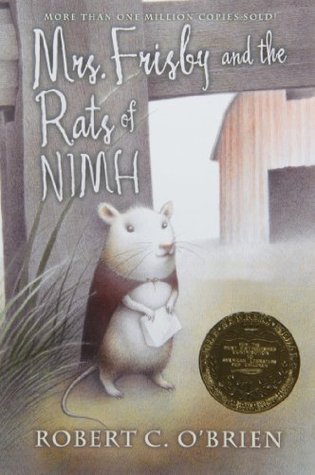
Mrs. Frisby and the Rats of Nimh (Robert C O'Brien)

233817

I must have read this book when I was younger. It was all vaguely familiar and comfortable. However, I couldn't remember enough of the story to justify not continuing to the end - and I'm glad I did. I loved it. We read it for our grade 3 book club and it was a hit! The books we've read so far this year were pretty easy. This one had much more substance. It made for a smaller crowd at book club, but a great discussion. Some were troubled to not know who the rats were that didn't make it out. Maybe that comes up in the next books? Not sure. I am definitely interested in reading more.

I love the theme of reading and learning. For the rats, reading brings them hope and freedom so they can escape their evil Nimh captors. It changes their life forever....even makes them unable to enjoy their social circles the same as they did in the past. Life changes because they learned to read. If they hadn't learned to read they would have been content to live in their cages forever and have someone look after them. Because they could read, they created a whole new social structure where they really got into a rat race (err, people race??) and dissatisfaction was created.  I also liked that rats are positive characters. That doesn't often happen with rats. They are very smart creatures so I was glad to see someone give them a little respect!

Goodreads says:

Mrs. Frisby, a widowed mouse with four small children, is faced with a terrible problem. She must move her family to their summer quarters immediately, or face almost certain death. But her youngest son, Timothy, lies ill with pneumonia and must not be moved. Fortunately, she encounters the rats of NIMH, an extraordinary breed of highly intelligent creatures, who come up with a brilliant solution to her dilemma. And Mrs. Frisby in turn renders them a great service.

Friday, March 4, 2016

Jacob Have I Loved (Katherine Paterson)


I got this book out after reading Bridge to Terabithia (again) for my grade three book club. Katherine Paterson is quite a renound author, but I haven't really read anything else of hers. I decided I should. I was interested in seeing what she did with the Jacob and Esau reference. 

Is the Jacob and Esau story a foundation for a meta narrative? I had no idea. Seemed intriguing though. She certainly does weave plenty of biblical reference through this entire story. 

As I read, I wondered if this would be a good story to do for grade three book club. There were enough odd moments (huge crush on someone who could be her grandpa? Her senile grandmother accusing her mother endlessly of being a harlot?!) that made me realize it wouldn't be appropriate. As a matter of fact, as I read I started to hate the main character. I wondered how in the world the book became a Caldecott winner. However, as I kept on, I realized there really is beauty in the story. She touches on some themes in an amazing way.

Main themes seem to be finding yourself and sibling rivalry. Sara Louise hates her twin sister. She seems justified. Her sister smart quite unaware of the rivalry. She just goes about doing what she does...totally irritating Sarah Louise, who never resolves the problems with her sister. It makes it so that their sisterhood isn't at all one of those wonderful friendships. Not at all. Actually, Sarah Louise's negativity and loathing really began to wear on me. At the part where she is complaining to her mother about her mother's choices in life, I realized that she  really needed to quit projecting her unhappiness on to everyone else! Happily, she does seem to figure this out for herself. She finally realizes that she needs to do what makes her happy and goes away to school. She's wants to become a doctor, but it is a time when women are really only expected to be nurses. She ends up in a small mountainous community, being the only medical professional, and ends up marrying. In her new life, she leaves her family behind, even unable to return fo funerals. Frankly, I knew if she did go back, she would go straight back to her miserableness.....so I understood her not going.

The story comes full circle when she delivers twins, spending her energy saving the life of one while the other waits in a basket.....just like when she was born. I feel like she would have made the connection and perhaps had some healing as a result of the experience.

There is magic and wisdom in this story. It would be great to read it with middle school students or even with adults....especially my church friends.

Goodreads summary:

Jacob have I loved, but Esau have I hated . . . With her grandmother's taunt, Louise knew that she, like the biblical Esau, was the despised elder twin. Caroline, her selfish younger sister, was the one everyone loved.Growing up on a tiny Chesapeake Bay island in the early 1940s, angry Louise reveals how Caroline robbed her of everything: her hopes for schooling, her friends, her mother, even her name. While everyone pampered Caroline, Wheeze (her sister's name for her) began to learn the ways of the watermen and the secrets of the island, especially of old Captain Wallace, who had mysteriously returned after fifty years. The war unexpectedly gave this independent girl a chance to fulfill her childish dream to work as a watermen alongside her father. But the dream did not satisfy the woman she was becoming. Alone and unsure, Louise began to fight her way to a place where Caroline could not reach.Renowned author Katherine Paterson here chooses a little-known area off the Maryland shore as her setting for a fresh telling of the ancient story of an elder twin's lost birthright.

Friday, October 10, 2014

The Fourteenth Goldfish (Jennifer Holm)

This entire premise of this book is crazy, but it works.  Grandpa comes to live with Ellie and her mom, only he has discovered a serum that has reversed the aging process and he is actually 13 years old now. Mom and Grandpa don't really ever see eye to eye. Grandpa is a scientist with two PhDs and mom is a drama teacher. Ellie discovers the beauty and wonder of science along with the pitfalls of scientific advancements on society. It is a great story if hope and imagination. It was easy to read. Very well written.


P. 47 "Scientists never give up, they keep trying because they believe in the possible."

P. 171 I stare at his tye-dyed shirt, and I suddenly understand what Starlily was trying to teach us with the goldfish. Endings are sad. Like goldfish dying and grandma's slippers and Brianna and me. But beginnings are exciting. Like discovering something I might be good at and making new friends. Raj.
"It's the cycle of life," I say, remembering Starlily's words. "Things move forward, not backward."
"Who wants to move forward? Not me."
My mind is racing now and I think if things not moving forward. Like my mom. She's scared if making a mistake again, even though anyone can see that Ben's the perfect missing piece for her puzzle.
"What about the whole law of motion thing? You're supposed to keep moving or you get stuck! Like Mom with Ben!"
"She can do better than him," my grandfather says, ignoring what I am really saying.
"What if we've gone too far? What if we ruin the whole world?"
"So dramatic," he observes. "Just like your mother."
"What about the trash cans?" I ask.
"I'll put then out tonight," he says.
"How's that going to work? When all the old people are young again, who's going to be in charge? Who's going to decide when to put out the trash cans and turn up the head. Who's going to be the grown up?"
He looks momentarily off balance, as if he hasn't considered this. Then his expression hardens.
"You don't understand. You haven't had to live through this," he says.
The words tumble from my mouth before I can stop them. "But I want to!"
I look at him imploringly. "Is growing up, growing old - life - is it all so terrible?"
His eyes go still and he looks at me, like he's seeing me for the first time.
I take a deep breath, remembering the feeling if dancing in that dark floor, the music pounding through me, the possibility of something - I don't know what - so close, and I want to feel that again.
"Because I want to try it," I whisper. "I'm only twelve." 

Tuesday, July 29, 2014

Think Smart (Richard Restak, M.D.)

I listened to this on CD while we were traveling. It was quite interesting. The beginning talks about the best things to do for your brain's health: eat well and exercise (why is it always the same thing?!) :)
He also tells of interesting ideas for ways to increase your mental capacity. It inspired me to work on my memory and concentration skills. I have set a goal to memorize six piano songs over the next year and continue learning new words, writing, and memorizing lists.
I was particularly fascinated with his information on Alzheimer's. When people's brains were examined, after death, they discovered that there were grey areas of the brain - as if those areas of the brain were worn out. The interesting thing is they appeared in people's brains who exhibited symptoms of Alzheimer's as well as those who didn't. The difference seemed to be those who worked on brain active brain skills rather than falling into passivity in old age, as well as if they had spent their younger years learning and staying mentally engaged. Fascinating.


Goodreads Summary:

In Think Smart, the renowned neuropsychiatrist and bestselling author Richard Restak details how each of us can improve and tone our body's most powerful organ: the brain.

As an expert on the brain, Restak knows that in the last five years there have been exciting new scientific discoveries about the brain and its performance. So he has asked his colleagues—among them the world's leading brain scientists and researchers—one important question: What can I do to help my brain work more efficiently? Their surprising and remarkably feasible answers are at the heart of Think Smart.

Dr. Restak combines advice culled from cutting-edge research with brain-tuning exercises to show how individuals of any age can make their brains work more effectively. In the same accessible prose that made Mozart's Brain and the Fighter Pilot a New York Times bestseller, Restak presents a wide array of practical recommendations about a variety of topics, including the crucial role sleep plays in boosting creativity, the importance of honing sensory memory, and the neuron-firing benefits of certain foods.

In Think Smart, the man the Smithsonian Institution has called "wise, witty, and ethical" offers audiences helpful suggestions for fighting neurological decline that will put every listener on the path to building a healthier, more limber brain.


Thursday, July 18, 2013

The Fault in Our Stars (John Green)

The Fault in Our Stars
The main character in this book loves reading and the story is centered around her love of a book: An Imperial Affliction. I loved this quote:

p. 33: My favorite book, by a wide margin, was An Imperial Affliction, but I didn't like to tell people about it. Sometimes, you read a book and it fills you with this weird evangelical zeal, and you become convinced that the shattered world will never be put back together unless and until all living humans read the book. And then there are books like An Imperial Affliction which you can't tell people about, books so special and rare and yours that advertising your affection feels like betrayal.
It wasn't even that the book was so good or anything; it was just that the author, Peter Van Houten, seemed to understand me in weird and impossible ways. An Imperial Affliction was my book, in the way my body was my body and my thoughts were my thoughts.
The author has a great way with words and there were many times where I had to pause and chew on the words a little longer to truly appreciate them.

And to get a little philosophical - I think the underlying message in this book could be that we need to write our own stories. She tries to find out how An Imperial Affliction should end - but is unable. (I loved how Peter Van Houten was portrayed, by the way....shocking and ridiculous and pathetic). In the end, she really should have written how the story should end....just as she writes how her story will end.

I have a confession though: I didn't cry.
I know. I have no heart.
I do, however, think it's really really good. You should read it.

Originally posted July 18, 2013. Reread May 18, 2020: It's been 7 years since I first read this. Since then I've been raising teenagers. I have a whole new perspective on teenagers. The moments where Hazel's parents struggle with Hazel's cancer really got to me. In addition, my brother currently has stage 4 cancer. This was a tough and touching re-read.

                                         -----------------------------------------------
Augustus: He's seldom seen without a cigarette.And by the way that cigarette....is just a metaphor.

"You put the killing thing right between your teeth, but you don't give it the power to do its killing."


P. 157 Some tourists think Amsterdam is a city of sin, but in truth it is a city of freedom. And in freedom, most people find sin.


I found this on GoodReads. I have no idea who made it, but it's a great summary of wonderful things to remember about this book.


Friday, March 8, 2013

George's Marvelous Medicine (Roald Dahl)

The love for Roald Dahl seems to not have any end in our classroom. Recently a student handed me George's Marvelous Medicine and said, "Mrs. Ackroyd, you need to read this to our class. It's so funny!"

So, read it, we did!

And it is funny. It is right up a kid's alley. The story is about George, a boy who has a cranky old Grandmother. She's always barking at him to get her medicine, get her some toast, and for heaven's sake, stop growing!

George, like kids love to do, decides to make a special potion. He uses stuff from the bathroom, stuff from the kitchen, stuff from the garage, and stuff from the barn!! Then he feeds it to his grandmother (well, after she insists he shouldn't be so selfish with whatever it is that he's cooking). What's a kid to do?!

The result is hilarious.

This book is a quick read, has lots of great pictures, and will provide loads of laughs.


Thursday, August 30, 2012

How They Croaked (Georgia Bragg)


This is a great book. It is not unlike driving by a train wreck. It's ghoulish and I find myself thinking I shouldn't be looking, but I can't help it!

The author of this book has a great sense of humor and entertaining writing style. The introduction is a warning, that if you don't have theguts for gore, you shouldn't read the book.

How to encite the curious, or what?!

The author says:

Remember when you watched Bambi for the first time and you got to the part where Bambi's mom dies? And the sweet movie about a family of deer turns into a horror flick? |What the heck was that?" you thought. And in that second ou realized that if Bambi's mom can do, so can everybody else.

How They Croacked is like reliving Bambi's mom's death over and over again. Except it's worst because it's the blood, sweat, and guts of real people. In this book are the true stories of how some of the most important people who ever lived - died.

The author tells the endings of King Tut, Julius Ceasar, Cleopatra, Christopher Columbus, Henry VIII, Elizabeth I, Pocahontas, Galileo Galilei, Wolfgang Amadeus Mozart, Marie Antoinette, George Washington, Napoleon Bonaparte, Ludwig Van Beethoven, Edgar Allan Poe, Charles Dickens, James A Garfield, Charles Darwin, Marie Curie, and Albert Einstein.

You've got to read this one!