Showing posts with label the brain. Show all posts

Monday, October 13, 2025

The Brain at Rest (Dr. Joseph Jebelli)


I seem to be on a deep dive into rest and the importance of taking it easy. This book was a great addition to that quest.

Chapter 1: How Overwork Is Literally Killing Us

  • Spend at least twenty minutes a day staring blankly into space. Try not to think about anything in particular; simply let your mind rest and wander, breathing slowly and deeply through your nose as your do. This is arguably the hardest way to rest because our society has indoctrinated us into believing it's a waste of time, but it's one of the best ways to activate your default network.
  • Try to step away from your normal routines and thoughts for at least a few minutes every day. Your mind needs intermittent breaks to refresh and stimulate default network activity. Don't worry about justifying it - you never need to justify your health. I snatch these precious moments just before getting on my bike in the morning, pausing to look at trees lining my street. 
  • In Poincare fashion, go for long walks and spend time sitting on public transport, staring out of the window. Sometimes, when I need inspiration, I take a bus to nowhere in particular.
  • If you have a bathtub, have more baths than showers. Besides being better for sore muscles and lowering your blood sugar levels, a bath lets your best thinking happen because it allows your mind ample space to roam. A bath before bed also improves your sleep, another period of high default network activity. Try including some soothing bath salts; I find they give me the best mental relief.
Chapter 2: The Neuroscience of Work
  • Take regular, scheduled breaks throughout the day. Follow, for example, the Pomodoro Technique (25 minutes of work followed by a 5-minute break), which lowers your risk of burnout, allowing the brain to recover and restore its executive functions, thus maintaining a higher level of performance.
  • Try the time-blocking technique, where you simply divide your day into blocks of time, which prevents task-switching and multitasking (known productivity killers) and ensures focused effort on one thing at a time. This method harnesses your executive network's preference for structured tasks. By focusing on a single activity, you reduce cognitive overload and help your prefrontal cortex optimize task management.
  • Implement email rules - that is, set specific times for checking and responding to emails. This prevents consistent interruption and helps preserve focus on more important tasks. Ceaselessly checking your email fatigues the prefrontal cortex and depletes your executive network's resources for focused thinking and decision-making. It's like trying to walk a tightrope while someone keeps tugging on your rope from below, throwing you off-balance with each pull.
  • Establish criteria for accepting work meetings. Ask yourself, Is this meeting relevant? How long is it? Do I really need to be there? Then propose alternatives like email updates or condensed sessions to preserve time. Streamlining meetings helps your executive network enormously. When meetings are short and relevant, they make better use of our attention and working-memory capacities.
Part 2 Rest
Chapter 3: Mind Wandering
Practical tips to help your mind wander:
  • Try a technique called positive constructive daydreaming (PCD) which involves tempting yourself into a controlled fantasy, helping your mind wander and thus engage your default network. For example, imagine it is one year from now and you're living the life you want, or imagine yourself in an earthly paradise. This intention kind of mind wandering, as opposed to the unintentional kind we often slip into, may provide even more protection from stress and anxiety, according to a recent study by the American Psychological Association - and this is especially true if we find what we're thinking about particularly interesting. So the next time you feel guilty for wandering off from work to muse about the fact that whale song can be used to map the ocean floor, or that there are 4 quadrillion quadrillion bacteria on the Earth, or that there are fossilized plants in Greenland under 1.4 kilometers of ice - don't.
  • Try something new at least once a week. Every time you put your brain in a novel situation, it quickly learns how to process the new circumstances using the inferior prefrontal cortex, a hotbed of creativity-enhancing default network neurons. If it's hard to try something new, try something you usually do in an unusual way; take a different route to work, write paper notes instead of typing, pause while in your neighborhood and soak in all the multisensory impressions
  • Listen to sad music. Not only does it improve your mood when you're feeling down (yes, really), but it's also associated with stronger mind wandering and greater default network activity.
  • For employers, do yourself and your company a huge favor by removing teh stigma associated with mind-wandering. Discuss its benefits with your employees and allow them time to explore its creative powers.
Chapter 4: The Science of Tree-Hugging (Why Nature is So Good For Your Brain)
Some tips to activate your default network with forest bathing.
  • Walk slowly through the forest. This isn't a hike or jog; it's a leisurely stroll.  The goal isn't to get to the finishing line. Move at a pace that allows you to observe and connect with your surroundings.
  • Hugs a tree whenever you can. As well as reducing cortisol, blood pressure, and heart rate, it releases oxytocin and activates your brain's default network.
  • If at all possible ,go camping a few times a year. This will raise your natural killer cell count nicely. If you can go more frequently, even better.
  • As well as in the forest, spend time on the beach or near the sea. People who live near the coast tend to have better physical and mental health than those who don't. Believe it or not, a big reason for this is that the color blue actually changes our brain waves and induces a sense of calm and peace. The sea air is also remarkably good for our mood.

Chapter 5: Mindful Solitude

1. Start small (10 min/day) Just sit and breathe.

2. Schedule solitude. Plan a specific time each day to be alone.

3. Disconnect to reconnect. No digital devices during your solitude time.

4. Engage in solo activities (walking, journaling, yoga)

5. Reflect and reassess. 

  • Just go. Sometimes the simplest advice is best, especially when it comes to rejuvenating your brain's health. Planning a solo trip or retreat can seem daunting at first, with concerns about loneliness or boredom creeping in. But the act of stepping away from your daily routine and immersing yourself in a new environment can be incredibly liberating. It forces you out of your comfort zone, stimulates your senses in unexpected ways, and provides the perfect backdrop for introspection and creativity
  • If you can't plan a big trip and are tied down by work and family commitments, just go to a quiet room alone; even a brief respite in a tranquil space can be a powerful form of solitude. By making the effort to find peace in the midst of a busy life, you're taking a vital step toward maintaining mental well-being and enhancing your brain's health.
  • Understand that doing nothing, even when it involves not being social, is no bad thing. The social circuits within your brain's default network need time to rest and replenish. In fact, studies show that too much socializing may even cause harm, including high stress and greater mortality risk. Though isolation and loneliness are not good for our health, we still need solitude, so set boundaries and leave space for alone time.
  • Ensure that when you do socialize, it's meaningful, good quality socializing. Many of us spend time with people we shouldn't - bad friends, frenemies, a toxic family member - but we do it because we feel obliged to. This raises levels of the stress hormone cortisol int he brain, which damages our social circuitry and harms the good-quality relationships we should be enjoying.
Chapter 6: Sleep On It Your Brain's Master Healer

- Broadly speaking, sleep has two functions: it's cognitive enhancer and a restorative powerhouse. The cognitive side of sleep nurtures our capacity for learning and memory. (p. 123) Note to self: Re-read pages 123-127

Napping: it lowers stress by reducing cortisol levels in the brain; it encourages the regeneration of damaged brain cells; and it triggers a new kind of thinking "that we have yet to understand." That final point presents an intriguing mystery. We know that napping improves memory, creativity, and cognitive function, yet there could be other, less understood aspects of brain function and benefit from napping. (p. 129)

  • Every night before you go to bed, spend ten to twenty minutes staring blankly into space. This will activate your default network at the critical hypnagogic phase, the period between wakefulness and sleep. After doing nothing during your hypnagogic phase, write down your thoughts in a journal. It's a key moment for your best insights and ability to solve problems.
  • When you wake up the following day, don't immediately roll out of bed and begin your day as usual; instead, spend another ten to twenty minutes doing absolutely nothing. Just stare into space. At this point, the period between sleep and full alertness, your brain's hypnopompic phase is active, which is another golden opportunity to active your default network.
  • Try to nap for thirty minutes daily. This short rest during the day will make your brain bigger, reduce stress, and regenerate damaged brain cells.
  • Sleep  for as long as you feel like sleeping. Your brain doesn't care about arbitrary work hours or overbearing bosses. Your brain needs as much asleep as it tells you it needs. Listen to it. And know that the usual amount of six to eight hours' sleep is often not enough. To ensure your default network is thriving, aim for eight to ten hours.
Chapter 7: Playology
Re: Video games: My partner has noticed an improvement in my mood ever since I started gaming a little each day, a hobby I hadn't indulged in since my early twenties. Like many, I feared it could negatively affect my well-being, especially given the moral panic that video games can harm our brains or incite violence - theories now thoroughly disproved. In fact, video games can positively impact mental health and well-being, providing a sense of achievement and a safe escape from everyday pressures. (p. 148)

Play personalities (p. 149) (or ways to engage in play...keeping this list for when I feel at a loss for something fun to fill time with:
The Collector - finds joy in the hunt, whether it be for books, plants, antiques or rare Pokémon cards;
The Competitor - thrives on sports and winning, and loves a five-a-side football match and the teamwork of a basketball game
The creator - finds deep satisfaction in the hours spent filing, painting, composing music or tending to a garden
The Director - has natural aptitude for leadership and wants to change the world by organizing and inspiring others
The Explorer - driven by an insatiable curiosity, always on the lookout for new experiences, be it a new forest or a spontaneous hike in he mountains
The Jokes - loves to laugh, using wit hand humor among friends and injecting levity into life's darker moments
The Kinesthete -loves to move - to dance, to swing, and to reap all the brain benefits of active rest
The Storyteller - the ultimate raconteur and who loves to transport their audience to other worlds; using mediums like writing, acting or teaching
  • Find micro-moments of play throughout your day. Whether it's dancing to your favorite song while cooking dinner or singing out loud on your cycle home, these small acts of joy will lighten your mood and significantly improve your brain health. Embrace these snippets of spontaneity to weave a tapestry to playfulness into the fabric of everyday life.
  • Advocate for a shorter workweek. Explore the feasibility and benefits of a four-day workweek in your workplace or community, inspired by the successful trials in Iceland, to create more time for rest and play. Now, more than ever, is the moment for workers around the globe to unite and reclaim their time for leisure, wellness, and personal growth.
  • Make downtime and play sacrosanct. In our rush toward short-term productivity we completely overlook the value that comes from moments of leisure and play, not just for children but for adults as well. This sacred time, carved out from the demands of our daily lives, is vital for the resting brain. Value it like sleep, a cornerstone of life itself.
  • Resist the urge to share your playful activities on social media. True play is for your enrichment, not for external validation. This approach helps maintain the purity and personal significance of the experience, ensuring that it remains a genuine source of joy and rest.
Chapter 8: Active Rest
  • If you can, introduce some high-intensity exercise - anything aerobic - into your week. This will strengthen connections in your default network
  • Aim for thirty minutes of exercise a day, five days a week. If you're struggling to fit this in, remember, your brain doesn't need quite as much to see benefits: just twenty-five minutes of exercise per week, a mere four minutes a day, can enhance your brain size and health. Even gentle physical exercises like walking and yoga can increase your brain size.
  • Harness the brain benefits of sex if you can. Whether it's once every few weeks or several times a week, incorporating this form of active rest benefits adults of all ages, stimulating the brain's default network and improving memory, thinking ability, decision-making, and emotional processing.
  • Ultimately, the crucial thing to remember is that active rest lowers your risk of developing a devastating neurological disorder. Just as stopping smoking lowers your risk of cancer, embracing active rest lowers your risk of Alzheimer's disease, stroke, PTSD, and depression, to name a few. So create a sense of urgency about active rest - because it is urgent.

Chapter 9: Just Do Nothing
  • Carve out time every day to just be. I find the best way to do this is to simply sit in a chair and stare out the window. In doing so, your brain is no longer focusing on the details of an action; it has entered the perfect zone for default network activity. A great resource for helping people just be is www.donothingfor2minutes.org. Try it
  • When you feel that you've had enough niksing, try combining it with an easy, semiautomatic activity such as knitting, This will keep your mind occupied without deactivating your default network. If knitting's not your thing, explore other semiautomatic activities: draw, do a jigsaw puzzle, sort things by color, create a family tree, look for stones and shells on the beach, stargaze, fold and refold paper, peel the labels from bottles, pop bubble wrap. There is no one-size-fits-all. Try whatever form of rest fits you best.
  • Try what's called the Black marker test; jot down all the things you plan to do this week, then take a black marker and cross out all the tasks that can be postponed or, better still, canceled. You'll be amazed at how cluttered your free time really is.
  • Push through the initial discomfort of doing nothing and work up to longer stretches of doing nothing. Reach a stage where you have a few days a week without any obligations or appointments. Dare to be idle. It is a quiet kind of revolution, but your brain will thank you in the end.
He had some great quotes in the book too. I just had to note them:
Burnout is not the price we have to pay for success. (Arianna Huffington)
How much better is silence; the coffee cup, the table. (Virginia Wolf)
How we spend our days is, of course, how se spend our lives. (Annie Dillard)
The soul should always stand ajar, ready to welcome the ecstatic experience. (Emily Dickinson)
Everybody should be quiet near a little stream and listen. (Ruth Krauss)
Without great solitude, no serious work is possible. (Pablo Picasso)

The death of each day's life, sore labor's bath, 
Balm of hurt minds, great nature's second course,
Chief nourisher in life's feast.
 (Macbeth 2.2.36-38)

Leisure is the mother of philosophy (Thomas Hobbes)
I have always believed that exercise is the key not only to physical health but to peace of mind. (Nelson Mandela)
Just act normal, that's already crazy enough (Dutch proverb)
How much better is silence; the coffee cup, the table. (Virginia Woolf)


Goodreads says:

From Joseph Jebelli, PhD, neuroscientist and author of In Pursuit of Memory, a narrative exploration of the science of doing nothing and its benefits for the brain and body.


We are constantly told to make the most of our time. Work harder, with more focus. Stop procrastinating. Optimize. To be happy, creative, and successful requires discipline. The most important thing is to be efficient with every precious hour. 


But what if all that advice was wrong, and letting the brain rest, and the mind wander, could improve our lives? Dr. Joseph Jebelli proves this surprising and fascinating point in The Brain at Rest, blending science and personal stories with practical tips about using the brain’s “default network,” which turns itself on when we turn off the constant need to always do and achieve. By activating our default network through long walks, baths, and spending time in nature, we can all be more content, less stressed, and actually more productive.


Perfect for anyone interested in science and creativity, or anyone feeling overwhelmed in their day-to-day lives, The Brain at Rest is a deeply researched and entertaining antidote to overwork and burnout, showing readers the way to happier, healthier, and more balanced lives.

Monday, December 30, 2024

The Brain Fog Fix (Dr. Mike Dow)


My maternal grandmother had trouble with dementia. My mother appears to be heading that way. This is a topic that I need to pay attention to! 

This book has lots of good idea for things to do to be healthier. I plan to implement eating seafood daily, berries as fruit of choice, exercise and brain exercises like memorizing, playing the piano more and creative pursuits. Also, less TV more reading! 

Goodreads says:

A new epidemic is sweeping the country. Some people call it "ADHD," "scatter brain," or "brain fog." And some people simply say they "just don’t feel like themselves"—and haven’t for a long time. People are thinking and feeling worse than ever. Why? Because our brains are not getting the support they need to produce the essential brain chemicals that keep us energized, calm, focused, and inspired. In fact, if you look at the way that most of us live, it’s almost as though we had chosen a lifestyle deliberately intended to undermine our brain chemistry. Fortunately, there is a solution. The Brain Fog Fix is a three-week program designed to help you naturally restore three of your brain’s most crucial serotonin, dopamine, and cortisol. Rebalancing these three brain chemicals will, in turn, enable the rest of your brain’s chemistry to reach optimal levels. You will find yourself thinking more clearly, remembering more accurately, learning more quickly, and unleashing the floodgates of your creativity. You will also find yourself feeling more optimistic, calm, energized, connected, and inspired. The good news is that this is easier than you think. Instead of trying to ambitiously overhaul one aspect of your life entirely with some difficult-to-maintain resolution, begin by making small and achievable changes in many different areas of your life. "If I’ve learned one thing from the thousands of people I’ve treated, it’s that you have to take the whole person into account if you want to think and feel better." —Dr. Mike Dow

Wednesday, October 23, 2024

Outsmart Your Brain (Daniel T Willingham, PhD)


I got this book from the library after following the author on TikTok. I didn't read all of it - but I did read the instructor tips.  His TikTok account is a brilliant way to share good tips from the book as well a the other things he knows about the science of learning. 

The thing about this book is that it is full of great tips - but I don't know if people who struggle in school read these kinds of books. The "for the instructor" of each section was really good too. My wish is for everyone to enjoy and do well in school and his book is a great tool for making that happen.

In the chapter, "How to Read Difficult Books" he made me feel good about my habit of note taking when I read non-fiction books. Most, I get from the library so I can't highlight them. Instead I write notes and he says that is a great learning strategy. Yay! He says taking notes keeps you mentally on task and the notes will help refresh your memory later. He also suggests posting a question when you begin a section of a book...and then when you finish that section, go back and see if your question was satisfactorily answered and whether or not you caught the gist of the section.

Goodreads says:

In this revolutionary, comprehensive, and accessible guide on how the brain learns, discover how to study more efficiently and effectively, shrug away exam stress, and most of all, enjoy learning.

When we study, we tend to focus on the tasks we can most easily control—such as highlighting and rereading—but these practices only give the illusion of mastery. As Dan Willingham, professor of psychology and bestselling author, explains, familiarity is not the same as comprehension.

Perfect for teachers and students of all ages, Outsmart Your Brain provides real-world practices and the latest research on how to train your brain for better learning. Each chapter provides clear and specific strategies while also explaining why traditional study processes do not work. Grounded in scientifically backed practical advice, this is the ultimate guide to improving grades and better understanding the power of our own brains.

Thursday, July 27, 2023

Reader, Come Home (Maryanne Wolf)


The author seems to say that digital reading is kind of like fast food. 

She starts off with a chapter on how the brain learns to read....and it was tough for me to slog through that. Truthfully, most of it was tough to slog through. I read it out of principle....I can handle tough text! However, I found her to be very wordy. Long sentences. Obscure words. It really wasn't easy reading....does she do that to make her point? I don't know. I think she could have said what she said in half the words though. 

She says that we are losing our ability to read deeply, to ponder on great words and thoughts and to build on them. Social Media has done this to adults so what is it doing to children? She says that we are reading just as much as we ever did, maybe even more, but we are skimming and missing the meat. People are less empathetic. They're easily led down conspiracy theory holes. They aren't thinking. I'm not a huge fan of e-books myself - but I don't agree that by themselves, reading is doomed. She doesn't offer much for a solution, especially with children. I guess I'm going back to Donalyn Miller's The Book Whisperer and Beers and Probst's Notice and Note for those kinds of tips. 


Goodreads says:

The author of the acclaimed Proust and the Squid follows up with a lively, ambitious, and deeply informative book that considers the future of the reading brain and our capacity for critical thinking, empathy, and reflection as we become increasingly dependent on digital technologies.


A decade ago, Maryanne Wolf’s Proust and the Squid revealed what we know about how the brain learns to read and how reading changes the way we think and feel. Since then, the ways we process written language have changed dramatically with many concerned about both their own changes and that of children. New research on the reading brain chronicles these changes in the brains of children and adults as they learn to read while immersed in a digitally dominated medium.

Drawing deeply on this research, this book comprises a series of letters Wolf writes to us—her beloved readers—to describe her concerns and her hopes about what is happening to the reading brain as it unavoidably changes to adapt to digital mediums. Wolf raises difficult questions, including:


Will children learn to incorporate the full range of "deep reading" processes that are at the core of the expert reading brain?
Will the mix of a seemingly infinite set of distractions for children’s attention and their quick access to immediate, voluminous information alter their ability to think for themselves?
With information at their fingertips, will the next generation learn to build their own storehouse of knowledge, which could impede the ability to make analogies and draw inferences from what they know?
Will all these influences, in turn, change the formation in children and the use in adults of "slower" cognitive processes like critical thinking, personal reflection, imagination, and empathy that comprise deep reading and that influence both how we think and how we live our lives?
Will the chain of digital influences ultimately influence the use of the critical analytical and empathic capacities necessary for a democratic society?
How can we preserve deep reading processes in future iterations of the reading brain?
Who are the "good readers" of every epoch?
Concerns about attention span, critical reasoning, and over-reliance on technology are never just about children—Wolf herself has found that, though she is a reading expert, her ability to read deeply has been impacted as she has become, inevitably, increasingly dependent on screens.

Wolf draws on neuroscience, literature, education, technology, and philosophy and blends historical, literary, and scientific facts with down-to-earth examples and warm anecdotes to illuminate complex ideas that culminate in a proposal for a biliterate reading brain. Provocative and intriguing, Reader, Come Home is a roadmap that provides a cautionary but hopeful perspective on the impact of technology on our brains and our most essential intellectual capacities—and what this could mean for our future.

Wednesday, March 8, 2023

The Power of Habit (Charles Duhigg)


This was an excellent read (well, listen!). It has a lot of the same principles of Atomic Habits, but also talks a lot about people who have studied the brain in relation to habits. I finally understood the power of cues and appreciated his strategy for figuring out what are the cues that make you do what you do. Definitely a book to read again! 


A young woman walks into a laboratory. Over the past two years, she has transformed almost every aspect of her life. She has quit smoking, run a marathon, and been promoted at work. The patterns inside her brain, neurologists discover, have fundamentally changed.

Marketers at Procter & Gamble study videos of people making their beds. They are desperately trying to figure out how to sell a new product called Febreze, on track to be one of the biggest flops in company history. Suddenly, one of them detects a nearly imperceptible pattern—and with a slight shift in advertising, Febreze goes on to earn a billion dollars a year.

An untested CEO takes over one of the largest companies in America. His first order of business is attacking a single pattern among his employees—how they approach worker safety—and soon the firm, Alcoa, becomes the top performer in the Dow Jones.

What do all these people have in common? They achieved success by focusing on the patterns that shape every aspect of our lives.

They succeeded by transforming habits.

In The Power of Habit, award-winning New York Times business reporter Charles Duhigg takes us to the thrilling edge of scientific discoveries that explain why habits exist and how they can be changed. With penetrating intelligence and an ability to distill vast amounts of information into engrossing narratives, Duhigg brings to life a whole new understanding of human nature and its potential for transformation.

Along the way we learn why some people and companies struggle to change, despite years of trying, while others seem to remake themselves overnight. We visit laboratories where neuroscientists explore how habits work and where, exactly, they reside in our brains. We discover how the right habits were crucial to the success of Olympic swimmer Michael Phelps, Starbucks CEO Howard Schultz, and civil-rights hero Martin Luther King, Jr. We go inside Procter & Gamble, Target superstores, Rick Warren’s Saddleback Church, NFL locker rooms, and the nation’s largest hospitals and see how implementing so-called keystone habits can earn billions and mean the difference between failure and success, life and death.

At its core, The Power of Habit contains an exhilarating argument: The key to exercising regularly, losing weight, raising exceptional children, becoming more productive, building revolutionary companies and social movements, and achieving success is understanding how habits work.

Habits aren’t destiny. As Charles Duhigg shows, by harnessing this new science, we can transform our businesses, our communities, and our lives.

Wednesday, August 3, 2022

Head Strong (Dave Asprey)


Improving the way my brain works is a big interest of mine. I liked many of the tips this author had but overall I found it overwhelming. I don't think it would be even possible to do all these things. I'm always leery of programs that suggest cutting out entire categories of food (i.e. grains, milk and a lot of meat) and that suggests you buy HIS products because they're superior to everything else out there. I finished it because I'm a finisher and I figured maybe something would come up that would change my mind. It didn't.  

I will continue to do some things: daily exercise, meditation, watching out for junk light, avoiding sugar, eating healthy fats, etc. I am not into his bulletproof coffee, microdosing nicotine and the looooong list of supplements. As I was reading, I found myself wondering what a biologist would say about all this. He goes to great pains to explain the science - which just ended up being a lot of confusing vocabulary for me. 

I will give it a 2/5. Moving on.


Goodreads says:

From the creator of Bulletproof Coffee and author of the bestselling The Bulletproof Diet comes a revolutionary plan to upgrade your brainpower—in two weeks or less.

For the last decade, Silicon Valley entrepreneur Dave Asprey has worked with world-renowned doctors and scientists to uncover the latest, most innovative methods for making humans perform better—a process known as "biohacking." In his first book, The Bulletproof Diet, he shared his biohacking tips for taking control of your own biology. Now, in Head Strong, Asprey shows readers how to biohack their way to a sharper, smarter, faster, more resilient brain.

Imagine feeling like your mind is operating at its clearest and sharpest, and being able—possibly for the first time in your life—to do more in less time? What it suddenly became easier to do the very hardest things you do? Or if you could feel 100% confident about your intellect, and never again fear being the person in the room who just isn’t smart enough, or can’t remember something important? How would you treat people if the mood swings, short temper, and food cravings that disrupt your day could simply disappear?

In Head Strong, Asprey shows us that all of this is possible—and more. Using his simple lifestyle modifications (or "hacks") to take advantage of how the structure of your brain works, readers will learn how to take their mental performance to the next level. Combining the latest findings in neuroscience and neurobiology with a hacker-inspired "get it done now" perspective, Asprey offers a program structured around key areas of brain performance that will help you:


Power the brain with exactly what it needs to perform at its best all day long
Eliminate the sources of "kryptonite," both nutritional and environmental, that make the brain slower.
Supercharge the cellular powerhouses of our brains, the mitochondria, to eliminate cravings and turn up mental focus.
Reverse inflammation to perform better right now, then stay sharp and energized well into your golden years.
Promote neuron growth to enhance processing speed and reinforce new learning—hotwiring your brain for success.
Asprey’s easy to follow, two-week program offers a detailed plan to supercharge brain performance, including: which foods to eat and which ones to avoid, how to incorporate the right kinds of physical activity into your day, a detox protocol for your home and body; meditation and breathing for performance, recommended brain-boosting supplements; and how to adjust the lighting in your home and work space to give your brain the quality light it thrives on.

A better brain—and a happier, easier, more productive life—is within reach. You just need to get Head Strong.

Thursday, August 12, 2021

Make It Stick: The Science of Successful Learning (Peter C Brown, Henry L Roediger III, Mark A McDaniel)


Chapter 1: Learning is Misunderstood

- Many people believe that their intellectual ability is hard-wired from birth, and that failure to meet a learning challenge is an indictment of their native ability. But every time you learn something new, you change the brain - the residue of yoru experiences is stored.

- Many teachers believe that if they can make learning easier and faster, the learning will be better. Much research turns this belief on its head: when learning is harder, it's stronger and lasts longer.

....then the book came due at the library so I skipped ahead to chapter 8:

1. Retrieving - practice retrieving new (and old) learning (self-quizzing).
2. Spacing - space out your retrieval practice, leave time to forget in between practice sessions.
3. Interleaving - alternate working on different problems facilitates spacing and forgetting (making learning more difficult, which improves learning).
4. Elaboration - try to find additional layers of meaning in the new material.
5. Generation - attempt to answer a question or solve a problem before looking at the answer (experiential learning).
6. Reflection - a combination of retrieval practice and elaboration that adds layers to learning new material. Ask your self questions.
7. Calibration - to avoid various cognitive illusions, use an objective instrument to adjust your sense of what you know and don't know.
8. Mnemonic devices - build memory palaces to help yourself retrieve what you have learned.

I should go back and read the rest.


Goodreads says:

To most of us, learning something "the hard way" implies wasted time and effort. Good teaching, we believe, should be creatively tailored to the different learning styles of students and should use strategies that make learning easier. Make It Stick turns fashionable ideas like these on their head. Drawing on recent discoveries in cognitive psychology and other disciplines, the authors offer concrete techniques for becoming more productive learners.

Memory plays a central role in our ability to carry out complex cognitive tasks, such as applying knowledge to problems never before encountered and drawing inferences from facts already known. New insights into how memory is encoded, consolidated, and later retrieved have led to a better understanding of how we learn. Grappling with the impediments that make learning challenging leads both to more complex mastery and better retention of what was learned.

Many common study habits and practice routines turn out to be counterproductive. Underlining and highlighting, rereading, cramming, and single-minded repetition of new skills create the illusion of mastery, but gains fade quickly. More complex and durable learning come from self-testing, introducing certain difficulties in practice, waiting to re-study new material until a little forgetting has set in, and interleaving the practice of one skill or topic with another. Speaking most urgently to students, teachers, trainers, and athletes, Make It Stick will appeal to all those interested in the challenge of lifelong learning and self-improvement.

Wednesday, July 28, 2021

Keep Sharp (Sanjay Gupta)


I've read quite a few books about aging, the brain and dementia. The thing I really like about this one is he gives solid steps for keeping your brain sharp...a 12 week program. I borrowed the book from the library but I will buy it so that I can get a copy of this 12 week program. It is full of great things to focus on for a healthy life!


Goodreads says:

Keep your brain young, healthy, and sharp with this science-driven guide to protecting your mind from decline by neurosurgeon and CNN chief medical correspondent Sanjay Gupta.

Throughout our life, we look for ways to keep our mind sharp and effortlessly productive. Now, globetrotting neurosurgeon Dr. Sanjay Gupta offers insights from top scientists all over the world, whose cutting-edge research can help you heighten and protect brain function and maintain cognitive health at any age.

Keep Sharp debunks common myths about aging and cognitive decline, explores whether there’s a “best” diet or exercise regimen for the brain, and explains whether it’s healthier to play video games that test memory and processing speed, or to engage in more social interaction. Discover what we can learn from “super-brained” people who are in their eighties and nineties with no signs of slowing down—and whether there are truly any benefits to drugs, supplements, and vitamins. Dr. Gupta also addresses brain disease, particularly Alzheimer’s, answers all your questions about the signs and symptoms, and shows how to ward against it and stay healthy while caring for a partner in cognitive decline. He likewise provides you with a personalized twelve-week program featuring practical strategies to strengthen your brain every day.

Keep Sharp is the only owner’s manual you’ll need to keep your brain young and healthy regardless of your age!

Saturday, August 15, 2020

Stillness Is The Key (Ryan Holiday)


Books like this are changing my life. Love it! I've been trying to meditate daily since March and I believe it is making a difference in how I handle the back to school stress of school during a pandemic. 

Quotes and notes:

Page xiv

To Seneca and his fellow adherents of stoic philosophy, if a person could develop peace within themselves - if they could achieve apatheia, as they called it-then the whole world could be at war, and they could still think well, work well, and be well. "You may be sure that you are at peace with yourself, "Seneca wrote, "when no noise reaches you, when no word shakes you out of yourself, whether it be flattery or a threat, or merely an empty sound buzzing about you with unmeaning sin." In this state, nothing could touch them (not even a deranged emperor), no emotion could disturb them, no threat could interrupt them, and every beat of the present moment would be theirs for living.

A wealth of information creates a poverty of attention - Herbert Simon


p. 31 Napolean was content with being behind on his mail, even if it upset some people or if he missed  out on some gossip, because it meant that trivial problems had to resolve themselves without him. We need to cultivate a similar attitude - give things a little space, don't consume news in real time, be a season or two behind on the latest trend or cultural phenomenon, don't let your inbox lord over your life.

p. 32 In her diary in 1942, Dorothy Day, the Catholic nun and social activist, admonished herself...."Turn off your radio," she wrote, "put away your daily paper. Read one review of events and spend time reading." Books, spending time reading books - that's what she meant. Books full of wisdom.
(Stillness is the Key, Ryan Holiday, p. 32)

April 2025: There are so many sections of this book that I love. The "Take a Walk" chapter really struck me this time. I need to get walking back into my daily life.
Take a Walk (p. 192) A cantankerous Danish philosopher, Soren Kirkegaard, was particularly eloquent in his writing about walking, but he was by no means alone in his dedication to the practice - nor alone in reaping the benefits. Nietzsche said that the ideas in Thus Spoke Zarathustra came to him on a long walk. Nikola Tesla discovered the rotating magnetic field, one of the most important scientific discoveries of all time on a walk through a city ark in Budapest in 1882. When he lived in Paris, Ermest Hemingway would take long walks along the quais whenever he was stuck in his writing and needed to clarify his thinking. Charles Darwin's daily scheduled included several walks, as did those of Steve Jobs and the groundbreaking psychologists Amos Tversky and Daniel Kahneman, the latter of whom wrote that "I did the best thinking of my life on leisurely walks with Amos. It was the physical activity in the body, Kahneman said, that got his brain going.

p. 196 Consider who may have walked in this very spot before you. Consider the person who paved the asphalt you are standing on. What was going on with them? Where are they now? What did they believe/ what problems did they have?
When you feel the tug of your responsibilities or the desire to check in with the outside world, push yourself a bit further. If you're on a path you have trod before, take a sudden turn down a street or up a hill where you haven't been before. Feel the unfamiliarity and the newness of these surroundings, drink in what you have not yet tasted.
Get lost. Be unreachable. Go slowly.
It's an affordable luxury available to us all. Even the poorest pauper can go for a nice walk - in a national park or an empty parking lot. Goodreads says: In The Obstacle Is the Way and Ego Is the Enemy, bestselling author Ryan Holiday made ancient wisdom wildly popular with a new generation of leaders in sports, politics, and technology. In his new book, Stillness Is the Key, Holiday draws on timeless Stoic and Buddhist philosophy to show why slowing down is the secret weapon for those charging ahead.

All great leaders, thinkers, artists, athletes, and visionaries share one indelible quality. It enables them to conquer their tempers. To avoid distraction and discover great insights. To achieve happiness and do the right thing. Ryan Holiday calls it stillness--to be steady while the world spins around you.

In this book, he outlines a path for achieving this ancient, but urgently necessary way of living. Drawing on a wide range of history's greatest thinkers, from Confucius to Seneca, Marcus Aurelius to Thich Nhat Hanh, John Stuart Mill to Nietzsche, he argues that stillness is not mere inactivity, but the doorway to self-mastery, discipline, and focus.

Holiday also examines figures who exemplified the power of stillness: baseball player Sadaharu Oh, whose study of Zen made him the greatest home run hitter of all time; Winston Churchill, who in balancing his busy public life with time spent laying bricks and painting at his Chartwell estate managed to save the world from annihilation in the process; Fred Rogers, who taught generations of children to see what was invisible to the eye; Anne Frank, whose journaling and love of nature guided her through unimaginable adversity.

More than ever, people are overwhelmed. They face obstacles and egos and competition. Stillness Is the Key offers a simple but inspiring antidote to the stress of 24/7 news and social media. The stillness that we all seek is the path to meaning, contentment, and excellence in a world that needs more of it than ever.
 

Monday, July 13, 2020

The Woman Who Changed Her Brain (Barbara Arrowsmith-Young)

This book made me think about all the times I've sat down with someone who has done a learning assessment where they've told me all the areas where the child has a deficit. There were so many times when I thought of various people I've known over the years. If there are exercises someone can do to work on specific areas of the brain and change people's lives, I need to know the exercises! Unfortunately, they're not in this book.

Goodreads says:

Born with severe learning disabilities that caused teachers to label her slow, stubborn, or worse, Barbara Arrowsmith-Young read and wrote everything backwards, struggled to process concepts in language, continually got lost, and could make no sense of an analog clock. But through her formidable memory and determination, she made her way to graduate school, where she chanced upon research that inspired her to invent cognitive exercises to "fix" her brain. Now the Director of Arrowsmith School, the author interweaves her personal tale with riveting case histories from her more than 30 years of working with both children and adults to restructure their own brains.

The Woman Who Changed Her Brain powerfully and poignantly illustrates how the lives of children and adults struggling with learning disorders can be dramatically transformed. This remarkable book by a brilliant pathbreaker deepens our understanding of how the brain works and of the brain’s profound impact on how we participate in the world. Our brains shape us, but this book offers clear and hopeful evidence of the corollary: we can shape our brains.

Friday, July 10, 2020

Science Comics: The Brain - The Ultimate Thinking Machine (Tory Woollcott and Alex Graudins)

This is amazing! They don't dumb things down at all and everything is taught so well. The graphics are amazing. A great book!

It starts off with the history of brain studies....right back to the Egyptians who would keep all sorts of body parts, but throw the brain away. They thought the brain was just for cooling the blood!

Goodreads says: nothing!! There is no summary on Goodreads. Weird!

This is the summary on the back of the book:

Make Connections with the brain!

Fahama has been kidnapped by a mad scientist and his zombie assistant, and they are intent on stealing her brain! She'll need to learn about the brain as fast as possible in order to plan her escape.

Think fast! The Brain: The ultimate thinking machine

How did the brain evolve? How do you senses work in relation to the brain? How do we remember things? What makes you, YOU? And why do neurons need an unlimited texting plan? (Because they send a lot of messages!) Get an inside look at the human brain, the most advanced operating system in the world....if you have the nerve!

Wednesday, October 30, 2019

The Brain is Kind of a Big Deal (Nick Seluk)

There is so much information packed into this book! My class loved it. I just read the main information and they were dying to grab it after and read all the little captions and speech bubbles. Great book. The brain is kind of a big deal, for sure!

Goodreads Says:

Oh hey, guess what? New York Times bestseller Nick Seluk has a hilarious new nonfiction picture book all about your body's very own computer -- the brain!
Have you ever thought about everything your brain does for you? It is always working to keep you alive and safe. (Plus it lets you think about funny stuff, too.) So why is the brain such a big deal? Because it makes you YOU, of course!

This funny and factual picture book from Heart and Brain creator Nick Seluk explains the science behind everything the brain helps you do: keeping your heart beating, telling you when you are sleepy, remembering stuff, and more. The brain is in charge of everything you do, every minute of every day for your entire life. That's kind of a big deal.

Each spread features bite-sized text and comic-style art with sidebars sprinkled throughout. Anthropomorphized organs and body parts -- recognizable from Nick Seluk's New York Times bestselling book -- help readers learn through funny jokes and comic panels. Funny, smart, and accessible, The Brain Is Kind of a Big Deal is a must-have!
 

Wednesday, January 3, 2018

The Wonderful Wizard of Oz (Frank Baum)

236093

I recently saw a stage production of the Wonderful Wizard of Oz. I had wanted to read the book ahead of time so that I could see the differences between the original story and the stage production. Although I didn't find the book in time, I'm still glad I read it.

A lot of the book is pretty much the same as the stage production, until you get to the end. The end of the book goes on much longer after Lion and Tinman and Scarecrow receive what they're seeking. The wizard gives them a much bigger run around in the book and there seems to be a lot more violence, which is often the irony in fairy tales written for children - except for that lady who wanted to take Toto. I don't remember her in the book at all. The other thing is in the book it wasn't a dream, like the movie or the play...thank goodness! I think that is a pansy way of making sense of a story. I liked that about the book! Also, Dorothy wears silver shoes in the book, not red. There seem to be a lot more witches in the book. I couldn't keep them straight. Every point on the compass has a witch, it seems. I also couldn't keep track of all the places in Oz in the book. Mifkets? Merryland? The Land of Ev? They were also things I couldn't really keep in my head.

I'm glad I read the book.

Good reads says:

HarperCollins is proud to present its new range of best-loved, essential classics.‘“Come along, Toto,” she said. “We will go to the Emerald City and ask the Great Oz how to get back to Kansas again.”’Swept away from her home in Kansas by a tornado, Dorothy and her dog Toto find themselves stranded in the fantastical Land of Oz. As instructed by the Good Witch of the North and the Munchkins, Dorothy sets off on the yellow brick road to try and find her way to the Emerald City and the Wizard of Oz, who can help her get home.With her companions the Scarecrow, the Tin Woodman and the Cowardly Lion, Dorothy experiences an adventure full of friendship, magic and danger. A much-loved children’s classic, The Wizard of Oz continues to delight readers young and old with its enchanting tale of witches, flying monkeys and silver shoes.

Friday, December 29, 2017

Healthy Brain, Healthy Life (Wendy Suzuki)

22635869

I'm fascinated at how exercise is such a big part of every brain book I read. It makes all the difference. I can testify to that! I loved her research on how exercise helps with creativity, problem solving, mood and more. It made me want to recommit to getting my students to move more. I also think that when the school day ends, I should go for a walk around the block and think about what went great and what I need to follow up on the next day before I sit down. Perhaps I'd be more productive if I did. Her stories of voicing intentions while exercising made a lot of sense. I have read recently how important it is to use all the senses to increase memory - see it, read it, write it, say it. This fits well with what she talked about.

I really enjoyed the mix of science and personal experiences in this book. It made it much more relate-able than just straight science research.

This book made me want to work on adding meditation to my life.

I listened to this as an audio book and I have to admit I found the voice a little irritating. It was a little too bouncy and chipper (which I feel silly saying...but it's true). I liked the brain hacks (ways to implement the topics of the chapter) at the end of each chapter.


Goodreads says:

Dr. Wendy Suzuki one day woke up and realized she didn’t have a life. As an almost-40-year-old award-winning college professor, world-renowned neuroscientist, she had—what many considered—everything: tenure as a professor at New York University; her own very successful neuroscience research lab; prizes for scientific discoveries on cognition and memory; articles published in prestigious scientific journals. As a woman and a scientist, she was the envy of her peers and lauded by her superiors. On paper, she had a stellar career and an impeccable record. 

What could she possibly be missing? Everything else. 

Suzuki was overweight. She was tired. She was lonely, had strained work relationships, and for the first time in her life, completely without direction. So she resolved to change her life. The first step--get moving. 

Everyone knows that exercise makes you feel better—that when you hit the gym despite the dread, you leave in a better mood. Healthy Brain, Happy Life offers the real science of how exercise effects your mind. 

Using Wendy’s journey from frumpy, fat and frustrated to fit and fabulous as a guide, Healthy Brain offers not just the HOWS of making exercise an important part of life, but the WHYS of the benefits it brings. But movement is just the first step to being Brain Healthy. Once you get your body and mind hooked on exercise, you bring in practices in mindfullness to calm stress and allow your minds to wander to unlock creativity. As your brain begins to change (something called neuroplasticity), the benefits build--you get fitter, improve your memory, increase your ability to work quickly and move from task to task easily. 

Along with Dr. Suzuki’s 4 minute Brain Hacks, Healthy Brain, Happy Life offers a simple program for changing your life, straight from a leading scientist’s personal experience.

Wednesday, November 1, 2017

My Stroke of Insight (Dr Jill Bolte Taylor)

142292

I loved the author's positivity about strokes. She is a brain scientist who had a stroke. Her experience about what it was like to have a stroke and to recover is inspiring. Neuroplasticity rocks!

I also love how she connects Eastern medicine and Western medicine in the final chapters.

Goodreads says:

Jill Taylor was a 37-year-old Harvard-trained brain scientist when a blood vessel exploded in her brain. Through the eyes of a curious scientist, she watched her mind deteriorate whereby she could not walk, talk, read, write, or recall any of her life. Because of her understanding of the brain, her respect for the cells in her body, and an amazing mother, Jill completely recovered. In My Stroke of Insight, she shares her recommendations for recovery and the insight she gained into the unique functions of the two halves of her brain. When she lost the skills of her left brain, her consciousness shifted away from normal reality where she felt "at one with the universe." Taylor helps others not only rebuild their brains from trauma, but helps those of us with normal brains better understand how we can consciously influence the neural circuitry underlying what we think, how we feel and how we react to life's circumstances.


Saturday, July 16, 2016

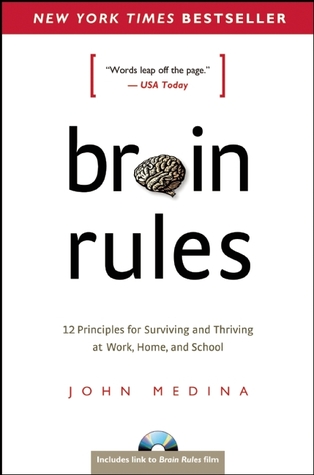
Brain Rules: 12 Principles for Surviving and Thriving at Work, Home, and School (John Medina)

2251306


The brain fascinates me. I loved this book because it explains the science in ways I can understand (I'm really not a science person!) I also liked how he added ideas for ways to implement these ideas in regular work, home and school life.


The 12 rules are:
EXERCISE | Rule #1: Exercise boosts brain power.
SURVIVAL | Rule #2: The human brain evolved, too.
WIRING | Rule #3: Every brain is wired differently.
ATTENTION | Rule #4: We don't pay attention to boring things.
SHORT-TERM MEMORY | Rule #5: Repeat to remember.
LONG-TERM MEMORY | Rule #6: Remember to repeat.
SLEEP | Rule #7: Sleep well, think well.
STRESS | Rule #8: Stressed brains don't learn the same way as non-stressed
SENSORY INTEGRATION | Rule #9: Stimulate more of the senses.
VISION | Rule #10: Vision trumps all other senses.
GENDER | Rule #11: Male and female brains are different.
EXPLORATION | Rule #12: We are powerful and natural explorers.


Goodreads summary:


Most of us have no idea what’s really going on inside our heads. Yet brain scientists have uncovered details every business leader, parent, and teacher should know—like the need for physical activity to get your brain working its best.

How do we learn? What exactly do sleep and stress do to our brains? Why is multi-tasking a myth? Why is it so easy to forget—and so important to repeat new knowledge? Is it true that men and women have different brains?

In Brain Rules, Dr. John Medina, a molecular biologist, shares his lifelong interest in how the brain sciences might influence the way we teach our children and the way we work. In each chapter, he describes a brain rule—what scientists know for sure about how our brains work—and then offers transformative ideas for our daily lives.

Medina’s fascinating stories and infectious sense of humor breathe life into brain science. You’ll learn why Michael Jordan was no good at baseball. You’ll peer over a surgeon’s shoulder as he proves that most of us have a Jennifer Aniston neuron. You’ll meet a boy who has an amazing memory for music but can’t tie his own shoes.

You will discover how:

Every brain is wired differently
Exercise improves cognition
We are designed to never stop learning and exploring
Memories are volatile
Sleep is powerfully linked with the ability to learn
Vision trumps all of the other senses
Stress changes the way we learn

In the end, you’ll understand how your brain really works—and how to get the most out of it.