Showing posts with label homework. Show all posts

Wednesday, July 25, 2018

The Bear Report (Thyra Heder)

Beautiful illustrations! The water color style makes it seem kind of dreamy.


This would be a great book to read when we are doing our animal life cycle reports. Sophie immerses herself in learning when she is assigned a research report. What she ends up sharing is so much more interesting than the first three points she writes down.

Goodreads says:

Sophie does not want to do her homework, a research report on polar bears. Bor-ing. They’re big. They eat things. They’re mean. What else is there to say about them anyway? As it turns out, plenty. And when a polar bear named Olafur swoops her away to the Arctic, she soon learns all about the playful bear’s habits and habitat—from glacier mice to the northern lights—and, despite her first reservations, she finds herself not just interested but excited about the Arctic. When the two are swept out to sea on an iceberg, Sophie’s new knowledge and knack for creative thinking pay off in a big way: she calls a whale to their aid! Inspired by her journey, she’s ready to return home and take another swing at her assignment, this time with gusto.

The Bear Report showcases the power of curiosity and imagination to fill any blank canvas, whether it’s an incomplete homework assignment or the Arctic ice.
 

Saturday, July 16, 2016

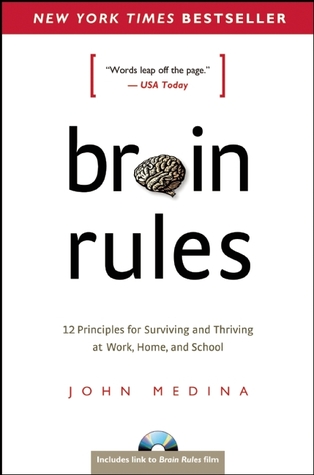
Brain Rules: 12 Principles for Surviving and Thriving at Work, Home, and School (John Medina)

2251306


The brain fascinates me. I loved this book because it explains the science in ways I can understand (I'm really not a science person!) I also liked how he added ideas for ways to implement these ideas in regular work, home and school life.


The 12 rules are:
EXERCISE | Rule #1: Exercise boosts brain power.
SURVIVAL | Rule #2: The human brain evolved, too.
WIRING | Rule #3: Every brain is wired differently.
ATTENTION | Rule #4: We don't pay attention to boring things.
SHORT-TERM MEMORY | Rule #5: Repeat to remember.
LONG-TERM MEMORY | Rule #6: Remember to repeat.
SLEEP | Rule #7: Sleep well, think well.
STRESS | Rule #8: Stressed brains don't learn the same way as non-stressed
SENSORY INTEGRATION | Rule #9: Stimulate more of the senses.
VISION | Rule #10: Vision trumps all other senses.
GENDER | Rule #11: Male and female brains are different.
EXPLORATION | Rule #12: We are powerful and natural explorers.


Goodreads summary:


Most of us have no idea what’s really going on inside our heads. Yet brain scientists have uncovered details every business leader, parent, and teacher should know—like the need for physical activity to get your brain working its best.

How do we learn? What exactly do sleep and stress do to our brains? Why is multi-tasking a myth? Why is it so easy to forget—and so important to repeat new knowledge? Is it true that men and women have different brains?

In Brain Rules, Dr. John Medina, a molecular biologist, shares his lifelong interest in how the brain sciences might influence the way we teach our children and the way we work. In each chapter, he describes a brain rule—what scientists know for sure about how our brains work—and then offers transformative ideas for our daily lives.

Medina’s fascinating stories and infectious sense of humor breathe life into brain science. You’ll learn why Michael Jordan was no good at baseball. You’ll peer over a surgeon’s shoulder as he proves that most of us have a Jennifer Aniston neuron. You’ll meet a boy who has an amazing memory for music but can’t tie his own shoes.

You will discover how:

Every brain is wired differently
Exercise improves cognition
We are designed to never stop learning and exploring
Memories are volatile
Sleep is powerfully linked with the ability to learn
Vision trumps all of the other senses
Stress changes the way we learn

In the end, you’ll understand how your brain really works—and how to get the most out of it.

Tuesday, May 5, 2015

A Fine, Fine School (Sharon Creech)

This reminded me of The Mixed of Files of Mrs. Basil E Frankweiler:

Claudia is telling Mrs. Frankweiler that you should try to learn something every day:

"No," I answered, "I don't agree with that. I think that you should learn, of course, and some days you must learn a great deal. But you should also have days when you allow what is already in you to well up inside of you until it touches everything. And you can feel it inside you. If you never take time out to let that happen, that you just accumulate facts, and they begin to rattle around inside of you. You can make noise with them, but never really feel anything with them. It's hollow."


Goodreads summary:


One day, Mr. Keene called all the students and teachers together and said, "This is a fine, fine school! From now on, let's have school on Saturdays too."And then there was more.

School all weekend.School on the holidays.

School in the SUMMER!

What was next . . .

SCHOOL AT NIGHT?

So it's up to Tillie to show her well-intentioned principal, Mr. Keene, that even though his fine, fine school is a wonderful place, it's not fine, fine to be there all the time.

This would be a great story for before a long break or an end of year story. Learning is important, and it doesn't just happen in the classroom.

This would also be a great book for predicting because it has a pattern, then the pattern changes and if kids are paying attention they'll notice it.

Saturday, July 19, 2014

I Didn't Do My Homework Because.... (Benjamin Chaud)


This book would be really fun to read with my class. Our school gives homework each day and it is a big topic! I wonder if it would work to read this book early in the year after we have talked about homework needing to be done each day as well as the consequences that go with not doing it. Everyone's pretty keen at first, but it doesn't take too long until issues start to creep up. It would be fun to have the kids pick crazy reasons for homework not getting finished, illustrate it, and have it on the bulletin board. I wonder if we could get rid of some of the excuses by having a funny discussion starting by reading this book.

Goodreads Summary:

How many excuses are there for not doing homework? Let us count the ways: Giant lizards invaded the neighborhood. Elves hid all the pencils. And then there was that problem with carnivorous plants.... The excuses go on and on, each more absurd than the next and escalating to hilarious heights. Featuring detail-rich illustrations by Benjamin Chaud, this book is guaranteed to amuse kids and their parents, not to mention anyone who has experienced a slacker student moment—and isn't that everyone?

Here are some of my favorite pages from this book: