Lovely story...perfect for our SS unit. Good example of dot art!
Goodreads says:
The Giving Tree is a charming story that focuses on the boyhood reminisces of Moushoom as he describes finding the «Great Giving Tree» with his mother and father. Steeped in Métis culture, this vibrantly-illustrade children's book is a beautiful retelling of a traditional story. It emphasizes Métis core values and beliefs including strength, kindness, courage, tolerance, honesty, respect, love, sharing, caring, balance, patience, but most importantly, the connection with the Creator and Mother Earth. This book also includes an accompanying narration CD in English and Michif.
Just happened to come across this book in time for Indigenous People's Day! Perfect!
The back of the book says that haw êkwa! is pronounced "how Aygwa" and is a Cree idiom that means "okay then!" The author was the illustrator for David Robertson's book, When We Were Alone.
The "cacussh!" sound through the book sounds just like a skateboard and the pictures flow and make you feel like you are following the skateboarder.
Goodreads says: An extraordinary book that celebrates skateboarding, family, and community, from beloved artist and author Julie Flett, winner of The New York Times / New York Public Library Best Illustrated Children’s Book Award. Every day, a little boy watches kids pass by on skateboards, and dreams of joining them. One day, his mother brings a her old skateboard, just for him! haw êkwa! Let’s go! Together, they practice on the sidewalk, at the park, in Auntie’s yard—everywhere. But when it comes time to try the skatepark, the skateboarders crash down like a waterfall. Can he find the confidence to join them? Let’s Go! This fun and touching story is a tribute to family, friendship, and perseverance. Julie Flett’s renowned art and powerful text shows a community of support is all around, ready to help each other… go!
I'm just an Alberta teacher who loves the earth but also feels a little guilty when I read books about how we should not have pipelines.
Goodreads says:
A young Indigenous water protector named Minnow goes on an underwater journey, learning from our ocean-living relatives. When she returns to the surface, she gathers her community to help make a change.
This story is told in lyrical rhyme and helps children gain a better respect for Indigenous after and land protectors, the environment around them, and helps show children activism at an early age.
We all come from Mother Earth, we all learn from her, and we all live from her. Mother Earth has many children, not just humans. These children are all our relatives, including animals. This book focuses on our relationship with our ocean-living relatives and teaches us what we all must do to nurture and protect them.
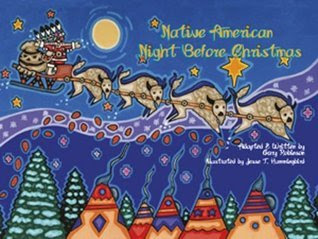
We enjoyed this story. Some of my student's weren't familiar with Twas The Night Before Christmas since many of them don't celebrate Christmas so the connection was kind of lost on them.
A good conversation starter:
- Why is Santa's face red?
- Why do they call him Old Red Shirt?
- How does he go up the smoke hole?
Goodreads says:
An innovative retelling of the classic Christmas tale, Native American Night Before Christmas presents a whimsical look at a Native American Christmas Eve, when Old Red Shirt (the Indian Santa Claus) comes a-calling on his wooden sleigh pulled by a team of flying white buffalo. Jesse Hummingbird's inspired illustration transform the author's playful adaptation into a fresh and modern work of art. A delight for people of all ages and cultures. Winner of the 2010 Moonbeam Award for Holiday Books.
My favorite part: Now, as a great-grandmother, I look back at the time and see what sweet little geniuses we were. In the full face of genocide and cruelty, we secured our families' path for generations to come. We sewed our survival into every stitch. We come from a strong line of artists and geniuses, so we stitch with easy skill.
...We were geniuses. We are geniuses. We will always be geniuses.
Goodreads says: “Captures the sympathy of readers and holds their attention...An age-appropriate telling by an Indigenous creative team of a tragic historical period.”― School Library Journal , starred review The true story of how Indigenous girls at a residential school sewed secret pockets into their dresses to hide food and survive. Mary was four years old when she was first taken away to the Lejac Indian Residential School. It was far away from her home and family. Always hungry and cold, there was little comfort for young Mary. Speaking Dakelh was forbidden and the nuns and priest were always watching, ready to punish. Mary and the other girls had a genius drawing on the knowledge from their mothers, aunts and grandmothers who were all master sewers, the girls would sew hidden pockets in their clothes to hide food. They secretly gathered materials and sewed at nighttime, then used their pockets to hide apples, carrots and pieces of bread to share with the younger girls. Based on the author's mother's experience at residential school, The Secret Pocket is a story of survival and resilience in the face of genocide and cruelty. But it's also a celebration of quiet resistance to the injustice of residential schools and how the sewing skills passed down through generations of Indigenous women gave these girls a future, stitch by stitch.
I'm not one to often read a whole series, so I'm pretty proud of myself for getting to this one, the third book in the series. I would do it again too. I love the magic. I love the soul searching. I love the resolution in this book. I think this book is a great resource for understanding more about First Nation's culture and ways. It's beautiful.
Goodreads says:
It's a race against time to save Eli, in this third book in the award-winning, Narnia-inspired Indigenous middle-grade fantasy series.
After discovering a near-lifeless Eli at the base of the Great Tree, Morgan knows she doesn't have much time to save him. And it will mean asking for help -- from friends old and new. Racing against the clock, and with Arik and Emily at her side, Morgan sets off to follow the trail away from the Great Tree to find Eli's soul before it's too late. As they journey deep into the northern woods, a place they've been warned never to enter, they face new challenges and life-threatening attacks from strange and horrifying creatures. But a surprise ally comes to their aid, and Morgan finds the strength to focus on what's most important: saving her brother's life.
I really loved book 1 and I'd have to say this book is even better. If not a novel study in many classrooms, this series is destined to be read and discussed! Having similar challenges in the real world as well as Misewa was fascinating. It made me think of how if we are connected to where we come from, we are more able to handle life's challenges.
I have to get book 3 right away.....but it's only in hard cover. One of my weird book idiosyncrasies is that I have to have all the books in a series be the same size. The library will have to do. Given that this book was banned though, I will definitely commit to buying the last book in the series, if not multiple copies of all of them. Book 2 ends with a cliff hanger that makes it impossible to not read book 3 right away.
Goodreads says:
Back at home after their first adventure in the Barren Grounds, Eli and Morgan each struggle with personal issues: Eli is being bullied at school, and tries to hide it from Morgan, while Morgan has to make an important decision about her birth mother. They turn to the place where they know they can learn the most, and make the journey to Misewa to visit their animal friends. This time they travel back in time and meet a young fisher that might just be their lost friend. But they discover that the village is once again in peril, and they must dig deep within themselves to find the strength to protect their beloved friends. Can they carry this strength back home to face their own challenges?
There is a reverence that happens when we read First Nation's stories. The students seem to really empathize with the stories.
Goodreads says:
I lost my talk The talk you took away When I was a little girl At Shubenacadie school.
One of Rita Joe’s most influential poems, “I Lost My Talk” tells the revered Mi’kmaw Elder’s childhood story of losing her language while a resident of the residential school in Shubenacadie, Nova Scotia. An often quoted piece in this era of truth and reconciliation, Joe’s powerful words explore and celebrate the survival of Mi’kmaw culture and language despite its attempted eradication.
A companion book to the simultaneously published I’m Finding My Talk by Rebecca Thomas, I Lost My Talk is a necessary reminder of a dark chapter in Canada’s history, a powerful reading experience, and an effective teaching tool for young readers of all cultures and backgrounds. Includes a biography of Rita Joe and striking colour illustrations by Mi’kmaw artist Pauline Young.
Good introduction to sharing circles and the issue of a problem between friends was quite relatable.
Goodreads says:
When two red foxes have an argument which breaks apart their community, a gentle buffalo decides to take a braid of sweetgrass to a local elder and asks her to help with a sharing circle for all the animals.
I'd heard a lot of people talking about having this book on their TBR list. I didn't like the cover and that may have put me off for a while. I also thought the title was kind of odd. However, with so many people talking about it, I figured I should read it.
I loved the story behind how this book came together (manuscript lost and discovered by someone down the line and then published) but I'm sorry to say that I didn't love it. I found the writing to be uncaptivating and the story was just a little too didactic for me. I do think the topic is important and more people need to know these stories. Perhaps because we are so pushed to learn about these things as teachers, it didn't hit me the same. I actually didn't finish it.
Goodreads says:
Regina Petit's family has always been Umpqua, and living on the Grand Ronde reservation is all ten-year-old Regina has ever known. Her biggest worry is that Sasquatch may actually exist out in the forest. But when the federal government signs a bill into law that says Regina's tribe no longer exists, Regina becomes "Indian no more" overnight--even though she was given a number by the Bureau of Indian Affairs that counted her as Indian, even though she lives with her tribe and practices tribal customs, and even though her ancestors were Indian for countless generations.
With no good jobs available in Oregon, Regina's father signs the family up for the Indian Relocation program and moves them to Los Angeles. Regina finds a whole new world in her neighborhood on 58th Place. She's never met kids of other races, and they've never met a real Indian. For the first time in her life, Regina comes face to face with the viciousness of racism, personally and toward her new friends.
Meanwhile, her father believes that if he works hard, their family will be treated just like white Americans. But it's not that easy. It's 1957 during the Civil Rights Era. The family struggles without their tribal community and land. At least Regina has her grandmother, Chich, and her stories. At least they are all together.
In this moving middle-grade novel drawing upon Umpqua author Charlene Willing McManis's own tribal history, Regina must find out: Who is Regina Petit? Is she Indian? Is she American? And will she and her family ever be okay?
This is beautiful. It is based on a true story. Our students read a similar story in grade three in their Open Court anthologies. After we read it we had a big discussion about whether or not this really happened and students looked up additional information.
Goodreads says:
Glashka can . . . but with that mysterious power comes great responsibility. When she discovers thousands of whales trapped in a rapidly freezing inlet, she knows it is up to her to gather the people of her town to help them. Based on an actual event, this inspiring story follows Glashka and her people as they come to understand the importance of all life.
I read this book because it was a nominee for the 2022 Rocky Mountain Book Awards.
It's a small book, like the size of a handbook. In some ways, it is a handbook of reminders of not just treaties, but promises and covenants we make. It is a conversation, like many lessons taught by First Nations' people. I loved the feeling it brings....calming and thoughtful. It would be a good book to read at the beginning of the year when you are establishing class rules and expectations. It is short and could be a read aloud for the day. It would establish a good feeling in the room.
Goodreads says:
The first treaty that was made was between the earth and the sky. It was an agreement to work together. We build all of our treaties on that original treaty.
On the banks of the river that have been Mishomis’s home his whole life, he teaches his granddaughter to listen—to hear both the sounds and the silences, and so to learn her place in Creation. Most importantly, he teaches her about treaties—the bonds of reciprocity and renewal that endure for as long as the sun shines, the grass grows, and the rivers flow.
Accompanied by illustrations by Luke Swinson and an author’s note at the end, Aimée Craft communicates the importance of understanding an Indigenous perspective on treaties.The first treaty that was made was between the earth and the sky. It was an agreement to work together. We build all of our treaties on that original treaty.
On the banks of the river that have been Mishomis’s home his whole life, he teaches his granddaughter to listen—to hear both the sounds and the silences, and so to learn her place in Creation. Most importantly, he teaches her about treaties—the bonds of reciprocity and renewal that endure for as long as the sun shines, the grass grows, and the rivers flow.
Accompanied by illustrations by Luke Swinson and an author’s note at the end, Aimée Craft communicates the importance of understanding an Indigenous perspective on treaties.
This book is bound for greatness! I see a multitude of classrooms doing novel studies. It is going to become a classic, I'm sure of it.
Topics for the classroom:
- foster care
- anger
- environment
Fun reason to read it: I will never forget how fun it was for my daughter to get the Harry Potter books as they came out. People would like up at the bookstore at midnight to get it on the first day and start reading immediately. This book is the first in a four part series. Book one and two are out and three and four are planned but not out yet. This is a chance to get in on the new books when they come out!
"Stories always lead people somewhere, "Arik said. "To a place, to a memory." (p. 232)
Setting Winnipeg in November
Characters: Morgan - 13 Grade 8, in 8th foster home Eli - always has a drawing pad, in grade 7 Kate - a teacher James - a doctor Emily Houldsworth p. 18 Calls Moran "Ghost" Arik p. 124 Fischer p. 62 Mrs Edwards ELA teacher p. 21 Always overdressed Elaborative detail:
p. 194 setting
Notice and Note Signposts
Again and Again p. 40/41 wind bows when Eli draws (C&C?) p. 44 adults apologizes for mistakes p. 47Morgan hates them trying so hard to make her feel at home p. 170 Morgan's dreams of mother (p. 170)
Ah Ha Moment? p. 122 Eli feels more alive in the cold barren grounds Eli being taken by the wolf (p. 172) = Morgan being taken? wolf = persecution by white men?
p. 181 nature of the wolf is to attack. White man's nature is....??
p. 191 Moran realizes she belongs on the land
Goodreads says:
Morgan and Eli, two Indigenous children forced away from their families and communities, are brought together in a foster home in Winnipeg, Manitoba. They each feel disconnected, from their culture and each other, and struggle to fit in at school and at their new home -- until they find a secret place, walled off in an unfinished attic bedroom. A portal opens to another reality, Askí, bringing them onto frozen, barren grounds, where they meet Ochek (Fisher). The only hunter supporting his starving community, Misewa, Ochek welcomes the human children, teaching them traditional ways to survive. But as the need for food becomes desperate, they embark on a dangerous mission. Accompanied by Arik, a sassy Squirrel they catch stealing from the trapline, they try to save Misewa before the icy grip of winter freezes everything -- including them.
While I understand the fear of oil pipelines, I am not sure I agree with the concerns. However, I did read the book. My kids were intrigued by it and did notice it is likely a First Nations story. It's always good to present a different perspective to my classroom of children whose parents are often employed in the oil industry?
Goodreads says:
Inspired by the many Indigenous-led movements across North America, We Are Water Protectors issues an urgent rallying cry to safeguard the Earth's water from harm and corruption--a bold and lyrical picture book written by Carole Lindstrom and vibrantly illustrated by Michaela Goade.
Water is the first medicine. It affects and connects us all . . .
When a black snake threatens to destroy the Earth And poison her people's water, one young water protector Takes a stand to defend Earth's most sacred resource.
We read this book on Epic while everyone was learning at home. It kept everyone's attention, that's for sure. I found it ended really fast though. We wanted to know more about their friendship.
Also, it uses old terms for First Nations people. I just said, "It says...., but I'm going to say First Nations when I read this."
Goodreads says:
In the mid-1800s thousands of pioneers crossed the western plains of the United States using the 2,000-mile pathway called the Oregon Trail. Minnow and her family live in one of the many native villages scattered across the plains. She has a lively sense of adventure and her favorite pastime is swimming in the nearby river where she rightly earns her nickname. Rose and her family are traveling in one of the many wagon trains making their way west. It's been a tedious journey with little excitement. Rose can't wait for something thrilling to happen. And one day it does. On the banks of a rushing river that divides one way of life from another, two very different cultures come face-to-face, with life-changing results.In addition to writing children's books, Judy Young teaches poetry writing workshops for children and educators across the country. Her other books with Sleeping Bear Press include the popular R is for Rhyme: A Poetry Alphabet and The Lucky Star. Judy lives near Springfield, Missouri. A graduate of the Ringling School of Art and Design, Bill Farnsworth has created paintings for magazines, advertisements, children's books, and fine art commissions. He has illustrated more than 50 children's books and his book awards include a Teachers' Choice Award, the 2005 Patricia Gallagher Award, and the 2007 Volunteer State Book Award. Bill lives in Venice, Florida.
This is a story that many wouldn't read because there's so much that is difficult to read about - addiction, homelessness, crime. The only way to get an idea of why some people end up with the lives they do though is to read the details. It's sad and difficult but worth the time if you really want to get a perspective on this topic.
Most of this story is hard. Near the end, he finally makes it through rehab and ends up marrying someone who helps him keep his life together. It all seems to happen really fast in the book - but my guess is it wasn't really fast in real life.
Goodreads says:
In this extraordinary and inspiring debut memoir, Jesse Thistle—once a high school dropout and now a rising Indigenous scholar—chronicles his life on the streets and how he overcame trauma and addiction to discover the truth about who he is.
If I can just make it to the next minute . . . thenI might have a chance to live; I might have a chance to be something more than just a struggling crackhead.
From the Ashes is a remarkable memoir about hope and resilience, and a revelatory look into the life of a Métis-Cree man who refused to give up.
Abandoned by his parents as a toddler, Jesse Thistle briefly found himself in the foster-care system with his two brothers, cut off from all they had known. Eventually the children landed in the home of their paternal grandparents, but their tough-love attitudes meant conflicts became commonplace. And the ghost of Jesse’s drug-addicted father haunted the halls of the house and the memories of every family member. Struggling, Jesse succumbed to a self-destructive cycle of drug and alcohol addiction and petty crime, spending more than a decade on and off the streets, often homeless. One day, he finally realized he would die unless he turned his life around.
In this heartwarming and heartbreaking memoir, Jesse Thistle writes honestly and fearlessly about his painful experiences with abuse, uncovering the truth about his parents, and how he found his way back into the circle of his Indigenous culture and family through education.
An eloquent exploration of what it means to live in a world surrounded by prejudice and racism and to be cast adrift, From the Ashes is, in the end, about how love and support can help one find happiness despite the odds.
At first, I started to feel like this book was a bit of a downer. Every chapter is a story of someone who is an underdog. As I pressed on though, it became more and more compelling to hear their stories. They are stories of people who not only persisted, but accomplished great things despite other people. The more I read, the more inspired I was. I think this book is one of those best taken in full doses. It reminded me of reading a book by Deborah Ellis on First Nations kids called Looks Like Daylight. It wasn't until I had really buried myself in the stories that the feeling took over. This is one of those books that can change you, if you let it.
Goodreads says:
A powerful collection of essays from actors, activists, athletes, politicians, musicians, writers, and teens, including Senator Amy Klobuchar, actress Alia Shawkat, actor Maulik Pancholy, poet Azure Antoinette, teen activist Gavin Grimm, and many, many more, each writing about a time in their youth when they were held back because of their race, gender, or sexual identity--but persisted.
"Aren't you a terrorist?" "There are no roles for people who look like you." "That's a sin." "No girls allowed." They've heard it all. Actress Alia Shawkat reflects on all the parts she was told she was too "ethnic" to play. Former NFL player Wade Davis recalls his bullying of gay classmates in an attempt to hide his own sexuality. Teen Gavin Grimm shares the story that led to the infamous "bathroom bill," and how he's fighting it. Holocaust survivor Fanny Starr tells of her harrowing time in Aushwitz, where she watched her family disappear, one by one.
What made them rise up through the hate? What made them overcome the obstacles of their childhood to achieve extraordinary success? How did they break out of society's limited view of who they are and find their way to the beautiful and hard-won lives they live today? With a foreword by Minnesota senator and up-and-coming Democratic party leader Amy Klobuchar, these essays share deeply personal stories of resilience, faith, love, and, yes, persistence.
"Each tale is a soulful testament to the endurance of the human spirit and reminds readers that they are not alone in their search for self. An unflinchingly honest book that should be required reading for every young person in America."--Kirkus, Starred review
"An invaluable collection of snapshots of American society."--VOYA, Starred review
"[A] gem of a book. . . There's a lot to study here and talk about on the way to becoming kinder, more empathetic, and most important, compassionate."--Booklist
"Readers encountering injustice in their own lives may be compelled to take heart--and even action."--Publishers Weekly
"A powerful collection of voices."--SLJ
"The sheer variation in writing styles, subject-matters, and structure to these narratives provides readers with inspiration in assorted forms and a complex interpretation of what it means to persist."--The Bulletin
I started out by asking my students what they knew about Orange Shirt Day. No one really knew anything except for one student. His brother had read something about Orange Shirt Day and he had quite a lot of knowledge. I started off by telling them that this was historical fiction. The characters in this story might not be real, but what happened to them was real. As we read the story my class became more and more troubled. We have been learning about integrity and how to stand up for something when no one else does. Learning about racism, segregation and residential schools is troubling but necessary. Like Number the Stars as a great way to introduce WWII, the holocaust and all that happened then, this is a similar gentler way to introduce the topic to children.
Goodreads says:
When a young girl helps tend to her grandmother's garden, she begins to notice things that make her curious. Why does her grandmother have long braided hair and beautifully colored clothing? Why does she speak another language and spend so much time with her family? As she asks her grandmother about these things, she is told about life in a residential school a long time ago, where all of these things were taken away. When We Were Alone is a story about a difficult time in history and, ultimately, one of empowerment and strength.
This is an interesting story. I plan to read it because today is Orange Shirt Day. I hope it will be a gentle enough introduction to the atrocities of Residential Schools.
Interestingly, the very concept behind Orange Shirt Day (not allowing the child to wear her orange shirt and instead wear something so that everyone looked the same) is one of the concepts behind our charter school's uniforms. I wonder if any students will make that connection.
I think we all have things from our childhood that didn't sit well. My family were big TV watchers. The TV was always on. Now I can't stand that and in my house we only have the TV on now and then. I'm not sure if that's necessarily better, but it's something that affected my experience growing up, for sure. I can't imagine having experienced what the First Nations people did with residential schools. It is a sad mark on our history. The author of this book does a great job showing how this experience affected every aspect of their lives. Goodreads says: When a young girl helps tend to her grandmother's garden, she begins to notice things that make her curious. Why does her grandmother have long braided hair and beautifully colored clothing? Why does she speak another language and spend so much time with her family? As she asks her grandmother about these things, she is told about life in a residential school a long time ago, where all of these things were taken away. When We Were Alone is a story about a difficult time in history and, ultimately, one of empowerment and strength.
This reminded me of those videos you see on Youtube of a baby the laughs and laughs and laughs and brings such delight to everyone with his or her laugh.
In this story, everyone celebrates the baby's laugh. The get together is one family get together I could relate to. So much food. So many people. So much fun.
The best part was when I read this at the end:
For the Navajo, a child's first laugh always has been a precious moment. They celebrate this even with a First Laugh Ceremony. The baby - with the help of grown-ups - gives small sweet gifts to each guest, so that he will become generous he gives nuggets of rock salt to keep him from being stingy. Then, to bring good luck, the baby is passed from guest to guest.
This would be a great book to give to new parents.
Goodreads says:
From Caldecott
Medalist Stephen Gammell and beloved writer Tony Johnston, this joyous
picture book with audio celebrates the sound of a baby’s laughter.The
family gathers round to hear the sweet sound of the new baby’s sweet
laugh! But just because everyone has gathered doesn’t mean the baby’s
ready. When the moment finally comes, the sound makes everyone else
laugh too—aunts, uncles, cousins, and even great-grandma. It seems no
one can resist the sound of baby’s laugh. And who would want to?
With
simple, endearing text, audio, and Stephen Gammell’s unmistakable art,
this tribute to the joy a young child’s laughter will quickly become a
family favorite.