Showing posts with label survival. Show all posts

Saturday, January 18, 2025

Island of the Blue Dolphins (Scott O'Dell)


I thought my grade three book club was going to pick this as our book for the month so I bought it. They ended up picking another book but then I read Alone and it referred to this book so I decided it was destiny and that I should read it. 

This is one of those classics that I think I probably should have read already, but hadn't. I found it slow and difficult at first, but after a while I felt like I was feeling the vibe. It is one of those books I  almost abandoned but I'm so glad I didn't. In the end, I loved the story and found it quite similar to Alone. For example, there are times hunters come to the island, but she hides from them - just like the character in Alone does when she sees looters on the streets. As a matter of fact, in Alone, Maddie's younger brother has to do a book report on this exact book, which I thought was a strange meeting of the books. That often happens to me! I end up reading a number of books in a row that follow a theme and I have to ask myself, what is the universe trying to tell me??

There were some parts that really touched me:

- Chapter 21 when she meets a girl who has come to the island with some hunters. They smile, teach each other words, exchange gifts and make a friendship. However, soon she is gone when the hunters and their ship leaves. Their interactions were really lovely though. 

- I thought it was interesting that she had a name and a secret name (like the temple?). She actually does share her secret name with this girl - which shows how much it meant to her to make a friend.

 - Chapter 24 has all sorts of stories about her relationship with animals on the island. I thought those were beautiful as well. She has relationships with animals all through the book, but I especially noticed it in this chapter.

- Chapter 25 - She becomes friends with a dog when names Rontu. In chapter 25 Rontu dies and I felt my heart break with hers. Later, she snares some wild dogs and causes a deep sleep to come upon them with a plant that causes sleepiness. She befriends a dog she thinks is Rontu's offspring. I was so happy to her!

In the end, she approaches hunters who come to the island and they take her home. Apparently, her beautiful skirt made with green feathers was sent to Rome but has gone missing. Wikipedia has some great info on the real Lost Woman of St. Nicholas.
 
Goodreads says:
Scott O'Dell's Newbery Medal-winning classic is a gripping tale of survival, strength, and courage. Based on the true story of a Nicole�o Indian girl living alone on an island off the coast of California, Island of the Blue Dolphins has captivated readers for generations.

On San Nicolas Island, dolphins flash in the surrounding blue waters, sea otter play in the vast kelp beds, and sea elephants loll on the stony beaches. Here, in the early 1800s, a girl named Karana spent eighteen years alone.

Karana had to contend with the ferocious pack of wild dogs that killed her younger brother, constantly guard against Aleutian sea otter hunters, and maintain a precarious food supply. Her courage, self-reliance, and grit has inspired millions of readers in this breathtaking adventure.

As Smithsonian magazine put "For kids all over the country, reading the book in language arts classes, Karana is a powerful symbol of their growing independence. Through her, they can imagine themselves making their way in the world alone--and thriving."

Thursday, June 27, 2024

My Father's Dragon (Ruth Stiles Gannett)


Did this as a quick class read/novel study. We focused on keeping a list of characters and writing a couple sentences after each chapter. Couldn't find much in the way of notice and note sign posts. Watched the Netflix movie after. The kids loved both. The movie is very different from the book!

Goodreads says:

Elmer Elevator (narrator's father as a boy) runs away with an old alley cat to rescue a flying baby dragon being exploited on a faraway island. With the help of two dozen pink lollipops, rubber bands, chewing gum, and a fine-toothed comb, Elmer disarms the fiercest of beasts on Wild Island.

Friday, May 24, 2024

The Tree of Life (Elisa Boxer)


My students are fascinated with war and how terrible things happen. This is a great way to talk about that topic with a beautiful aspect. People are amazing.

Goodreads says:


Hope triumphs over fear in this poignant and impactful true story of the Holocaust—a delicate introduction to World War Two history for older picture book readers.

During World War Two, in the concentration camp Terezin, a group of Jewish children and their devoted teacher planted and nurtured a smuggled-in sapling. Over time fewer and fewer children were left to care for the little tree, but those who remained kept lovingly sharing their water with it. When the war finally ended and the prisoners were freed, the sapling had grown into a strong five-foot-tall maple.

Nearly eighty years later the tree’s 600 descendants around the world are thriving . . . including one that was planted at New York City’s Museum of Jewish Heritage in 2021. Students will continue to care for it for generations to come, and the world will remember the brave teacher and children who never gave up nurturing a brighter future.

Tuesday, March 22, 2022

The Girl Who Smiled Beads (Clementine Wamariya)


African countries are full of unbelievable stories. I just recently sat and listened to the stories of someone who lived in the DRC for two years and found the stories a universe away from my experiences. This book is like that. Clemantine's story is amazing. I am sure glad she told it, although, I don't know if I can ever say that I understand it. It's just so much. I have read some other books on the Rawandan war, and while this one starts there, it isn't really about Rawanda because Clemantine and her sister, Claire, are sent away when the war starts. However, the war comes to them and so they have to run. Their horrific journey travels through seven different African countries and then to the states. Her family is eventually reunited through an Oprah show. All doesn't end well there. How do you just start over and continue on when you have been through so much? This book was one I could not put down. It will stay with me for a long time. I have no answers. War is terrible.


Goodreads says:

A riveting story of dislocation, survival, and the power of the imagination to save us.

Clemantine Wamariya was six years old when her mother and father began to speak in whispers, when neighbors began to disappear, and when she heard the loud, ugly sounds her brother said were "thunder." It was 1994, and in 100 days more than 800,000 people would be murdered in Rwanda and millions more displaced. Clemantine and her fifteen-year-old sister, Claire, ran and spent the next six years wandering through seven African countries searching for safety--hiding under beds, foraging for food, surviving and fleeing refugee camps, finding unexpected kindness, witnessing unimaginable cruelty. They did not know whether their parents were alive.

At age twelve, Clemantine, along with Claire, was granted asylum in the United States--a chance to build a new life. Chicago was disorienting, filled with neon lights, antiseptic smells, endless concrete. Clemantine spoke five languages but almost no English, and had barely gone to school. Many people wanted to help--a family in the North Shore suburbs invited Clemantine to live with them as their daughter. Others saw her only as broken. They thought she needed, and wanted, to be saved. Meanwhile Claire, who had for so long protected and provided for Clemantine, found herself on a very different path, cleaning hotel rooms to support her three children.

Raw, urgent, yet disarmingly beautiful, The Girl Who Smiled Beads captures the true costs and aftershocks of war: what is forever lost, what can be repaired, the fragility and importance of memory, the faith that one can learn, again, to love oneself, even with deep scars.

Monday, December 20, 2021

Everything Happens for a Reason, and Other Lies I've Loved (Kate Bowler)


I first was introduced to Kate Bowler when her book, No Cure For Being Human, was chosen for the Happier podcast book club. I loved that book. I had a harder time with this one. A lot of it was the same story as her other book but this one was more philosophical. I found that sometimes I felt buoyed by it and admired her approached and other times I just found it depressing and had to take a break. Recently I have had a friend whose son died after trying for the nth time to get away from drugs. I also had a former student pass away after a 2 year battle with leukemia, searching for a stem cell donor match and in the end, not finding one and having cancer take him. Kate survives her cancer diagnosis and it seems like it has given her a new way to look at life. I especially appreciated the appendixes at the end with tips on and to not do/say to people who are facing death as well as things to do/say. I'm interested in her research about prosperity gospel and plan to read her book, Blessed: The History of the American Prosperisty Gospel, as well as The Preacher's Wife: The Precarious Power of Evangelical Women Celebrities.

She takes on touch topics and topics that I'm interested in. I like her. I plan to add her blog to my blogroll as well as her podcast. 

Goodreads says:

A divinity professor and young mother with a Stage IV cancer diagnosis explores the pain and joy of living without certainty.

Thirty-five-year-old Kate Bowler was a professor at the school of divinity at Duke, and had finally had a baby with her childhood sweetheart after years of trying, when she began to feel jabbing pains in her stomach. She lost thirty pounds, chugged antacid, and visited doctors for three months before she was finally diagnosed with Stage IV colon cancer.

As she navigates the aftermath of her diagnosis, Kate pulls the reader deeply into her life, which is populated with a colorful, often hilarious collection of friends, pastors, parents, and doctors, and shares her laser-sharp reflections on faith, friendship, love, and death. She wonders why suffering makes her feel like a loser and explores the burden of positivity. Trying to relish the time she still has with her son and husband, she realizes she must change her habit of skipping to the end and planning the next move. A historian of the "American prosperity gospel"--the creed of the mega-churches that promises believers a cure for tragedy, if they just want it badly enough--Bowler finds that, in the wake of her diagnosis, she craves these same "outrageous certainties." She wants to know why it's so hard to surrender control over that which you have no control. She contends with the terrifying fact that, even for her husband and child, she is not the lynchpin of existence, and that even without her, life will go on.

On the page, Kate Bowler is warm, witty, and ruthless, and, like Paul Kalanithi, one of the talented, courageous few who can articulate the grief she feels as she contemplates her own mortality.

Friday, July 2, 2021

The King of Jam Sandwiches (Eric Walters)


This is a great story! I love stories of people who figure out how to not just survive, but succeed in life despite everything being against them. The author (who is Canadian!) says this was a very personal story and that he also grew up in poverty. I was left wondering how much of it was directly from his life and how much he made up and who is the girl?! Is she a real person? It sounds like she is, from the afterward.

In some ways, we're all the underdog and this story inspires me to think I can do anything! 

I recently heard it won a 2021 Govenor General's Award for Young People's Literature.


Goodreads says:

★ "Tug at the heartstrings and tickle the funny bone...This warm tale is definitely one for the keeper shelves. Highly recommended."--School Library Journal, starred review

Thirteen-year-old Robbie leads a double life. It's just Robbie and his dad, but no one knows that his dad isn't like most parents. Sometimes he wakes Robbie up in the middle of the night to talk about dying. Sometimes he just leaves without telling Robbie where he's going. Once when Robbie was younger, he was gone for more than a week. Robbie was terrified of being left alone but even more scared of telling anyone in case he was put into foster care. No one can know. Until one day when Robbie has to show the tough new girl, Harmony, around school. Their first meeting ends horribly and she punches Robbie in the face. But eventually they come to realize that they have a lot more in common than they thought. Can Robbie's new friend be trusted to keep his secret?   

Thursday, January 21, 2021

Call It Courage (Armstrong Sperry)


This is kind of the island version of Hatchet. I have recently reorganized my classroom library and in the process took every book off the shelf. There were a bunch that I put aside because I thought I should read them. This was one of them. It's a Newberry Medal winner, published in 1940.  I only gave it a 3 because I don't think it will be one that my students will really love. I'll leave it on my shelves though for those readers who love to explore all sorts of books.


The boy in this story decides to try to prove himself. Everyone teases him about being afraid of the water - and the truth is, he is because it took his mother's life. However, he decides to face his fears, if only to prove something to other people. The vocabulary in the story was tricky for me since I'm really not familiar with island life, sea animals and boats. However, there were some riveting stories of fighting off animals (a shark, a wild boar and an octopus) and people (man-eating people!). 


Goodreads says:

Maftu was afraid of the sea. It had taken his mother when he was a baby, and it seemed to him that the sea gods sought vengeance at having been cheated of Mafatu. So, though he was the son of the Great Chief of Hikueru, a race of Polynesians who worshipped courage, and he was named Stout Heart, he feared and avoided tha sea, till everyone branded him a coward. When he could no longer bear their taunts and jibes, he determined to conquer that fear or be conquered-- so he went off in his canoe, alone except for his little dog and pet albatross. A storm gave him his first challenge. Then days on a desert island found him resourceful beyond his own expectation. This is the story of how his courage grew and how he finally returned home. This is a legend. It happened many years ago, but even today the people of Hikueru sing this story and tell it over their evening fires.

Saturday, November 21, 2020

Circling The Sun (Paula McLain)


Goodreads says:

Brought to Kenya from England as a child and then abandoned by her mother, Beryl Markham is raised by both her father and the native Kipsigis tribe who share his estate. Her unconventional upbringing transforms Beryl into a bold young woman with a fierce love of all things wild and an inherent understanding of nature’s delicate balance. But even the wild child must grow up, and when everything Beryl knows and trusts dissolves, she is catapulted into a string of disastrous relationships. Beryl forges her own path as a horse trainer, and her uncommon style attracts the eye of the Happy Valley set, a decadent, bohemian community of European expats who also live and love by their own set of rules. But it’s the ruggedly charismatic Denys Finch Hatton who ultimately helps Beryl navigate the uncharted territory of her own heart. The intensity of their love reveals Beryl’s truest self and her fate: to fly. 


My review:
I read this book for book club and didn't realize at first that it was a true story. That explained all the long detail about relationships with this person and that person that went nowhere. I was inspired by her ability to keep going despite seeming to have everything against her. She was abandoned by her mother at age 4 (bizarre turn of events) and raised by her father in Africa (Mom got tired of the African life). She rubbed shoulders with the richest of the rich, and went in cycles from poverty to great success. 


Memorable quotes:

p. 132 The more things change the more they stay the same:
"There are some women who'd be expecting a fellow to step up and get serious at some point."
"I that what you're worried about? I can't seem to get rid of teh husband I've got, and anyway, what I'd realy like to know is how it feels to be on my own. Not someone's daughter or wife, I mean...but my own person."

"Oh." It seemed I'd surprised him. "There isn't a lot of that kind of thinking around here."

"Of course there is," I told him, trying to draw a smile. "It's just usually a man who's doing it."

p. 167 Clara's mother to Beryl, after returning to Africa when Beryl was an adult:
"Harry was the joy of my life." Clara's mouth trembled. Her eyes silvered with tears. "You've no idea how hard it's been, wit hthe debts and the uncertainty. And now I'm alone again."

*blink*blink* This coming from a mother who abandoned her daughter. Bizarre.


p. 171 More on Beryl's fragile mother (and who is the total opposite of Beryl):

"I really am sorry for your trouble, "Karen said again and again.

"It's not your fault," Clara assured her, gathering damp bits of her hair into hairpins. But something in her tone told me she did hold Karen responsible - or perhaps me instead. I suppose it wasn't a great surprise to see she had very little gumption or resilience, and yet it made me sad for her. How dreadful it would be if everything toppled you and you folded in. Rain, for instance, not to mention the loss of a husband. She was s pitiful I shouldn't have been irritated with her, but I couldn't help it. By dinnertime, I was too fed up with the whole situation and bolded for Soysambu and my horses - for work, which was never mysterious and never failed to soothe me.


p. 204: This reminded me of the Bible story of the woman caught in adultery. It is after a terrible confrontation with her first husband:
He shrugged. "We're all very liberal until something shines a light on us. Somehow everyone undertands a husband's jealous raging more than a wife's.....indiscretions. It's not fair, but what is?"


p. 302 On society's expectations of women (which Beryl was never very good at meeting):

"Surely you'll stop riding....at least until the aby is born. You have to take care of yourself."
"This is how I take care of myself, don't you see? If we have this baby, I'll need to do my work just as before. I don't know any other way to live."


p. 307 On their impending family:
My body would transform first, and then everything else would follow. I still cared for Mansfield, but I also felt as if I'd boarded a train meant for one place and was no irrevocably going somewhere else entirely. The whole situation made me feel desperate.


p 308 Is this why people have affairs?
....I felt a surge of guilt and awareness. I wasn't trying to toy with Mansfield exactly, but I had been flirting with the princes. In a way, I couldn't help myself. It felt marvelous to smile and make Harry smile, too, or to walk off in a particular way and know that David's eyes were on me. It was childish, and also futile, but for those moments, I believe I was free-spirited and alluring again, as if I still had some measure of control in the world.


p. 341 On knowing when it's time to move on:

"Who has the privilege of knowing what's possible, or the burden, for that matter? I can tell you, though, that I never thought I could leave. I think that's what the dreams mean. I'm not leaving Africa, but slowly, ever so slowly, Africa has begun to seep out of me.


p. 346 When two women love the same man (but actually, neither ever really had him in this case) and how death seals some things that actually never were:

During the brief service, Karen's head sagged to her chest, and I felt a strong urge to go to her. I was the one person there who knew precisely what she'd lost in Denys; she was the only one who could have understood the weight and colour of my sorrow, too. But a shift had taken place, and it held me back. She was his publicly acknowledged widow now. The gods may have stolen him from her, but with his death, she had won him back. No one could challenge their bond, or doubt how she loved him. Or how truly he'd been hers. One day she was going to write about him-write him in such a way that would sela the two of them together forever. And from those pages, I would be absent.


p. 347 Is this the reason for the title? (I really couldn't figure the title out):
We had both tried for the sun, and had fallen, lurching to earth again, tasting melted wax and sorrow. Denys wasn't hers or mine. 

He belonged to no one and never had.

Monday, August 10, 2020

Where The Crawdads Sing (Delia Owens)


Kya is a girl who grows up alone because she is abandoned by everyone. Her father is abusive and this affects her mother so that she eventually leaves. She doesn't ever really recover from having her mother leave her, and eventually we find out that her mother never recovers from abandoning her children. No one really knows Kya. Even the people who do get close to her don't know her. She protects herself because of all the people that leave her. People make judgments about her and don't really ever give her a chance. It's heartbreaking to watch her endure the scorn from other people. Her ability to make sense of people through connections to her understanding of nature and animals is amazing. She has enough skills to survive on her own, but growing up so isolated really becomes a problem for her that she never really gets over. This was particularly interesting to think about in the midst of the pandemic right now where maintaining connections with people is not easy.

The wonderful thing about Kya is she really teaches that we can all do so much more than we think we can do. When things get really difficult, we usually find out we can do way more than we realize we can do. Kya pulls off everything she needs to do. She's witty and gritty and she gets it done.

When I finished this book I had just had to sit with the feeling it left me. The ending is a surprise and made me feel like I needed to sit and be in it for a while longer. 

This book reminded me of so many other books. It's a little bit like Hatchet because she has to survive on her own. It's a little bit like Tara Westover in Educated because her father is abusive and her family abandons her and even though she never goes to school, she learns to read, one day writes books and earns an honorary degree. It also reminded me of Looks Like Daylight, which was full of stories of First Nations kids and their connection to the land. It also has a murder trial just like To Kill A Mockingbird.

Meaning of the title: when Tate and Kya are looking for a place to hang out, her friend, Tate, suggests that they go somewhere “where the crawdads sing.” He explains to Kya that it means “far in the bush where critters are wild, still behaving like critters.”


Goodreads says:


For years, rumors of the “Marsh Girl” have haunted Barkley Cove, a quiet town on the North Carolina coast. So in late 1969, when handsome Chase Andrews is found dead, the locals immediately suspect Kya Clark, the so-called Marsh Girl. But Kya is not what they say. Sensitive and intelligent, she has survived for years alone in the marsh that she calls home, finding friends in the gulls and lessons in the sand. Then the time comes when she yearns to be touched and loved. When two young men from town become intrigued by her wild beauty, Kya opens herself to a new life–until the unthinkable happens.

Perfect for fans of Barbara Kingsolver and Karen Russell, Where the Crawdads Sing is at once an exquisite ode to the natural world, a heartbreaking coming-of-age story, and a surprising tale of possible murder. Owens reminds us that we are forever shaped by the children we once were, and that we are all subject to the beautiful and violent secrets that nature keeps.
 

Spoiler alert:

Why did Kya keep the shell necklace?
The shell necklace that Kya gives to Chase becomes a manifestation of the dissonance between her desire to be loved and her wariness to let other people into her life. ... However, Kya ends up putting the shell on a necklace that she later gives to Chase as a gift.

Thursday, March 26, 2020

The Invention of Wings (Sue Monk Kidd)


There is nothing I like better than a story of truly inspiring women. This is definitely one. The story is told from Sara Grimke's and Handful's point of view. Sarah, from early on, knew slavery was wrong, despite her family's practice of owning slaves. Handful is well named. She is a slave who suffers but doesn't lie down. Handful was not a real person. She is mostly made up by the author. Sarah Grimke, on the other hand, was a real person.

I loved this book and read it slowly so as to carefully soak up all the story into my heart. I hope I can be someone who stands up for those who need someone to speak up, rather than just accepting that that is the way things are.

"History is not just facts and events. History is also a pain in the heart and we repeat history until we are able to make another's pain in the heart our own." - Professor Julius Lester

One of the most striking moments in the story is when the slave owner comes across the quilt that Handful's mother has made. It tells the story of her life:

p. 336 - 337
"We looked back and forth to each other while little missus squinted from one square to the next like she was reading a book. Everything done to mauma - there it was. the one-legged punishment, the whippings, the branding, the hammering. mama's body laid on the quilt frame in pieces...."Who made this?"
"Mauma did. Charlotte."
"Well, it's gruesome!"
I never had wanted to scream as bad as I did right then. I said, "Those gruesome things happened to her."
A dark pink color poured into her cheeks. "For heaven's sakes then, you would think her whole life was nothing but violence and cruelty. I mean, it doesn't show what she did to warrant her punishments."
She looked at the quilt again, her eyes darting over the appliques. "We treated her well here, no one can dispute that. I can't speak for what happened to her when she ran away, she was out of our care then." Little missus was rubbing her hands now like she was cleaning them at the wash bowl.
The quilt had shamed hr. She walked to the door and took one look back at it, and I knew she'd never let it stay in the world. She'd send Hector to gt it the minute we were out of the room. He'd burn mauma's story to ash.
Standing there, waiting for little missus' steps to fade, I looked down at the quilt, at the slaves flying in the sky, and I hated being a slave worse than being dead. The hate I felt for it glittered so full of beauty I sank down on the floor before it.


That's the moment when Handful is ready to run away....and she does.


This is the second Sue Monk Kidd book I've read. I am thinking this summer might need to be a Sue Monk Kidd summer.


Goodreads says:

Writing at the height of her narrative and imaginative gifts, Sue Monk Kidd presents a masterpiece of hope, daring, the quest for freedom, and the desire to have a voice in the world—and it is now the newest Oprah’s Book Club 2.0 selection.

Hetty “Handful” Grimke, an urban slave in early nineteenth century Charleston, yearns for life beyond the suffocating walls that enclose her within the wealthy Grimke household. The Grimke’s daughter, Sarah, has known from an early age she is meant to do something large in the world, but she is hemmed in by the limits imposed on women.

Kidd’s sweeping novel is set in motion on Sarah’s eleventh birthday, when she is given ownership of ten year old Handful, who is to be her handmaid. We follow their remarkable journeys over the next thirty five years, as both strive for a life of their own, dramatically shaping each other’s destinies and forming a complex relationship marked by guilt, defiance, estrangement and the uneasy ways of love.

As the stories build to a riveting climax, Handful will endure loss and sorrow, finding courage and a sense of self in the process. Sarah will experience crushed hopes, betrayal, unrequited love, and ostracism before leaving Charleston to find her place alongside her fearless younger sister, Angelina, as one of the early pioneers in the abolition and women’s rights movements.

Inspired by the historical figure of Sarah Grimke, Kidd goes beyond the record to flesh out the rich interior lives of all of her characters, both real and invented, including Handful’s cunning mother, Charlotte, who courts danger in her search for something better.

This exquisitely written novel is a triumph of storytelling that looks with unswerving eyes at a devastating wound in American history, through women whose struggles for liberation, empowerment, and expression will leave no reader unmoved.

Sunday, January 19, 2020

The River (Gary Paulsen)


This is the second book in the Hatchet series. For this one, a psychologist wants to study Brian and his survival instincts. Of course, things go wrong. It's the same riveting crazy style journey. I enjoyed the different focus that brought out Brian's thinking through difficulties. It ends abruptly and wraps up quickly in the last chapter, just like the first book did.

I hope this kid doesn't go off into the wilderness again...but there are two more books.

Goodreads says:
These words, spoken to Brian Robeson, will change his life. Two years earlier, Brian was stranded alone in the wilderness for fifty-four days with nothing but a small hatchet. Yet he survived. Now the government wants him to do it again to go back into the wilderness so that astronauts and the military can learn the survival techniques that kept Brian alive.
This time he won't be alone: Derek Holtzer, a government psychologist, will accompany him to observe and take notes. But during a freak storm, Derek is hit by lightning and falls into a coma. Their radio transmitter is dead. Brian is afraid that Derek will die of dehydration unless he can get him to a doctor. His only hope is to build a raft and try to transport Derek a hundred miles down the river to a trading post if the map he has is accurate.


Wednesday, August 14, 2019

The Wild Robot (Peter Brown)

Wow! I couldn't stop reading when I started The Wild Robot. It's a beautiful and compelling story. I have book two on audio book waiting for me from the public library so I plan to jump into it right away. I have to know what happens to Roz.

I think it would make a great One School One Book selection. It is a simple story for young kids and has enough complex issues for discussion.

Peter Brown is the author of many picture books that we have read and loved:
Creepy Carrots!
Children Make Terrible Pets
Mr. Tiger Goes Wild
My Teacher is a Monster (No I'm Not!)

February 3, 2021: Read this aloud to my class. They were totally captivated by the story. I was a little worried that the violence at the end of the story when the Ricoh robots come to take Roz back would be too much - but they actually seemed to totally love it. This story really kept them on the edge of their seat.

May 6, 2022: Read aloud was a huge success. Students want me to read book 2 but we are going to use it in our literature circle/in-class book clubs.

Notice and Note Signposts

Tough Question? Ah ha Moment? Contrast and Contradiction?
p. 118 It was the first ship either of them had ever laid eyes on. From that distance, it looked as though it were moving slowly, but it was actually racing through the waves. From the distance, it looked as though it were small, but it was actually one of the largest ships ever built. The robot and the gosling watched it drawl across the ocean until it finally disappeared to the south.
Where had the ship come from? Where was it going? Who was on board? Roz and Brightbill had many questions but no answers.

Contrast and Contradiction
What does it mean to be alive?
p. 125 "What do you mean, you're not alive?" squawked Brightbill.
"It's true," said Roz. "I am not an animal. I do not eat or breathe. I am not alive."
"You move and talk and think, Mama. You're definitely alive."

Roz and the animals versus the Recos
Chapters 70-75

Memory Moment
Chapter 63 The Journey: Brightbill tells Roz about his migration experiences. Lots of foreshadowing!

October 29, 2022: Read it as a read-aloud again. It was a hit once again. I decided I will not read the second book aloud and instead will encourage students to read it on their own. 
Interestingly, this year a lot of kids had a hard time with the pronouns for Roz. Even though she was a mother. Even though the book clearly talks about the character as a she, they often referred to Roz initially as he. This video made me think maybe children are starting to break the barriers of gender stereotypes?

https://vm.tiktok.com/ZMFSsN8S7/ 

Goodreads says:

When robot Roz opens her eyes for the first time, she discovers that she is alone on a remote, wild island. Why is she there? Where did she come from? And, most important, how will she survive in her harsh surroundings? Roz's only hope is to learn from the island's hostile animal inhabitants. When she tries to care for an orphaned gosling, the other animals finally decide to help, and the island starts to feel like home. Until one day, the robot's mysterious past comes back to haunt her.... 

Tuesday, June 18, 2019

Tuck Everlasting (Natalie Babbitt)


It's been a while since I've read this book. I still love it. I think I've read it more than two times - but it might have been before I started tracking on GoodReads. I read it again this year with my class...and I cried. This group has been an interesting group. Usually, my class tires of me reading it aloud and asks if they can read some of it on their own. These guys are perfectly happy to have me read and so I read the ENTIRE thing aloud. Maybe that's why it touched me a little more. I did my very best to read with good expression. LOL It's full of drama!

p 62 (chapter 12) Tuck to Winnie, on the pond in a fishing boat: ....Everything's a wheel, turning and turning, never stopping. The frog is part of it, and the bugs, and the fish, and the wood thrush, too. And people. But never the same ones. Always coming in new, always growing and changing, and always moving on. That's the way it's supposed to be. That's the way it is."

p 63: That's what us tuck are, Winnie. Stuck so's we can't move on. We ain't part of the wheel no more. Dropped off, Winnie. Left behind. And everywhere around us, things is moving and growing and changing. You, for instance. A child now, but someday a woman. And after that, moving on to make room for the new children."

"....dying's part of the wheel, right there next to being born. You can't pick out the pieces you like and leave the rest. Being part of teh whole thing, that's the blessing. But it's passing us by, us Tucks. Living's heavy work, but off to one side, the way we are, it's useless, too. It don't make sense. If I knows how to climb back on the wheel, I'd do it in a minute. You can't have living without dying. So you can't call it living, what we got. We just are, we just be, like rocks beside the road."

Goodreads says:

Doomed to - or blessed with - eternal life after drinking from a magic spring, the Tuck family wanders about trying to live as inconspicuously and comfortably as they can. When ten-year-old Winnie Foster stumbles on their secret, the Tucks take her home and explain why living forever at one age is less a blessing that it might seem. Complications arise when Winnie is followed by a stranger who wants to market the spring water for a fortune. 

Friday, March 22, 2019

Because of Winn Dixie (Kate DiCamillo)

This is one of those books that when I finished it, I couldn't believe I hadn't read it before. It's definitely one to re-read. It is also one of those books that made me cry - which is pretty rare. It might have been because I read some chapters aloud to my class. (I always get so much more from a book when I read it aloud) All the heartache Opal has over her mother really pulled at my heart strings. We are doing this book for grade 3 book club this month. I'm going to put a poster up for kids to add a picture and 10 things about their pet, like Opal likes to list. She learns 10 things about her mother and later lists 10 things about Winn Dixie. There are plenty of laugh out loud moments in this book. It would be a great read aloud - if only the grade fours didn't often do it as a novel study.

Goodreads says:

Kate DiCamillo's beloved, best-selling debut novel is now available in a paperback digest edition.

Kate DiCamillo's first published novel, like Winn-Dixie himself, immediately proved to be a keeper—a New York Times bestseller, a Newbery Honor winner, the inspiration for a popular film, and most especially, a cherished classic that touches the hearts of readers of all ages. It's now available in a paperback digest format certain to bring this tale's magic to an even wider circle of fans.

The summer Opal and her father, the preacher, move to Naomi, Florida, Opal goes into the Winn-Dixie supermarket—and comes out with a dog. A big, ugly, suffering dog with a sterling sense of humor. A dog she dubs Winn-Dixie. Because of Winn-Dixie, the preacher tells Opal ten things about her absent mother, one for each year Opal has been alive. Winn-Dixie is better at making friends than anyone Opal has ever known, and together they meet the local librarian, Miss Franny Block, who once fought off a bear with a copy of WAR AND PEACE. They meet Gloria Dump, who is nearly blind but sees with her heart, and Otis, an ex-con who sets the animals in his pet shop loose after hours, then lulls them with his guitar.

Opal spends all that sweet summer collecting stories about her new friends and thinking about her mother. But because of Winn-Dixie or perhaps because she has grown, Opal learns to let go, just a little, and that friendship—and forgiveness—can sneak up on you like a sudden summer storm.

Friday, November 16, 2018

Rockbound (Frank Parker Day)


This is another one of those books I would have never read if it weren't for Book Club, however, I'm glad I read it.

Truthfully, I found it hard to follow. The dialogue made it especially difficult and I found myself needing to read it aloud to even come close to understanding it. I'm not patient enough to read and re-read lines to try to figure it out. The accept though was really reminiscent of how my husband talks about Nova Scotia from the time he spent there on his mission.

Apparently, when the book was written, people from the area were angry about it because they felt like they were portrayed negatively. I can see why they'd feel that way. The superstition, the lack of education and survival mentality is heavy. I did love the parts about the teacher coming to the island and David wanting to learn to read. I'm not sure he was really successful though.

The Maritimes is a harsh and unforgiving place. Interestingly, it continues. This was a news article from today:

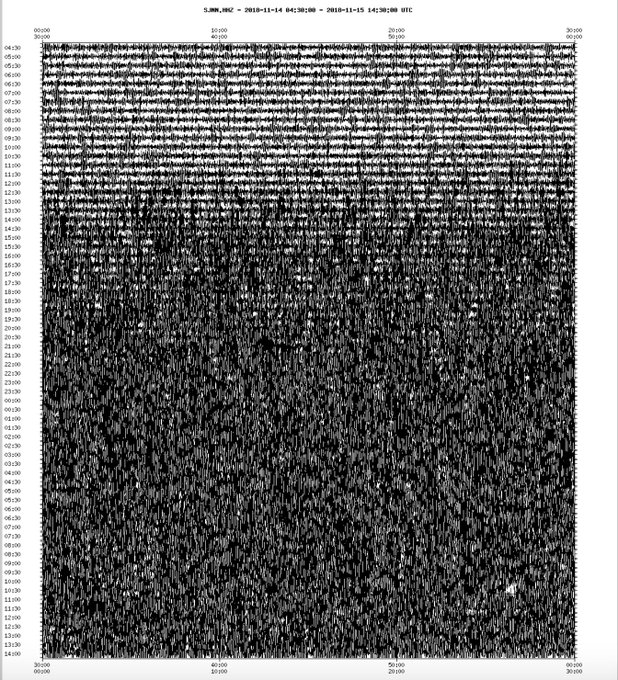
Seismic records show Newfoundland was literally shaking from wind and waves

Seismometer in St. John's shows how intense Thursday's winds were

Heavy seas crash into the land at the Drook, a spot on the road to Cape Race. (Submitted by Clifford Doran)
The waves crashing into the rugged shoreline of Newfoundland and Labrador this week led to waves of a different kind.
The squiggly black lines produced by a Natural Resources Canada seismometer show the seismic activity of a vicious windstorm that whipped across the province on Wednesday and Thursday.
The wind and waves were so strong, the island was shaking.
"What we saw over the past 48 hours was quite a dramatic change in [activity]," said John Cassidy, an earthquake seismologist with Natural Resources Canada. 
"It was very noticeable and in our seismic data, our plots, it just jumped off the page. You could just see that shaking."
The federal government has seismometers — tools that measure earth movements — all across the country.
Cassidy said each year, a handful of storms will produce winds and waves strong enough to record seismic activity on the east and west coast.
And over time, as these weather events impact older infrastructure, it just breaks down.- Randy Oram, Karwood Homes
With winds gusting between 100 and 140 km/h, the conditions were just right to get the Rock rocking.
"It's that combination of the wind, that incredible wind, and the waves that were hitting the island," Cassidy said. 
"Both of those, the waves and the wind, gets trees shaking, rocks shaking ... And all of that can be recorded by our seismometers on the island."

Homebuilders association reacts

Randy Oram, president of the Newfoundland and Labrador branch of the Canadian Home Builders' Association, said people have to prepare for these earth-quivering storms to be the new normal.
There was damage reported to home and businesses across the province, but Oram said his company, Karwood Homes, has yet to receive any reports of damage.
When asked why some homes suffer damage and others go unscathed, Oram said it has to do with location and age.
"With these weather events, some of the extremes can be localized," he said. "And over time, as these weather events impact older infrastructure, it just breaks down."​
Oram said the industry is changing as the weather worsens, and contractors need to keep up with the standards.
"You look at shingles we were using 15 years ago, they were rated for 97 km/h winds. What we're using nowadays, 210 kilometres is what they're rated for. As climate change happens, building products advance."
It was very noticeable and in our seismic data, our plots, it just jumped off the page. You could just see that shaking.- Seismologist John Cassidy
 
Randy Oram, president of the Newfoundland and Labrador branch of the Canadian Home Builders' Association, said standards are changing to meet climate change. (Paula Gale/CBC)
Part of the industry is regulated by Natural Resources Canada, which is currently working on a five-year project on adaptations to home building for climate change.
Where it used to study historical weather events, Natural Resources Canada is now trying to model future storms and set standards based on what is expected to happen, Oram said.
"They're actually looking at where the weather is going in the future, and testing new products and codes for the future."
With files from the St. John's Morning Show