Showing posts with label true stories. Show all posts

Monday, May 13, 2024

Pig On The Titanic (Gary Crew)


I feel like the title of this is kind of click bait. It wasn't a real pig. Someone had a good luck pig that made music. It is a true story...and it's a cute story, especially for Titanic aficionados! 


Goodreads says:

 A pig on a passenger liner?

Impossible!
No! No! It's me ...
Maxixe, the music box pig! Everyone knows the story of the night the great ship Titanic sank. But few know the story of Maxixe, one of the unsung heroes of that night, and how this small musical pig soothed the fears of a lifeboat full of children. Based on true events, this dramatic story by author Gary Crew is told through the charming and compassionate voice of Maxixe, and is brought to life by the stunning artwork of illustrator Bruce Whatley.

Tuesday, November 23, 2021

Watercress (Andrea Wang)


The author's note at the back of this book makes the book even more meaningful. My class totally got it. We all have stories and some we are leery to share...but we really should share them.

Goodreads says:

Gathering watercress by the side of the road brings a girl closer to her family's Chinese Heritage.

Driving through Ohio in an old Pontiac, a young girl's parents stop suddenly when they spot watercress growing wild in a ditch by the side of the road. Grabbing an old paper bag and some rusty scissors, the whole family wades into the muck to collect as much of the muddy, snail covered watercress as they can.

At first, she's embarrassed. Why can't her family get food from the grocery store? But when her mother shares a story of her family's time in China, the girl learns to appreciate the fresh food they foraged. Together, they make a new memory of watercress.

Andrea Wang tells a moving autobiographical story of a child of immigrants discovering and connecting with her heritage, illustrated by award winning author and artist Jason Chin, working in an entirely new style, inspired by Chinese painting techniques. An author's note in the back shares Andrea's childhood experience with her parents.

Thursday, March 26, 2020

The Invention of Wings (Sue Monk Kidd)


There is nothing I like better than a story of truly inspiring women. This is definitely one. The story is told from Sara Grimke's and Handful's point of view. Sarah, from early on, knew slavery was wrong, despite her family's practice of owning slaves. Handful is well named. She is a slave who suffers but doesn't lie down. Handful was not a real person. She is mostly made up by the author. Sarah Grimke, on the other hand, was a real person.

I loved this book and read it slowly so as to carefully soak up all the story into my heart. I hope I can be someone who stands up for those who need someone to speak up, rather than just accepting that that is the way things are.

"History is not just facts and events. History is also a pain in the heart and we repeat history until we are able to make another's pain in the heart our own." - Professor Julius Lester

One of the most striking moments in the story is when the slave owner comes across the quilt that Handful's mother has made. It tells the story of her life:

p. 336 - 337
"We looked back and forth to each other while little missus squinted from one square to the next like she was reading a book. Everything done to mauma - there it was. the one-legged punishment, the whippings, the branding, the hammering. mama's body laid on the quilt frame in pieces...."Who made this?"
"Mauma did. Charlotte."
"Well, it's gruesome!"
I never had wanted to scream as bad as I did right then. I said, "Those gruesome things happened to her."
A dark pink color poured into her cheeks. "For heaven's sakes then, you would think her whole life was nothing but violence and cruelty. I mean, it doesn't show what she did to warrant her punishments."
She looked at the quilt again, her eyes darting over the appliques. "We treated her well here, no one can dispute that. I can't speak for what happened to her when she ran away, she was out of our care then." Little missus was rubbing her hands now like she was cleaning them at the wash bowl.
The quilt had shamed hr. She walked to the door and took one look back at it, and I knew she'd never let it stay in the world. She'd send Hector to gt it the minute we were out of the room. He'd burn mauma's story to ash.
Standing there, waiting for little missus' steps to fade, I looked down at the quilt, at the slaves flying in the sky, and I hated being a slave worse than being dead. The hate I felt for it glittered so full of beauty I sank down on the floor before it.


That's the moment when Handful is ready to run away....and she does.


This is the second Sue Monk Kidd book I've read. I am thinking this summer might need to be a Sue Monk Kidd summer.


Goodreads says:

Writing at the height of her narrative and imaginative gifts, Sue Monk Kidd presents a masterpiece of hope, daring, the quest for freedom, and the desire to have a voice in the world—and it is now the newest Oprah’s Book Club 2.0 selection.

Hetty “Handful” Grimke, an urban slave in early nineteenth century Charleston, yearns for life beyond the suffocating walls that enclose her within the wealthy Grimke household. The Grimke’s daughter, Sarah, has known from an early age she is meant to do something large in the world, but she is hemmed in by the limits imposed on women.

Kidd’s sweeping novel is set in motion on Sarah’s eleventh birthday, when she is given ownership of ten year old Handful, who is to be her handmaid. We follow their remarkable journeys over the next thirty five years, as both strive for a life of their own, dramatically shaping each other’s destinies and forming a complex relationship marked by guilt, defiance, estrangement and the uneasy ways of love.

As the stories build to a riveting climax, Handful will endure loss and sorrow, finding courage and a sense of self in the process. Sarah will experience crushed hopes, betrayal, unrequited love, and ostracism before leaving Charleston to find her place alongside her fearless younger sister, Angelina, as one of the early pioneers in the abolition and women’s rights movements.

Inspired by the historical figure of Sarah Grimke, Kidd goes beyond the record to flesh out the rich interior lives of all of her characters, both real and invented, including Handful’s cunning mother, Charlotte, who courts danger in her search for something better.

This exquisitely written novel is a triumph of storytelling that looks with unswerving eyes at a devastating wound in American history, through women whose struggles for liberation, empowerment, and expression will leave no reader unmoved.

Monday, July 1, 2019

The Girl Who Named Pluto: The Story of Venetia Burney (Alice B McGinty)


Who would have thought it was a little girl that named Pluto? Great story!

One of my favorite As it Happens stories on CBC was the one where people vented their anger over Pluto no longer being a planet. This book even addresses that in the afterward.

Goodreads says:

An empowering, inspiring--and accessible!--nonfiction picture book about the eleven-year-old girl who actually named the newly discovered Pluto in 1930. 

When Venetia Burney's grandfather reads aloud from the newspaper about a new discovery--a "ninth major planet" that has yet to be named--her eleven-year-old mind starts whirring. She is studying the planets in school and loves Roman mythology. "It might be called Pluto," she says, thinking of the dark underworld. Grandfather loves the idea and contacts his friend at London's Royal Astronomical Society, who writes to scientists at the Lowell Observatory in Massachusetts, where Pluto was discovered. After a vote, the scientists agree unanimously: Pluto is the perfect name for the dark, cold planet.
Here is a picture book perfect for STEM units and for all children--particularly girls--who have ever dreamed of becoming a scientist.
 

Saturday, March 17, 2018

Fatty Legs (Chisty Jordan-Fenton and Margaret Pokiak-Fenton)

8585187

Education is in a bit of a change and we are moving towards a greater expectation to teach issues and history around First Nations so I'm always looking for books that bit the bill. I have had this one on my shelf for a while. I read the first couple of chapters when considering it for grade three book club and decided not to have it as a book suggestion because I was worried it would get into uncomfortable issues around residential schools. However, now that I have finished it, I realize I'd be quite comfortable reading it with my class. I think if we don't do it for book club I might see if I could find a way to do it as a novel study. It seems to have enough of the issues but not get into sexual abuse. I really like her focus on wanting to learn to read. There are lots of good topics for discussion in this book.

Goodreads says:

The moving memoir of an Inuit girl who emerges from a residential school with her spirit intact.

Eight-year-old Margaret Pokiak has set her sights on learning to read, even though it means leaving her village in the high Arctic. Faced with unceasing pressure, her father finally agrees to let her make the five-day journey to attend school, but he warns Margaret of the terrors of residential schools.

At school Margaret soon encounters the Raven, a black-cloaked nun with a hooked nose and bony fingers that resemble claws. She immediately dislikes the strong-willed young Margaret. Intending to humiliate her, the heartless Raven gives gray stockings to all the girls -- all except Margaret, who gets red ones. In an instant Margaret is the laughingstock of the entire school.

In the face of such cruelty, Margaret refuses to be intimidated and bravely gets rid of the stockings. Although a sympathetic nun stands up for Margaret, in the end it is this brave young girl who gives the Raven a lesson in the power of human dignity.

Complemented by archival photos from Margaret Pokiak-Fenton's collection and striking artwork from Liz Amini-Holmes, this inspiring first-person account of a plucky girl's determination to confront her tormentor will linger with young readers.

Monday, February 8, 2016

A Telling Time (Irene Watts)


Sometimes you pull a book off the library's shelf and it's a win. Sometimes it's not. This one wasn't so great for our class. The story is quite deep and requires a lot of background knowledge of the story of Purim, Queen Esther and more. My kids were totally lost.

Our read a book a day goal is a real benefit to when we have Reading Buddies with the grade ones. They have many books that have been read to them and they're familiar with and as a result, they do a little better job reading with their  buddies. I don't think I'll put this one on the shelf for that. Just won't work for Reading Buddies.

Quite a beautiful story if you are familiar with those topics though!


This tale is told in three time-frames. On the eve of the Festival of Purim, a grandmother tells her granddaughter how, as a little girl, she heard the story of Queen Esther from her family rabbi. This was in 1939, in Nazi-occupied Vienna, on the eve of WWII. Soon after the rabbi begins the story of the brave queen, soldiers come to arrest him. The young girl begs for the rabbi to finish his story, and the soldiers allow him to do so. When the tale is over, the soldiers permit him to send the children home. But when the children turn to wave goodbye, the rabbi had vanished in the snowflakes, safe from harm, saved by the miracle of a story from long ago. The illustrations by Kathryn Shoemaker perfectly highlight the story's message of hope. 

Wednesday, August 12, 2015

The Wife, The Maid and The Mistress (Ariel Lowhon)


I learned about this book from one of my favourite podcasts, Books on the Nightstand: https://itunes.apple.com/ca/podcast/books-on-the-nightstand/id278076085?mt=2&i=347675868

In the podcast, the author tells a great follow up story to the book. 

I really loved this book. I had trouble, at first, keeping all the characters straight. I am glad I stuck with it though. There were a number of times I responded out loud with gasps or laughter to things happened in the story. This is a great mystery. It is based on a real life account, still unsolved, of someone who went missing in the 1930's.

Goodreads summary:
One summer night in 1930, Judge Joseph Crater steps into a New York City cab and is never heard from again. Behind this great man are three women, each with her own tale to tell: Stella, his fashionable wife, the picture of propriety; Maria, their steadfast maid, indebted to the judge; and Ritzi, his showgirl mistress, willing to seize any chance to break out of the chorus line.

As the twisted truth emerges, Ariel Lawhon’s wickedly entertaining debut mystery transports us into the smoky jazz clubs, the seedy backstage dressing rooms, and the shadowy streets beneath the Art Deco skyline.
(less)


Friday, June 5, 2015

Pedro and Me (Judd Winnick)

I learned about this book from a Nerdy Book Club blog post.

This is a true story. It's about a man who is HIV +. The author meets him when they make it through the auditions for an MTV series and become roommates in the house where the show is filmed. The story talks about prejudisms and misunderstandings around the disease.

My best friend's brother died of HIV/AIDs about the same time. When I think of the sadness and the shame around that time, it breaks my heart. No one was really willing to talk about it. Frankly, they still have a hard time talking about it. I'm glad there are some people making efforts to make those kinds of things change.


I'm coming a bigger fan of graphic novels all the time. They express a story in a way that is different than just print. The pictures mixed with the words can be very moving.

This picture of them all surrounding his bed when he died.....makes me stop and feel the moment. Powerful.


Some of the pictures were hilarious. Again, they captured the feelings from the moment so perfectly.


The author captured the process of grieving so beautifully with this poem:


Sunday, May 31, 2015

Wild (Cheryl Strayed)

Good Reads summary:

At twenty-two, Cheryl Strayed thought she had lost everything. In the wake of her mother’s death, her family scattered and her own marriage was soon destroyed. Four years later, with nothing more to lose, she made the most impulsive decision of her life. With no experience or training, driven only by blind will, she would hike more than a thousand miles of the Pacific Crest Trail from the Mojave Desert through California and Oregon to Washington State — and she would do it alone.Told with suspense and style, sparkling with warmth and humor, Wildpowerfully captures the terrors and pleasures of one young woman forging ahead against all odds on a journey that maddened, strengthened, and ultimately healed her. 


This book is a story of a woman trying find herself. After her mother's death, breakdown of her marriage and sibling relationships, she decides it is time to go find herself by hiking the Pacific Crest Trail. 


P. 31 Blood is thicker than water, my mother had always said when I was growing up, a sentiment I'd often disputed. But it turned out it didn't matter whether she was right or wrong. They both flowed out of my cupped palms.

It took me way longer to read this book than it should have. I kept having to put it down because Cheryl Strayed stressed me out! 

I was disturbed by things this girl did and I worried about her....I had to take breaks but I also couldn't stop reading. I had to make sure she was going to be okay. From riding with hitch hikers to losing her boot and walking in duct tape to having no money to waking up to being covered in frogs to sex with strangers (although, there isn't as much of that as I originally worried) to losing her toenails. I reeled at the way she chose to make connections:

P. 269  Speaking of her mother: It felt like she was with me always, metaphorically at least. And in a way it was literal too. When we'd finally laid down that tombstone and spread her ashes into the dirt, I hadn't spread them all. I'd kept a few of the largest chunks in my hand. I'd stood for a long while, not ready to release theem to the earth. I didn't release them. I never would.
I put her burnt bones into my mouth and swallowed them whole.


The story starts off with her mother dying. I read that chapter as my mother was in the hospital getting a pacemaker. I had to take a break from reading because the idea of losing one's mother was a little too real in that moment. 

Her stories of what life was like with her siblings seemed so (potentially) real to me. It was heartbreaking. Her mother dying fractured her family.

She talked about getting divorced from her husband even though she loved him. She respected him. He felt the same about her, it seems - but somehow their life fell apart. Her story seemed so real and so relatable. It is frightening how quickly life and marriage can unravel. 

Cheryl Strayed has a great talent for evoking emotion. When I read about how fun her step dad was when they first met him, I smiled and laughed out loud. When I read about her having to put her mother's horse down I felt like I had to turn away. I was horrified. 

There was great symbolism as well. The pack that she carries is way to heavy for her - symbolic, I think of how she carried emotions way too heavy for herself as well.

So much regret in this book. She remembers her mother, on her deathbed, bemoaning the fact that she was always responsible towards someone, whether it was as a daughter, wife or mother:
P. 273 "I never got to be in the drivers seat of my own life," she'd wept to me.....I've never just been me."

Cheryl, in the other hand, learns to be comfortable with and by herself. That was one great triumph of her experience: 
...I liked him perhaps a thousand times.....For once I didn't ache for a companion. For once the phrase a woman with a hole in her heart didn't thunder in my head. That phrase, it didn't even live for me anymore.

Re: drugs and finding herself while on the trail p. 290 I'd finally come to understand that what it had. Been: a yearning for a way out, when actually what I had wanted was to find a way in. I was there now. Or close.

This is a great story. I totally recommend it, if you can hack the journey!

Warning: swearing is kind of commonplace in this book. While the author doesn't describe sex scenes in detail, there are a number of instances of casual sex

Saturday, January 10, 2015

Brown Girl Dreaming (Jacqueline Woodson)

I learned about this book from a Nerdy Book Club post by Donalyn Miller. I've seen a lot of tweets about it as well. It seemed like a book that I needed to carve out some special time for. I was fascinated that the entire book is written in verse. How weird could that be? It wasn't weird. It was beautiful and had magic. As Donalyn Miller said, "Jackie catches words, blows on them, and floats them on to me." 

I wanted this book to go on forever. I tend to be a fast reader. This book made me want to slow down and savor every word. Seriously.

Goodreads Summary:


Jacqueline Woodson, one of today's finest writers, tells the moving story of her childhood in mesmerizing verse.  A novel in verse. Raised in South Carolina and New York, Woodson always felt halfway home in each place. In vivid poems, she shares what it was like to grow up as an African American in the 1960s and 1970s, living with the remnants of Jim Crow and her growing awareness of the Civil Rights movement. Touching and powerful, each poem is both accessible and emotionally charged, each line a glimpse into a child’s soul as she searches for her place in the world. Woodson’s eloquent poetry also reflects the joy of finding her voice through writing stories, despite the fact that she struggled with reading as a child. Her love of stories inspired her and stayed with her, creating the first sparks of the gifted writer she was to become. 
I got this book from the library and must apologize to the librarian for all the pages I had to turn down. They were the pages I just couldn't quite let go of yet.

I loved the image this stirs.
p. 131 sometimes, no words are needed
Deep winter and the night air is cold. So still,
it feels like the world goes on forever in the darkness
until you look up and the earth stops
in a ceiling of stars. My head against
my grandfather's arm,
is a blanket around us as we sit on the front porch swing.
Its whine like a song.

You don't need words 
on a night like this. Just the warmth
of your grandfather's arm. Just the silent promise
That the world as we know it
will always be here.

I hope I can help all my students feel like this about school:
p. 158 first grade
My hand inside my sister's hand,
We walk the two blocks fo P.s. 106 - 
I am six years old and
my sister tells me our school was once a castle.
I believe her. The school stretches for a full city block.
Inside
marble stairs wind their way to classrooms filled
with dark wood desks
nailed down to dark wood floors polished to a high
and beautiful shine.

I am in love with everything around me,
the dotted white lines moving
across my teacher's blackboard, the smell of chalk,
the flag jutting out from the wall and slowly swaying 
above me.

There is nothing more beautiful than P.s. 106.
Nothing more perfect than my first-grade classroom.
No one more kind than Ms. Feidler, who meets me
at the door each morning,
takes my hand from my sister's, smiles down and says,
Now that Jacqueline is here, the day can finally begin.

And I believe her.
Yes. I truly believe her.

Jacqueline Woodson is a Jehovah's Witness and that plays a role in the story. It was a unique view into a religion I really don't understand.
p. 162 flag
When the kids in my class ask why
I am not allowed to pledge to the flag
I tell them It's against my religion but I don't say,
I am in the world but not of the world. This,
they would not understand.
Even though my mother's not a Jehovah's Witness,
she makes us follow their rules and
leave the classroom when the pledge is being said.

Every morning, I walk out with Gina and Alina
the two other Witnesses in my class.
Sometimes, Gina says,
Maybe we should pray for the kids inside
who don't know that God said
"No other idols before me." That our God
is a jealous God.
Gina is a true believer. Her Bible open
during reading time. But Alina and I walk through
our roles as Witnesses as though this is the part
we've been given in a play
and once offstage, we run free, sing
"America the Beautiful" and "The Star-Spangled Banner"
far away from our families - knowing every word.

Alina and I want
more than anything to walk back into our classroom
press our hands against our hearts, Say,
"I pledge allegiance..." loud
without our jealous God looking down on us.
  Without our parents finding out.
Without our mothers' voices
in our heads saying, You are different.
Chosen.
Good.

When the pledge is over, we walk single file
back into the classroom, take our separate seats
Alina and I far away from Gina. But Gina
always looks back at us - as if to say,
I'm watching you. As if to say,
I know.

Jacqueline also struggles with comparing herself to her brilliant sister:
p. 169 gifted
Everyone knows my sister
is brilliant. The letters come home folded neatly
inside official-looking envelopes that my sister proudly
hands over to my mother.
Odella has achieved
Odella has excelled at
Odella has been recommended to
Odella's outstanding performance in

She is gifted
we are told
And I imagine presents surrounding her.

I am not gifted. When I read, the words twist
twirl across the page.
When they settle, it is too late.
The class has already moved on.

I want to catch words one day. I want to hold them
then blow gently,
watch them float
right out of my hands.

I was really taken by her ability to describe her difficulties with reading.
p. 226 reading
I am not my sister.
Words from the books curl around each other
make little sense
until
I read them again
and again, the story
settling into memory. Too slow
the teacher says.
Read faster.
Too babyish, the teacher says.
Read older.
but I don't want to read faster or older or 
any way else that might
make the story disappear too quickly from where
  it's settling
inside my brain,
slowly becoming 
a part of me.
A story I will remember
long after I've read it for the second, third,
tenth, hundredth time.

I know this story! It's called Stevie. 
p. 227 stevie and me
Every Monday my mother takes us
to the library around the corner. We are allowed
to take out seven books each. One those days,
no one complains
that all I want are picture books.

These days no one tells me to read faster
to read harder books
to read like Dell

No one is there to say, Not that book,
when I stop in front of the small paperback 
with a brown boy on the cover.
Stevie.

I read:
One day my momma told me,
"You know you're gonna have
a little friend come stay with you."
And I said, "Who is it?"

If someone had been fussing with me
to read like my sister, I might have missed
the picture book filled with brown people, more
brown people than I'd ever seen
In a book before.

The little boy's name was Steven but 
his mother kept calling him Stevie.
My name is Robert but my momma don't

call me Robertie.

If someone had taken
that book out of my hand
said, You're too old for this
maybe
I'd never have believed
that someone who looked like me
could be in the pages of the book
that someone who looked like me
had a story.


One fascinating part of the story was the aftermath of segregation. During her time as a child there wasn't segregation, well, sort of. I wish I was more like Jacqueline Woodson when it comes to change. I'm a little more like the grandma sometimes though, a little afraid to step out. And when I do step out, I do it pretty quietly. I don't like that about myself.
p. 237 what everybody knows now

Even though the laws have changed
my grandmother still takes us
to the back of the bus when we go downtown
in the rain. It's easier, my grandmother says,
than having white folks look at me like I'm dirt.

But we aren't dirt. We are people
paying the same fare as other people.
When I say this to my grandmother,
she nods, says, Easier to stay where you belong.

I look around and see the ones
who walk straight to the back. See
the ones who take a seat up front, daring
anyone to make them move. And know
this is who I want to be. Not scared
like that. Brave
like that.

Still, my grandmother takes my hand downtown
pulls me right past the restaurants that have to let us sit
wherever we want now. No need in making trouble
she says.  You'll all go back to New York City but
I have to live here.

We walk straight past Woolworth's
without even looking in the windows
because the one time my grandmother went inside
they made her wait and wait. Acted like
I wasn't even there. It's hard not to see the moment - 
my grandmother in her Sunday clothes, a hat
with a flower pinned to it
neatly on her head, her patent-leather purse,
perfectly clasped
between her gloved hands - waiting quietly
long past her turn.


Wednesday, December 17, 2014

A Chanakah Noel (Sharon Jennings)

 
This is a wonderful story. There are so many of us who live amongst people who celebrate in different ways. Everyone's traditions are special and it is nice to find ways to be a part of it even if you are not a part of that religion or culture.
 
We read this book on Tumblebooks.
 
Goodreads summary:
 

When Charlotte and her family move to France, there is a lot to adjust to. Because she can't speak French, Charlotte is put in the lowest grade, which she doesn't like. And what she dislikes the most is when Colette, a girl in her class, calls her a "foreigner." But the holidays are coming, and Charlotte is fascinated by the preparations being made for Christmas--"Noel" in French. To her disappointment, her mother tells her that this is not for their family, they will have Chanukah instead. But when Charlotte learns that Colette's family will miss Christmas too, not because they are Jewish but because they are poor, she puts aside her hurt feelings and convinces her parents that they should give Christmas to Colette's family, as a gift.


Saturday, March 8, 2014

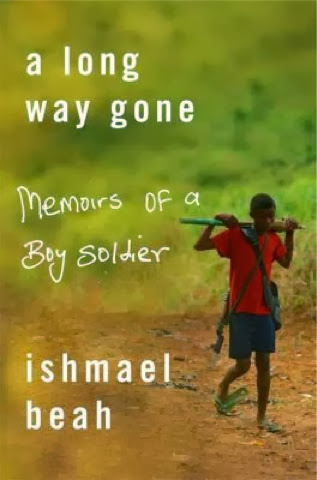
Long Way Gone (Ishmael Beah)

Considering all the boys went through in this story, it is really trite to say this, but this was a hard book to read. I took a long time to get through it because I kept having to take breaks. I couldn't handle too much of it for too long. It is difficult to give words to the emotions stirred by this book. It is a story, however, that should be heard.

First, I was so heartbroken for Ishmael to lose his family in such violence. After that, for him to have to simply run and hope for the kindness of strangers to help him out was also heartbreaking. He was the same age as my own son is now. When he was taken by the army to be a boy soldier, I was horrified with the violence and drugs. It never ended though. Even when he was taken away from the army to be rehabilitated, it was painful to read! The violence and hate was deep n these boys and thinking they would be removed from the army and go on to a better life was niiave. Inear the end of the book, after being rehabilitated, he finds family again, only to have to run for his life when war breaks out again.

I wonder, as Ishmael did, why do I get to keep living such a good life when others go through so much horror?


Sunday, January 26, 2014

My story (Elizabeth Smart)


I don't know what to rate this book on Goodreads. To give it a one star because of the lack of depth in the writing seems disrespectful. To give it five stars seems to give credence to the horror that David Mitchell and Wanda Barzee inflicted on Elizabeth. It isn't the most beautifully crafted story. However, the story truly is astounding. Elizabeth's resilience is remarkable and she is a testament to the miracle of the atonement available to all. I found myself cringing as I read it, and unable to out it down as a groped for the hope I knew would come at the end. Thank goodness for happy endings. Her dedication to important principles like gratitude and not letting anyone steal anymore of her happiness are astounding.

Saturday, December 7, 2013

The Stamp Collector (Jennifer Lanthier)

Beautiful and haunting. It doesn't really strike me as a children's book though. It is a wonderful way to tell the story if the need for story, or the tragedy if oppression, and how it can be overcome.

Goodreads summary:

A city boy finds a stamp that unlocks his imagination; a country boy is captivated by stories. When they grow up, the two boys take different paths – one becomes a prison guard, the other works in a factory – but their early childhood passions remain. When the country boy’s stories of hope land him in prison, the letters and stamps sent to him from faraway places intrigue the prison guard – and a unique friendship begins.