Showing posts with label Art history. Show all posts

Tuesday, March 24, 2026

Frida Kahlo - She Painted Her World in Self Portraits (Amy Guglielmo)


This author has an amazing number of books on artists. 

This one is really complete....lots of information. It wouldn't work great as a read aloud in my class because there is just so much information - but if you did a study of Frida and her art, it would be awesome. She was very inspiring.

Goodreads says:

See how iconic artists like Frida Kahlo were influenced by their environments in this beautiful series produced in collaboration with The Met.

See the world through Frida Kahlo’s eyes and be inspired to produce your own masterpieces.

Have you ever wondered exactly what your favorite artists were looking at to make them draw, sculpt, or paint the way they did? In this charming illustrated series of books to keep and collect, created in full collaboration with The Metropolitan Museum of Art, you can see what they saw, and be inspired to create your own artworks, too. In What the Artist Frida Khalo , meet the famous Mexican painter. Learn all about how she experimented with different ways of painting herself, and how she channeled her experiences into her art. Have a go at producing your own self portrait!

In this series, follow the artists’ stories and find intriguing facts about their environments and key masterpieces. Then see what you can see and make your own art. Take a closer look at landscapes, or even yourself, with Vincent van Gogh. Try crafting a story in fabric like Faith Ringgold, or carve a woodblock print at home with Hokusai. Every book in this series is one to treasure and keep – perfect for budding young artists to explore exhibitions with, then continue their own artistic journeys.

Friday, August 4, 2023

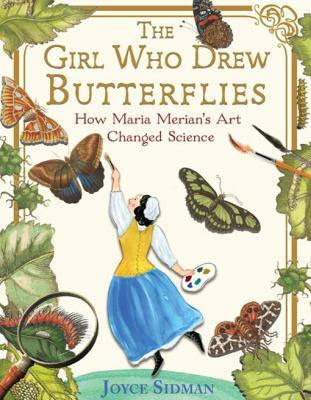
The Girl Who Drew Butterflies (Joyce Sidman)


This is a story of a girl from the 1600 and 1700s and her fascination with insects. It was interesting to read about the things they used to think (insects came from dung and/or mud and butterflies were known as summer birds that came out from somewhere in the summer only) and how it changed and the role she played. It is really the story of Maria Merian's life. The author creatively organized her life into chapters connected to the butterfly life cycle (egg, hatching, molting, pupa, etc.) I don't think this is really a children's book though. The vocabulary is definitely beyond your average eight year old. However, it is in the J section at the library. I hope that doesn't mean it will become an undiscovered treasure.


Goodreads says:

In this beautiful nonfiction biography, a Robert F. Sibert Medal winner, the Newbery Honor-winning author Joyce Sidman introduces readers to one of the first female entomologists and a woman who flouted convention in the pursuit of knowledge and her passion for insects.

One of the first naturalists to observe live insects directly, Maria Sibylla Merian was also one of the first to document the metamorphosis of the butterfly.

Richly illustrated throughout with full-color original paintings by Merian herself, The Grew Who Drew Butterflies will enthrall young scientists.

Bugs, of all kinds, were considered to be "born of mud" and to be "beasts of the devil." Why would anyone, let alone a girl, want to study and observe them? The Girl Who Drew Butterflies answers this question.


Booklist Editor's ChoiceChicago Public Library Best of the YearKirkus Best Book of the Year Bulletin Blue Ribbon BookJunior Library Guild SelectionNew York Public Library Top 10 Best Books of the Year

Tuesday, May 23, 2023

The Noisy Paintbox


Amazing story about a boy whose senses seem to merge. This blew my class' mind! We know a lot about the senses, about sound and about colors and how to mix them. We did not know that they can have such a connection! 


Goodreads says:


In this exuberant celebration of creativity, Barb Rosenstock and Mary Grandpre tell the fascinating story of Vasily Kandinsky, one of the very first painters of abstract art. Throughout his life, Kandinsky experienced colors as sounds, and sounds as colors--and bold, groundbreaking works burst forth from his noisy paint box.

Wednesday, May 17, 2023

The Last Painting of Sara De Vox (Dominic Smith)


I read this book over a short period of time (a couple days) and that was probably was good because I am not sure I would have stuck with it if I was reading it at a more leisurely pace. There is a lot of jumping between time for each character and I found that confusing. Each chapter switches from one character to another and to another time. I enjoyed learning about the art and history of artists and their "union" rules. I read it for book club and this book was a perfect example of why I love being in a book club. I enjoyed the book enough and it is one I would not have read if it wasn't for book club. It got 'meh' ratings from everyone at book club.

Goodreads says:

This is what we long for: the profound pleasure of being swept into vivid new worlds, worlds peopled by characters so intriguing and real that we can't shake them, even long after the reading's done. In his earlier, award-winning novels, Dominic Smith demonstrated a gift for coaxing the past to life. Now, in The Last Painting of Sara de Vos, he deftly bridges the historical and the contemporary, tracking a collision course between a rare landscape by a female Dutch painter of the golden age, an inheritor of the work in 1950s Manhattan, and a celebrated art historian who painted a forgery of it in her youth.

In 1631, Sara de Vos is admitted as a master painter to the Guild of St. Luke's in Holland, the first woman to be so recognized. Three hundred years later, only one work attributed to de Vos is known to remain--a haunting winter scene, At the Edge of a Wood, which hangs over the bed of a wealthy descendant of the original owner. An Australian grad student, Ellie Shipley, struggling to stay afloat in New York, agrees to paint a forgery of the landscape, a decision that will haunt her. Because now, half a century later, she's curating an exhibit of female Dutch painters, and both versions threaten to arrive. As the three threads intersect, The Last Painting of Sara de Vos mesmerizes while it grapples with the demands of the artistic life, showing how the deceits of the past can forge the present.

Wednesday, October 24, 2018

The First Drawing (Modicai Gerstein)


Questions discussed:

Student: Why did the author say: You look up; You look back; Your eyes begin to close....etc.


Me: What genre is the story?

We settled on historical fiction although there are a lot of non-fiction text features. There is an author note at the end of the book explaining that in 1994 a cave was discovered in southern France with drawings made more than 30,000 years ago - 15,000 years older than all he other drawings known at the time. In the cave, they also found a child's footprint and the footprint of a wolf. Good questions ensued: But did a boy really stand in front of a woolly mammoth? 


They were also a little perplexed as to whether or not the main character was a boy or a girl. The character wore clothing without a shirt sometimes and  had quite long and messy hair.

I loved the ending. Referring to drawing, it says: And it's still MAGIC!


Goodreads says:

Imagine you were born before the invention of drawing, more than thirty thousand years ago.
You would live with your whole family in a cave and see woolly mammoths walk by!
You might even see images of animals hidden in the shapes of clouds and rocks.
You would want to share these pictures with your family, but wouldn't know how.
Who would have made the world's first drawing? Would it have been you?

In The First Drawing, Caldecott Medal winner Mordicai Gerstein imagines the discovery of drawing...and inspires the young dreamers and artists of today.
 

Tuesday, September 5, 2017

The Wonderful Towers of Watts (Patricia Zelver)

700543

Kids love REAL stories. This one is a true story of a man with an interesting hobby (fettish?) for building towers. It turns out there really was a Simon Rodia and he built so many amazing things there is now a center called The Watts Towers Arts Center. I want to visit it the next time I'm in LA!

Goodreads summary:

One man's monument to his neighborhood.

Thursday, July 6, 2017

The Elegance of the Hedgehog (Muriel Barbery)


My goodness. I started this book in April and it took me until July to finish it. I had a hard time getting into it. One of the problems was the words. oh the words in this book!! There were so many words I'm just unfamiliar with. Is all the wordiness really necessary??

page 1 There he stood, the most recent eructation of the ruling corporate elite-a class that reproduces itself solely by means of virtuous and proper hiccups....
eruct (verb) to belch forth, as gas from a stomach or to emit or issue violently, as matter from a volcano
"You ought to read The German Ideology," I told him. Little cretin in his confer green duffle coat.
cretin (noun) a stupid, obtuse or mentally defective person

Then there was the rambling. It rambles on and on and seems to not be about anything. One of the great readers I admire and follow in Goodreads is Donalyn Miller. She abandoned the book and said:

Abandoned on page 145. I could not connect to the characters at all and did not care what happened to them. Perhaps, I would have liked it better if I was French-- the book was originally published in France.

However, this is one of those books that makes me glad I"m in a book club. I did finally finish it. I had to re-start it a number of times and it took a deadline to get me to finish it. And in the end, I'm glad I did.

The story is set in France and I have a great love affair with everything French. Despite their social awkwardness and preference to be invisible, I really did enjoy getting to know Renee ( "a widow, short, ugly, chubby", with "bunions on my feet and, on certain difficult mornings, it seems, the breath of a mammoth") and Paloma. There's something about those two that we all live.

You have to be really smart to read this book, I think. I'm glad I have my book club to help me get more out of it than I could ever get on my own.


Goodreads says:

We are in the center of Paris, in an elegant apartment building inhabited by bourgeois families. Renée, the concierge, is witness to the lavish but vacuous lives of her numerous employers. Outwardly she conforms to every stereotype of the concierge: fat, cantankerous, addicted to television. Yet, unbeknownst to her employers, Renée is a cultured autodidact who adores art, philosophy, music, and Japanese culture. With humor and intelligence she scrutinizes the lives of the building's tenants, who for their part are barely aware of her existence.
Then there's Paloma, a twelve-year-old genius. She is the daughter of a tedious parliamentarian, a talented and startlingly lucid child who has decided to end her life on the sixteenth of June, her thirteenth birthday. Until then she will continue behaving as everyone expects her to behave: a mediocre pre-teen high on adolescent subculture, a good but not an outstanding student, an obedient if obstinate daughter.
Paloma and Renée hide both their true talents and their finest qualities from a world they suspect cannot or will not appreciate them. They discover their kindred souls when a wealthy Japanese man named Ozu arrives in the building. Only he is able to gain Paloma's trust and to see through Renée's timeworn disguise to the secret that haunts her. This is a moving, funny, triumphant novel that exalts the quiet victories of the inconspicuous among us.


Sunday, June 26, 2016

The Invention of Hugo Cabret (Brian Selznick)

I'm not one to re-read books very often. I have read this book a number of times though and love it every time. I have done this as a read-aloud before (good thing for smart boards where you can easily show all the pictures!) and this year I decided to do it as a novel study. I have done other Brian Selznick books before. It has always been a fantastic experience. The tricky part is getting enough copies of the book. It is an expensive book to buy so I haven't even dared ask the school to buy a class set. Instead, the Calgary Public Library kindly got enough copies that we could share a book amongst two students. It was wonderful!

I love it how kids take more care with illustrations. In this book you cannot ignore the illustrations. They tell the story as much as the words do, and sometimes tell you parts of the story the words have not told you.

Most of my students have not read a book as big as this one (although many claim they have...they are really moreso in the Geronimo Stilton mode as a whole, it seems). This one is a great stretcher and hopefully they will go on to read Wonderstruck and The Marvels this summer.

Recently, I have been reading Notice and Note and have tried to implement its strategies when I'm reading. I definitely plan to start using these strategies next year with book club.

Some of my favorite quotes and some of the Notice and Note signposts I noticed:

This is a great look into how we often can't know everything about someone else. Sometimes people do things that seem mean and they would totally not give themselves the same label because they have reasons for what they're doing.
p. 168 Hugo blinked. He had never thought of himself as mean before. The old man was mean, not him. Hugo had no choice...he had to keep secrets, but he couldn't explain this to the girl.

Again and again (Everytime Hugo is about to steal something he tubs his buttons):
p. 186  Hugo continued flipping through the book, seeing if there was anything at all about automata, but the book was silent on the subject. Still, Hugo wanted it very much. He knew that Monsieur Labisse lent books to Isabelle, but Hugo didn't want to just borrow this one. He wanted to own it.
He slipped it under his arm and inched toward the door. He rubbed the remaining buttons on his jacket...

Ah ha moment (Hugo and Isabelle realize maybe they can help Papa Georges find happiness):
p. 374 "Did you ever notice that all machines are made for some reason?" he asked Isabelle. "They are built ot make you laugh, like a mouse here, or to tell the time, like clocks, or to fill you with wonder, like the automaton. Maybe that's why a broken machines always makes me a little sad, because it isn't able to do what it was meant to do."
Isabelle picked up the mouse, wound it again, and set it down.
"Maybe it's the same with people," Hugo continued. "If you lose your purpose...it's like you're broken."

then on p. 494 Isabelle and Hugo find out that Papa Georges was the one who painted an interesting picture of Prometheus that they saw. He says: "Then you know that Prometheus was rescued in the end. His chains were broken, and he was finally set free." The old man squinted one of his eyes and added, "How about that."

Goodreads summary:

Orphan, clock keeper, and thief, Hugo lives in the walls of a busy Paris train station, where his survival depends on secrets and anonymity. But when his world suddenly interlocks with an eccentric, bookish girl and a bitter old man who runs a toy booth in the station, Hugo's undercover life, and his most precious secret, are put in jeopardy. A cryptic drawing, a treasured notebook, a stolen key, a mechanical man, and a hidden message from Hugo's dead father form the backbone of this intricate, tender, and spellbinding mystery. 


Wednesday, March 2, 2016

Moonlight Over Paris (Jennifer Robson)


I loved this book. You can't tell by how long it took me - but I found myself wanting to just immerse myself in Paris life as I read. It is report card season right now so I had less time to read - but when I did I found myself reading for an hour and not even realizing I had been immersed in the book that long.

I loved how Helena followed her dreams, messing up along the way, but persisting. I found myself wondering if it was a true reflection of what life was like in Paris back then and, given Jennifer Robson's great historian skills, I tend to think it was pretty spot on. I marvelled at people wanting to separate themselves from family fortunes. Really?! What harm is there in having a big pile of money?! :)

This is a book (series!) I'll definitely read again.

Goodreads summary:

USA Today and internationally bestselling author Jennifer Robson takes readers to 1920s Paris in an enthralling new historical novel that tells the riveting story of an English lady who trades in her staid aristocratic life for the mesmerizing salons and the heady world of the Lost Generation.

It’s the spring of 1924, and Lady Helena Montagu-Douglas-Parr has just arrived in France. On the mend after a near-fatal illness, she is ready to embrace the restless, heady allure of the City of Lights. Her parents have given her one year to live with her eccentric aunt in Paris and Helena means to make the most of her time. She’s quickly drawn into the world of the Lost Generation and its circle of American expatriates, and with their encouragement, she finds the courage to pursue her dream of becoming an artist.

One of those expats is Sam Howard, a journalist working for the Chicago Tribune. Irascible, plain-spoken, and scarred by his experiences during the war, Sam is simply the most fascinating man she has ever met. He’s also entirely unsuitable.

As Paris is born anew, rising phoenix-like from the ashes of the Great War, Helena realizes that she, too, is changing. The good girl she once was, so dutiful and obedient, so aware of her place in the world, is gone forever. Yet now that she has shed her old self, who will she become, and where, and with whom, does she belong…?
 

Wednesday, June 24, 2015

Wonderstruck (Brian Selznick)


I read this book years ago with my class. We did it again as an end of year novel study. Once again, it did not disappoint. This is a fantastic story. Brian Selznick seems to have a keen interest in theatre. Both this book and The Invention of Hugo Cabret involve cinema. Apparently his third book, The Marvels, does as well.

Goodreads Summary:


Reading it with my class this year was a really great experience. I got 9 copies of the book from the public library (thank you Calgary Public Library!) and we shared. I was so impressed with all the details we got this time around thanks to very observant students. Brian Selznick says that everything in his pictures is purposeful. I believe it!


Traditionally, when we do novel studies, it is paired with a workbook full of all sorts of comprehension questions, crossword puzzles, games and activities. I really simplified for this novel, and instead of a big booklet like that I usually use, we had a page where we wrote down cool vocabulary, some pages where we wrote summaries for each part of the book (it is divided into three parts) and then a page with finger spelling. At first, we'd stop when we came across cool words and write them down, but there was a lot of moaning and groaning. Eventually, I decided that isn't what real readers do. Instead, I gave them some sticky notes and had them put a sticky when they came across a word they thought was cool or didn't understand. The next day we'd start off our reading time by writing down 4 or 5 of these cool words and their definitions. Usually, we could get the meaning from the context. I encouraged kids, when they're reading other books, to use stickies to mark spots they want to remember to tell someone about or write about or have questions about.


Activity ideas:


  • Pair this book with Matchbox Diary and make our own boxes of wonder
  • Make a diorama about something we have been studying (pair with life cycle unit?)


Friday, March 20, 2015

From the Mixed-Up Files of Mrs. Basil E Frankweiler (E.L. Konigsburg)

I read this book because the Gr 4 students at my school were reading it for Battle of the Books. It's one of those books that I always thought I should read, but just never did. I'm glad to say I've now finally read it.

Unfortunately, the book wasn't a big hit with the students in my Battle of the Books group. I can see why. There isn't a lot of gripping action. It's a simple story. The mystery is good though if you appreciate art!

This book is a Newberry winner. I sure would like to be in some of those meetings where they pick the Newberry winners. I'd love to hear their reasoning.

Goodreads summary:


When suburban Claudia Kincaid decides to run away, she knows she doesn’t just want to run from somewhere, she wants to run to somewhere — to a place that is comfortable, beautiful, and, preferably, elegant. She chooses the Metropolitan Museum of Art in New York City. Knowing her younger brother Jamie has money and thus can help her with a serious cash-flow problem, she invites him along.

Once settled into the museum, Claudia and Jamie find themselves caught up in the mystery of an angel statue that the museum purchased at auction for a bargain price of $225. The statue is possibly an early work of the Renaissance master, Michelangelo, and therefore worth millions. Is it? Or isn’t it?

Claudia is determined to find out. Her quest leads her to Mrs. Basil E. Frankweiler, the remarkable old woman who sold the statue, and to some equally remarkable discoveries about herself.


I thought the author did a great job of Claudia's reasons to run away. She feels unappreciated and thinks running away will teach her parents a good lesson. After all, how is it fair that she has to both unload the dishwasher AND set the table? Mothers everywhere would snicker. Children everywhere would nod their heads in agreement!

I also thought Claudia was really good at picking good resources. She chose the particular brother she did simply because he was good with money.  That's important when you're heading out on your own for the first time.

Favorite quotes:

Chapter 9: Claudia is talking to Mrs. Frankweiler about her running away. Mrs. Frankweiler wants her to tell her where they stayed, but Claudia doesn't want to tell her.

...If I tell, then I know for sure that my adventure is over. And I don't want it to be over until I'm sure I've had enough."
"The adventure is over. Everything gets over, and nothing is ever enough. Except the part you carry with you. It's the same as going on vacation. Some people spend all their time on a vacation taking pictures so that when they get home they can show their friends evidence that they had a good time. They don't pause to let the vacation enter inside of them and take that home."

then later:

I continued, "Returning with a secret is what she really wants. Angel had a secret and that made her exciting, important. Claudia doesn't want adventure. She likes baths and feeling comfortable too much for that kind of thing. Secrets are the kind of adventure she needs. Secrets are safe, and they do much to make you different. On the inside where it counts. I won't actually be getting a secret from you; I'll be getting details. I'm a collector of all kinds of things besides art," I said, pointing to my files.

And on learning (also from chapter 9):
Claudia is telling Mrs. Frankweiler that you should try to learn something every day:

"No," I answered, "I don't agree with that. I think that you should learn, of course, and some days you must learn a great deal. But you should also have days when you allow what is already in you to well up inside of you until it touches everything. And you can feel it inside you. If you never take time out to let that happen, that you just accumulate facts, and they begin to rattle around inside of you. You can make noise with them, but never really feel anything with them. It's hollow."

Saturday, July 19, 2014

Emily's Blue Period (Cathleen Daly)


Every year I read a story with my student's about Picasso in a unit on imagination. This would be a great addition to that part of our unit. The feelings Emily has a realistic and could provide for a great discussion on children's experiences. She makes connections with what she knows about Picasso's art with her own life. Children could draw or write after about experiences in their own lives that bring about different feelings.

Goodreads Summary:

Emily wants to be an artist. She likes painting and loves the way artists like Pablo Picasso mixed things up.Emily's life is a little mixed up right now. Her dad doesn't live at home anymore, and it feels like everything around her is changing.

“When Picasso was sad for a while,” says Emily, “he only painted in blue. And now I am in my blue period.”

It might last quite some time.


Wednesday, July 2, 2014

Under The Egg (Laura Marx Fitzgerald)

Next time I take my kids on a trip to New York, we will visit all the museums and definitely read this book first!

This is a good read. There are lots of interesting connections to art. It would be fun to read it if you were studying these artists in an art class or history class. 


There we're some things that didn't make sense to me. They were too easy and very unexplained:


- chickens in the back yard in NYC? Isn't there a by-law against that?

- how do you have paparazzi-deserving movie stars living down the street from crazy math ladies whose children have to take on the adult responsibilities?

- would an x-ray tech really get bamboozled into x-raying a piece of old art?

- poor kid who has to worry so much about money and sees no solution....but alas, in the end it works out with hundreds of thousands of cash found in the walls of the house. Of course!


....and on and on and on.


Besides that (and a few more) I did enjoy the read. I would say this book is best suited for middle school though. Might be too much for an 8 year old...but then,  you never know! It would be a great book to read with your favorite child because the adult and child can be well entertained by it.


The writing, itself, is lovely. There were a number of times I folded down a corner of the page so that I could add it to my list of favorites:


P. 9 Jack said my mom was always a big "off", even as a little girl. It's not that she was crazy or even slow. It's just that she always preferred the world inside her mind to the world outside. 

 P. 33 Mr. Katsanakis was not exactly a friend of the family. In fact, he was on my grandfather's list (The League if Nameses, I called it). Jack had an extensive catalog of personal grievances against most of his acquaintances, stemming from disagreements over art, politics, sports rivalries, money owed (or not owed), parking violations, and garbage can placement. And like a good lieutenant, I accepted Jack's grudges as my own.

P. 75: by the time I got home, it was clear the house was feeling neglected and was going to take it out  on me - starting right with the front door, which dumped its heavy brass doorknob into my hand. The upstairs toilet swirled spitefully. My mother "helped out" by dumping her dirty laundry in the hallway floor.
The garden was paying the heaviest price for my extracurricular activities: stems drooped, vegetables shrivelled in the heat. Love your garden, and it will love you back, as jack would say. Same goes for chickens. But today the chickens were peeved too, and Srtmesis pecked my foot when I scattered some beet greens as a guilt gift.
I spent the next morning atoning, and by the time I had stopped for breakfast, I had re drilled and replaced the stripped screws in the front door, accosted the upstairs toilet, cleaned our the chicken coops, and turned the compost heap.

I loved this paragraph about the library:

P. 84. The public library is the closest I'll ever come to a shopping spree. Once, twice, sometimes three times a week, I'll drop in, raid the stacks, wielding my library card like a socialite with a Bloomingdake's charge account, I grab anything that Kim's interesting, flipping through a few pages before losing interest or devouring the whole thing in one sitting. And if I don't like it, I can return it. It's the only place where I can be wasteful with no consequences.

As long as I return the books on time.