Showing posts with label Realistic fiction. Show all posts

Tuesday, January 27, 2026

The Seventh Most Important Thing (Shelley Pearsall)


I really enjoyed this book. It also made for a great discussion for our Children's Lit book club. 

I think it would be a great book to read with Middle School kids. Some of the themes (death, alcoholism, redemption, being on probation) are pretty big. It's recommended for grade 4-9 but I don't think I'd read it to grades 4 or 5. I loved that it is actually historical fiction and there really was a man who created this representation of heaven that is currently displayed at The Smithsonian. Fascinating! There is a lot of symbolism in the book which is easy find lots of examples to wrap your head around the concept.  (the number 7, the power of art, perspective, trash versus treasure, healing after loss, etc.)

Goodreads says:

It was a bitterly cold day when Arthur T. Owens grabbed a brick and hurled it at the trash picker. Arthur had his reasons, and the brick hit the Junk Man in the arm, not the head. But none of that matters to the judge—he is ready to send Arthur to juvie for the foreseeable future. Amazingly, it’s the Junk Man himself who offers an alternative: 120 hours of community service . . . working for him.

Arthur is given a rickety shopping cart and a list of the Seven Most Important Things: glass bottles, foil, cardboard, pieces of wood, lightbulbs, coffee cans, and mirrors. He can’t believe it—is he really supposed to rummage through people’s trash? But it isn’t long before Arthur realizes there’s more to the Junk Man than meets the eye, and the “trash” he’s collecting is being transformed into something more precious than anyone could imagine. . . .

Inspired by the work of American folk artist James Hampton.

Monday, January 23, 2023

Once Upon A Wardrobe


I have really loved this book. As Megs, a caracter who leans more towards math and science, discovers the power of story, I was finding myself giving resounding sounds of agreement at the beauty and magic of story. It is a testament of the importance of imagination and the importance of reading.

Through a series of interviews with CS Lewis and his brother, Warnie, Meg discovers how CS Lewis came up with the story of Narnia. I listened to the audio book and read the physical copy sometimes and my ability to keep track of all the various parts of his life were quite muddled and so I don't have anything to record about that. It's a shame. Patti Callihan came up with him very probable connections between his story and his life. 


Goodreads says:

From Patti Callahan, the bestselling author of Becoming Mrs. Lewis, comes another enchanting story that pulls back the curtain on the early life of C. S. Lewis.

“Where did Narnia come from?”

The answer will change everything.

Megs Devonshire is brilliant with numbers and equations, on a scholarship at Oxford, and dreams of solving the greatest mysteries of physics.

She prefers the dependability of facts—except for one: the younger brother she loves with all her heart doesn’t have long to live. When George becomes captivated by a copy of a brand-new book called The Lion, the Witch and the Wardrobe and begs her to find out where Narnia came from, there’s no way she can refuse.

Despite her timidity about approaching the famous author, Megs soon finds herself taking tea with the Oxford don and his own brother, imploring them for answers. What she receives instead are more stories . . . stories of Jack Lewis’s life, which she takes home to George.

Why won’t Mr. Lewis just tell her plainly what George wants to know? The answer will reveal to Meg many truths that science and math cannot, and the gift she thought she was giving to her brother—the story behind Narnia—turns out to be his gift to her, instead: hope.
 

Saturday, May 23, 2020

Backcourt Battle (Rich Wallace)


Now that we are no longer at school, reading with my students, especially my struggling readers is a struggle. I've adapted by having a "Morning Warm up" activity each day where I ask them a simple questions or two or have them write something. I always ask the question, "What are you reading today?". I vary the questions:

What are you reading?
What page are you on?
What last happened in your book?
When do you think you'll finish this book?
What do you plan to read next?

I ask those questions because my training has told me that those are the things people who love to read know....they read every day, they can tell you what's happening in their book and they have a rough idea of how long it'll be before they're finished and what they're going to move on to next. 

I had a student who would tell me each and every day that he didn't like to read and didn't have a book and wasn't planning to read a book. After a few weeks of that, I told him that was no longer okay and that I expected him to read (you can do that when you teach 8 year olds....I don't recommend it for older kids LOL). I asked him to pick a book from Epic, a platform that we all have access to while schools are shut down. He picked this book. Each day we each read a chapter independently and would talk about it on Google Meet the next day. The first day he couldn't really tell me anything that happened in the first chapter and my attempt at a conversation went nowhere. We re-read the first chapter together and it was interesting the see the concepts he didn't understand about basketball. He likes to play basketball in the courtyard at recess - but that doesn't mean he knows about shot clocks and 3 point lines and more. We discussed some of those things. After that, he started to take it a little more seriously and we had some good discussions each day! 

This story has a good character lesson and is fun because you get to pick the ending. We had a good debate about which would be the best ending. I think a book like this would also be a good way to talk to students about revising that authors do with their stories. 

Goodreads says:

After the starting point guard sprains his ankle during a game, Jamere steps in until his rival teammate returns for the championship. But with both boys expecting to start in the final game, their coach asks Jamere to decide who will play. The ending is Up2U.

Monday, April 27, 2020

Big Little Lies (Liane Moriarty)


This book kept me up way too late. Usually I don't like to read books about domestic violence and infidelity, but I loved this book. In some ways it seemed shallow and yet it seemed entirely realistic. The way everyone kept their secrets is what people really do. As a teacher who watches families who become friends through school, the banter between people in the story made me laugh. Each of the characters in this book represented people I know. It was very relatable. The story was well written and light-hearted while being very serious. I didn't figure out who died until way after most readers probably do. LOL


Goodreads says:

Madeline is a force to be reckoned with. She’s funny and biting, passionate, she remembers everything and forgives no one. Her ex-husband and his yogi new wife have moved into her beloved beachside community, and their daughter is in the same kindergarten class as Madeline’s youngest (how is this possible?). And to top it all off, Madeline’s teenage daughter seems to be choosing Madeline’s ex-husband over her. (How. Is. This. Possible?).

Celeste is the kind of beautiful woman who makes the world stop and stare. While she may seem a bit flustered at times, who wouldn’t be, with those rambunctious twin boys? Now that the boys are starting school, Celeste and her husband look set to become the king and queen of the school parent body. But royalty often comes at a price, and Celeste is grappling with how much more she is willing to pay.

New to town, single mom Jane is so young that another mother mistakes her for the nanny. Jane is sad beyond her years and harbors secret doubts about her son. But why? While Madeline and Celeste soon take Jane under their wing, none of them realizes how the arrival of Jane and her inscrutable little boy will affect them all.

Big Little Lies is a brilliant take on ex-husbands and second wives, mothers and daughters, schoolyard scandal, and the dangerous little lies we tell ourselves just to survive.
 

Tuesday, March 20, 2018

419 (Will Ferguson)

13171072

I really enjoyed this book. It was fun to read a book set in the city I live in! The story is quite compelling. It makes me crazy to hear of people who get sucked into online scams. It was interesting to read the story from all sides. In the end, the women prevail. Only right! :)

Goodreads says:

A car tumbles down a snowy ravine. Accident or suicide?

On the other side of the world, a young woman walks out of a sandstorm in sub-Saharan Africa. In the labyrinth of the Niger Delta, a young boy learns to survive by navigating through the gas flares and oil spills of a ruined landscape. In the seething heat of Lagos City, a criminal cartel scours the internet looking for victims.

Lives intersect, worlds collide, a family falls apart. And it all begins with a single email: “Dear Sir, I am the son of an exiled Nigerian diplomat, and I need your help ...”

419 takes readers behind the scene of the world’s most insidious internet scam. When Laura’s father gets caught up in one such swindle and pays with his life, she is forced to leave the comfort of North America to make a journey deep into the dangerous back streets and alleyways of the Lagos underworld to confront her father’s killer. What she finds there will change her life forever...

Wednesday, January 10, 2018

Number the Stars (Lois Lowry)


47281

This book has reminded me how glad I am that I blog. I came across some posts from when I had previously read this book. I have actually read this book a few times. I read it first in 2008. I had forgotten that Jill wrote to Lois Lowry and even got a reply! What a great lady Lois Lowry is.

This time around I've read it a couple times. I read it through once just simply reading. Then I read it again to make questions for each chapter for my students. I still need to do it one more time to get a good list of vocabulary words. The re-reading has caused me to have an even greater appreciation for this great book.

We are discussing the book in book club next week. I will add more to this post then!

Re-read January 10, 2017
This book is a great read for reminding yourself of the greatness of people in difficult times.

Sunday, December 31, 2017

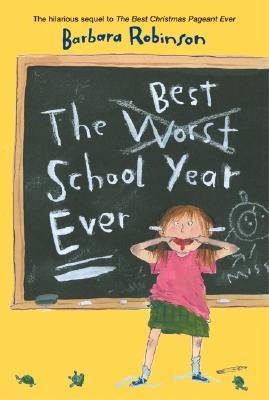
The Best School Year Ever - The Herdman's #2 (Barbara Robinson)

727428

I came across this book by chance. I read The Best Christmas Pageant Ever and loved it. I have always wanted to do it for grade 3 book club, but I figured the slang on the real Christmas story might not fly very well with everyone in school. This one has the same hilarity and would totally work for grade 3 book club! It even has a bit of character attached to the story with the teacher's year long assignment to make a list of positive traits about everyone in the class.

This book reminded me of sitting around listening to my aunt and uncle and their kids talk about funny stories in their insurance adjusting business.....matter of fact stories with hilarity attached.

Goodreads says:

The Worst Kids in the History of the World!

When anything goes wrong at Woodrow Wilson Elementary School, from the hexing of Bus Six to the mysterious disappearance of the kindergarten gerbil, it's sure to have a Herdman behind it. The Herdmans are more than famous -- they're outlaws. They smoke cigars, lie, and set fire to things, and that's only when they bother to come to school!

Then a school project forces the students to think of compliments for all their classmates -- including the Herdmans. Is it possible that behind their outrageous pranks there may be something good about this crazy clan after all?


Saturday, December 16, 2017

The True Confessions of Charlotte Doyle (Avi)

310146

I love Avi! I got to meet him once and ever since then, I've been a huge fan of his books. I have always meant to read this and am glad I finally got around to it. My son read it in junior high and loved it. I can see why. I wish I could do it with my grade 3 book club. I think it may  be too scary for them though. Perhaps it would work for  Grade 4's Battle of the Books, though!

When I read it I wished that Charlotte Doyle was a real person. I wish this was a real story. I loved her strength and determination and willingness to do whatever it takes. The acts outside of normal gender roles. That, by itself, would make for a great discussion.

“A sailor chooses the wind that takes the ship from a safe port. Ah, yes, but once you're abroad, as you have seen, winds have a mind of their own. Be careful, Charlotte, careful of the wind you choose.” 

Goodreads says:

An ocean voyage of unimaginable consequences... Not every thirteen-year-old girl is accused of murder, brought to trial, and found guilty. But I was just such a girl, and my story is worth relating even if it did happen years ago. Be warned, however: If strong ideas and action offend you, read no more. Find another companion to share your idle hours. For my part I intend to tell the truth as I lived it.

Wednesday, August 16, 2017

Small Great Things (Jodi Picoult)

I haven't done a great job of reading this summer. One reason is I seemed to have this sub-conscious need to stay focused on my husband, which meant I couldn't really get lost in a book. I tried, but I was reading a book that I couldn't quite get into and I was dragging myself through it. I finally put it aside and decided to read Small Great Things. It was a great break!


Goodreads says:

Ruth Jefferson is a labor and delivery nurse at a Connecticut hospital with more than twenty years' experience. During her shift, Ruth begins a routine checkup on a newborn, only to be told a few minutes later that she's been reassigned to another patient. The parents are white supremacists and don't want Ruth, who is African American, to touch their child. The hospital complies with their request, but the next day, the baby goes into cardiac distress while Ruth is alone in the nursery. Does she obey orders or does she intervene?

Ruth hesitates before performing CPR and, as a result, is charged with a serious crime. Kennedy McQuarrie, a white public defender, takes her case but gives unexpected advice: Kennedy insists that mentioning race in the courtroom is not a winning strategy. Conflicted by Kennedy's counsel, Ruth tries to keep life as normal as possible for her family—especially her teenage son—as the case becomes a media sensation. As the trial moves forward, Ruth and Kennedy must gain each other's trust, and come to see that what they've been taught their whole lives about others—and themselves—might be wrong.

With incredible empathy, intelligence, and candor, Jodi Picoult tackles race, privilege, prejudice, justice, and compassion—and doesn't offer easy answers. Small Great Things is a remarkable achievement from a writer at the top of her game.

My thoughts:

Right now there is some awful racial issue stuff going on in the states that totally parallel this story. It was surreal to be reading it at the same time.

It was crazy to see inside the mind of a white supremacist. Crazy.


I had to stop and take a break after this bit:


p. 377: Ruth talks about helping a mother who has just had a stillborn baby: Then I handed her a damp cloth I pressed it into her palm water shocked her into awareness, or if it was the baby. But with my hand guiding her she washed every fold and curve of her baby.She wrapped him in the blanket. She held him to her breast. Finally, with a Saab that sounded like she was tearing a piece of herself away, she offered the body of her child back to me.

.....speaking of the room in the hospital for grieving parents of newborns: I think I know now why it is called the kangaroo suite It's because even when you no longer have a child, you carry him forever


Tuesday, June 27, 2017

Ivan (Katherine Applegate)

I need to remember this book for when we do the novel in Grade 3 Book Club.

Goodreads says:

In a spare, powerful text and evocative illustrations, the Newbery medalist Katherine Applegate and the artist G. Brian Karas present the extraordinary real story of a special gorilla.
     Captured as a baby, Ivan was brought to a Tacoma, Washington, mall to attract shoppers. Gradually, public pressure built until a better way of life for Ivan was found at Zoo Atlanta. From the Congo to America, and from a local business attraction to a national symbol of animal welfare, Ivan the Shopping Mall Gorilla traveled an astonishing distance in miles and in impact.
     This is his true story and includes photographs of Ivan in the back matter.
 

Tuesday, May 23, 2017

Something About Hensleys (Patricia Polacco)


Patricia Polacco has a magic story telling gift. Every my toughest students who don't seem to enjoy story time get drawn into her stories. My students even gasped as the two girls were walking down the street and came across a kitten while having just what they needed to catch the kitten.

I started off telling my class how my husband's family lives in a very small town and everyone loves to go to The Merc. You find all sorts of cool things at The Merc....just like at Hensley's. This is a historical fiction book. The author says she is still loyal to Hensley's because of her great experiences there.

Goodreads summary:

There's something about Hensley's! No matter what you need, that general store is sure to have it. It's almost magical the way the manager, Old John, seems to know what the townsfolk need before they do! But then a new family moves to town. The youngest child, Molly, has asthma--but her mother doesn't have money to treat her, or for anything else. But leave it to Old John to find a way to use Hensley's to give the family exactly what it needs, even if it can't be boxed or bagged.
A true--and truly moving--story about an unforgettable general store and about the extraordinary power one person's acts of kindness can have on another.
About the Author: Patricia Polacco lives in Union City, Michigan.

Friday, May 19, 2017

Something From Nothing (Phoebe Gilman)

This story fits well with our Open Court unit on money.

We loved the little story under the story.

Goodreads summary:

The blanket Joseph's grandfather made him is transformed into many things as the years go by: a jacket, a vest, a tie, a handkerchief--and finally a button. Gilman's modern adaptation and lively illustrations turn this favorite Jewish tale into a contemporary classic.

Buy this book

Monday, March 28, 2016

Pax (Sara Pennypacker)

I took a chance on this book. I have a policy that I always have to read a book before we do it for book club at school - but I really wanted to do this one and I hadn't read it. I have heard so many great things about it. I decided to give it a go.


I love this book because it touched my heart and it left many questions unanswered....great conversation starter!


At first I had some regret. We started reading it aloud in class and found the author doesn't mince at all on vocabulary. I was doing a lot of explaining...and eventually we quit reading it in class (not because we decided to abandon it, but just because book club is supposed to be books that kids read on their own or at home, not necessarily a class read aloud). However, kids kept coming to me telling me how much they were enjoying it. I got report after report about what chapter they were on and how they thought it was really great. I would ask, "Is it too tricky? Too many hard words?" and they were adamant that it wasn't. Okay!!


I do agree that this is a great story. It doesn't have the expected happy ending - something that isn't common in J fiction. I had a student come to me after only having the book for a couple days. She had finished it and wanted to talk about it, but I wasn't finished so I couldn't say much. She just kept saying to me, "I can't believe it....after all that work...." I would just shrug....I couldn't really answer. Finally, she walked away, shaking her head. I am really looking forward to chatting with her now about this book!
Peter's persistence was inspiring. There were many things that seemed just not fair to him. Losing his mother is one bad blow. Why would a dad decide to go off to war and leave his son?? That is never answered. And what is up with grandparents not finding him once he runs off? It does follow a common theme of J fiction though - of kids just looking after themselves. Adults are kind of useless - except for Vola. She's helpful - but quite mysterious and hard to understand. Maybe many adults are that way for kids. I liked Pax's faith in Peter. Even though he continues on and thrives in his natural environment, he never loses faith in Peter - unlike the adults in Peter's life.


Other questions:


Why are they living so near a war-zone anyway? It seems to be set in North America - but we have not had wars here for so many years - that seemed a little disconnected for me.


And in the end, when he says: The apple does fall far from the tree....wasn't he actually relenting by not having Pax come with him? He gives in to everything his father has done.


Goodreads summary:


Pax was only a kit when his family was killed, and “his boy” Peter rescued him from abandonment and certain death. Now the war front approaches, and when Peter’s father enlists, Peter has to move in with his grandpa. Far worse than being forced to leave home is the fact that Pax can’t go. Peter listens to his stern father—as he usually does—and throws Pax’s favorite toy soldier into the woods. When the fox runs to retrieve it, Peter and his dad get back in the car and leave him there—alone. But before Peter makes it through even one night under his grandfather’s roof, regret and duty spur him to action; he packs for a trek to get his best friend back and sneaks into the night. This is the story of Peter, Pax, and their independent struggles to return to one another against all odds. Told from the alternating viewpoints of Peter and Pax.

Thursday, October 22, 2015

A Night Divided (Jennifer Nielsen)


This is by the same author that wrote The False Prince trilogy.


I had never thought of what it was like when the Berlin wall went up. The author tells this story in a gripping way that teaches a lot about that time. It was very hard to put down.


I have recommended this to many students and many of them have said they are reading it and loving it.


Goodreads summary:


From New York Times bestselling author Jennifer A. Nielsen comes a stunning thriller about a girl who must escape to freedom after the Berlin Wall divides her family between east and west.

With the rise of the Berlin Wall, twelve-year-old Gerta finds her family divided overnight. She, her mother, and her brother Fritz live on the eastern side, controlled by the Soviets. Her father and middle brother, who had gone west in search of work, cannot return home. Gerta knows it is dangerous to watch the wall, to think forbidden thoughts of freedom, yet she can't help herself. She sees the East German soldiers with their guns trained on their own citizens; she, her family, her neighbors and friends are prisoners in their own city.

But one day, while on her way to school, Gerta spots her father on a viewing platform on the western side, pantomiming a peculiar dance. Then, when she receives a mysterious drawing, Gerta puts two and two together and concludes that her father wants Gerta and Fritz to tunnel beneath the wall, out of East Berlin. However, if they are caught, the consequences will be deadly. No one can be trusted. Will Gerta and her family find their way to freedom?


Wednesday, June 24, 2015

Wonderstruck (Brian Selznick)


I read this book years ago with my class. We did it again as an end of year novel study. Once again, it did not disappoint. This is a fantastic story. Brian Selznick seems to have a keen interest in theatre. Both this book and The Invention of Hugo Cabret involve cinema. Apparently his third book, The Marvels, does as well.

Goodreads Summary:


Reading it with my class this year was a really great experience. I got 9 copies of the book from the public library (thank you Calgary Public Library!) and we shared. I was so impressed with all the details we got this time around thanks to very observant students. Brian Selznick says that everything in his pictures is purposeful. I believe it!


Traditionally, when we do novel studies, it is paired with a workbook full of all sorts of comprehension questions, crossword puzzles, games and activities. I really simplified for this novel, and instead of a big booklet like that I usually use, we had a page where we wrote down cool vocabulary, some pages where we wrote summaries for each part of the book (it is divided into three parts) and then a page with finger spelling. At first, we'd stop when we came across cool words and write them down, but there was a lot of moaning and groaning. Eventually, I decided that isn't what real readers do. Instead, I gave them some sticky notes and had them put a sticky when they came across a word they thought was cool or didn't understand. The next day we'd start off our reading time by writing down 4 or 5 of these cool words and their definitions. Usually, we could get the meaning from the context. I encouraged kids, when they're reading other books, to use stickies to mark spots they want to remember to tell someone about or write about or have questions about.


Activity ideas:


  • Pair this book with Matchbox Diary and make our own boxes of wonder
  • Make a diorama about something we have been studying (pair with life cycle unit?)


Wednesday, April 1, 2015

After the War is Over (Jennifer Robson)


Last year, with book club, we read Somewhere in France. This is the second book in the series. I have never really read a series as it comes out. This has been fun. We really had a wonderful time discussing this book.

It is Spring Break and I had great plans to do a lot of reading. Last week I ended up spending s bunch of time in the hospital and did absolutely no reading. Tuesday we went on a road trip. I didn't do any reading then either. So today I was in a time crunch. I spent the day reading this book in just one sitting. It was a wonderful day!
 
This was a great book for discussion. Everyone had lots of comments to add to the discussion. I learned a lot about WWI. Sometimes with historical fiction it is hard to know what is true and what is fiction. It seemed like this book had a lot of truth and it was a great way to learn about history. For example, I learned at book club, that apparently Miss Rathbone, the lady that Charlotte worked for, was a real person in history. It seems the author has done a great job researching these books.
 
I liked that this book leaned a little more towards feminism. In the first book, I realized that they were all just products of their time, but the lack of opportunity women had really drove me crazy. I loved how Charlotte stood up for herself and was strong in this book.
 
Apparently Jennifer Robson is working on another book. I'll definitely read that one too!
 
The internationally bestselling author of Somewhere in France returns with her sweeping second novel—a tale of class, love, and freedom—in which a young woman must fnd her place in a world forever changed

After four years as a military nurse, Charlotte Brown is ready to leave behind the devastation of the Great War. The daughter of a vicar, she has always been determined to dedicate her life to helping others. Moving to busy Liverpool, she throws herself into her work with those most in need, only tearing herself away for the lively dinners she enjoys with the women at her boardinghouse.

Just as Charlotte begins to settle into her new circumstances, two messages arrive that will change her life. One is from a radical young newspaper editor who offers her a chance to speak out for those who cannot. The other pulls her back to her past, and to a man she has tried, and failed, to forget.

Edward Neville-Ashford, her former employer and the brother of Charlotte's dearest friend, is now the new Earl of Cumberland—and a shadow of the man he once was. Yet under his battle wounds and haunted eyes Charlotte sees glimpses of the charming boy who long ago claimed her foolish heart. She wants to help him, but dare she risk her future for a man who can never be hers?

As Britain seethes with unrest and postwar euphoria fattens into bitter disappointment, Charlotte must confront long-held insecurities to find her true voice . . . and the courage to decide if the life she has created is the one she truly wants.
 
QUOTES I MARKED:
 
Lilly and Charlotte regarding Lilly's mother (p. 35):
"How has she been treating you?"
"More or less as she always does - which is to say she ignores me whenever possible, and tolerates me when she cannot ignore me."
 
p. 139:
Had she ever spent an entire day having fun? She sifted through her memories, but couldn't recall a single instance - not when she was at university, not when she was Lilly's governess, not in all the years with Miss Rathbone, and certainly not during the war. There had been afternoons in the park, evenings out with friends, the occasional lazy hour or two reading a book that was entertaining rather than improving, but she'd never felt she could spend a day simply enjoying life.


Saturday, January 10, 2015

Brown Girl Dreaming (Jacqueline Woodson)

I learned about this book from a Nerdy Book Club post by Donalyn Miller. I've seen a lot of tweets about it as well. It seemed like a book that I needed to carve out some special time for. I was fascinated that the entire book is written in verse. How weird could that be? It wasn't weird. It was beautiful and had magic. As Donalyn Miller said, "Jackie catches words, blows on them, and floats them on to me." 

I wanted this book to go on forever. I tend to be a fast reader. This book made me want to slow down and savor every word. Seriously.

Goodreads Summary:


Jacqueline Woodson, one of today's finest writers, tells the moving story of her childhood in mesmerizing verse.  A novel in verse. Raised in South Carolina and New York, Woodson always felt halfway home in each place. In vivid poems, she shares what it was like to grow up as an African American in the 1960s and 1970s, living with the remnants of Jim Crow and her growing awareness of the Civil Rights movement. Touching and powerful, each poem is both accessible and emotionally charged, each line a glimpse into a child’s soul as she searches for her place in the world. Woodson’s eloquent poetry also reflects the joy of finding her voice through writing stories, despite the fact that she struggled with reading as a child. Her love of stories inspired her and stayed with her, creating the first sparks of the gifted writer she was to become. 
I got this book from the library and must apologize to the librarian for all the pages I had to turn down. They were the pages I just couldn't quite let go of yet.

I loved the image this stirs.
p. 131 sometimes, no words are needed
Deep winter and the night air is cold. So still,
it feels like the world goes on forever in the darkness
until you look up and the earth stops
in a ceiling of stars. My head against
my grandfather's arm,
is a blanket around us as we sit on the front porch swing.
Its whine like a song.

You don't need words 
on a night like this. Just the warmth
of your grandfather's arm. Just the silent promise
That the world as we know it
will always be here.

I hope I can help all my students feel like this about school:
p. 158 first grade
My hand inside my sister's hand,
We walk the two blocks fo P.s. 106 - 
I am six years old and
my sister tells me our school was once a castle.
I believe her. The school stretches for a full city block.
Inside
marble stairs wind their way to classrooms filled
with dark wood desks
nailed down to dark wood floors polished to a high
and beautiful shine.

I am in love with everything around me,
the dotted white lines moving
across my teacher's blackboard, the smell of chalk,
the flag jutting out from the wall and slowly swaying 
above me.

There is nothing more beautiful than P.s. 106.
Nothing more perfect than my first-grade classroom.
No one more kind than Ms. Feidler, who meets me
at the door each morning,
takes my hand from my sister's, smiles down and says,
Now that Jacqueline is here, the day can finally begin.

And I believe her.
Yes. I truly believe her.

Jacqueline Woodson is a Jehovah's Witness and that plays a role in the story. It was a unique view into a religion I really don't understand.
p. 162 flag
When the kids in my class ask why
I am not allowed to pledge to the flag
I tell them It's against my religion but I don't say,
I am in the world but not of the world. This,
they would not understand.
Even though my mother's not a Jehovah's Witness,
she makes us follow their rules and
leave the classroom when the pledge is being said.

Every morning, I walk out with Gina and Alina
the two other Witnesses in my class.
Sometimes, Gina says,
Maybe we should pray for the kids inside
who don't know that God said
"No other idols before me." That our God
is a jealous God.
Gina is a true believer. Her Bible open
during reading time. But Alina and I walk through
our roles as Witnesses as though this is the part
we've been given in a play
and once offstage, we run free, sing
"America the Beautiful" and "The Star-Spangled Banner"
far away from our families - knowing every word.

Alina and I want
more than anything to walk back into our classroom
press our hands against our hearts, Say,
"I pledge allegiance..." loud
without our jealous God looking down on us.
  Without our parents finding out.
Without our mothers' voices
in our heads saying, You are different.
Chosen.
Good.

When the pledge is over, we walk single file
back into the classroom, take our separate seats
Alina and I far away from Gina. But Gina
always looks back at us - as if to say,
I'm watching you. As if to say,
I know.

Jacqueline also struggles with comparing herself to her brilliant sister:
p. 169 gifted
Everyone knows my sister
is brilliant. The letters come home folded neatly
inside official-looking envelopes that my sister proudly
hands over to my mother.
Odella has achieved
Odella has excelled at
Odella has been recommended to
Odella's outstanding performance in

She is gifted
we are told
And I imagine presents surrounding her.

I am not gifted. When I read, the words twist
twirl across the page.
When they settle, it is too late.
The class has already moved on.

I want to catch words one day. I want to hold them
then blow gently,
watch them float
right out of my hands.

I was really taken by her ability to describe her difficulties with reading.
p. 226 reading
I am not my sister.
Words from the books curl around each other
make little sense
until
I read them again
and again, the story
settling into memory. Too slow
the teacher says.
Read faster.
Too babyish, the teacher says.
Read older.
but I don't want to read faster or older or 
any way else that might
make the story disappear too quickly from where
  it's settling
inside my brain,
slowly becoming 
a part of me.
A story I will remember
long after I've read it for the second, third,
tenth, hundredth time.

I know this story! It's called Stevie. 
p. 227 stevie and me
Every Monday my mother takes us
to the library around the corner. We are allowed
to take out seven books each. One those days,
no one complains
that all I want are picture books.

These days no one tells me to read faster
to read harder books
to read like Dell

No one is there to say, Not that book,
when I stop in front of the small paperback 
with a brown boy on the cover.
Stevie.

I read:
One day my momma told me,
"You know you're gonna have
a little friend come stay with you."
And I said, "Who is it?"

If someone had been fussing with me
to read like my sister, I might have missed
the picture book filled with brown people, more
brown people than I'd ever seen
In a book before.

The little boy's name was Steven but 
his mother kept calling him Stevie.
My name is Robert but my momma don't

call me Robertie.

If someone had taken
that book out of my hand
said, You're too old for this
maybe
I'd never have believed
that someone who looked like me
could be in the pages of the book
that someone who looked like me
had a story.


One fascinating part of the story was the aftermath of segregation. During her time as a child there wasn't segregation, well, sort of. I wish I was more like Jacqueline Woodson when it comes to change. I'm a little more like the grandma sometimes though, a little afraid to step out. And when I do step out, I do it pretty quietly. I don't like that about myself.
p. 237 what everybody knows now

Even though the laws have changed
my grandmother still takes us
to the back of the bus when we go downtown
in the rain. It's easier, my grandmother says,
than having white folks look at me like I'm dirt.

But we aren't dirt. We are people
paying the same fare as other people.
When I say this to my grandmother,
she nods, says, Easier to stay where you belong.

I look around and see the ones
who walk straight to the back. See
the ones who take a seat up front, daring
anyone to make them move. And know
this is who I want to be. Not scared
like that. Brave
like that.

Still, my grandmother takes my hand downtown
pulls me right past the restaurants that have to let us sit
wherever we want now. No need in making trouble
she says.  You'll all go back to New York City but
I have to live here.

We walk straight past Woolworth's
without even looking in the windows
because the one time my grandmother went inside
they made her wait and wait. Acted like
I wasn't even there. It's hard not to see the moment - 
my grandmother in her Sunday clothes, a hat
with a flower pinned to it
neatly on her head, her patent-leather purse,
perfectly clasped
between her gloved hands - waiting quietly
long past her turn.