Showing posts with label reading. Show all posts

Sunday, March 1, 2026

Why Fascists Fear Teacher (Randi Weingarten)


Bottom line: Fascists don't want people to read or learn
Trump: Fascist
Alberta is headed that way too.
Well worth the read!

Goodreads says:

America’s most influential teacher’s union leader tells the anti-fascist history of public education, warning that American teachers today are under a new fascist assault--from book bans to culture wars and organized groups of “concerned” parents dictating what can be taught.

In 1940, as Hitler was gaining power and territory across Europe, a Nazi puppet government was put in power in Norway.  Teachers were among the first to publicly resist their rule—and they were winning. Frustrated that their attempts to recruit teachers into the party failed, the Nazis barged into Norway’s schools, beating teachers and students. When they still refused to submit, the Nazis closed the schools.  But the teachers figured out how to teach in private.  Increasingly incensed, the fascist government sent 1,300 teachers to concentration camps and 500 others to forced labor camps.  Even there, teachers kept teaching--and students kept learning how to think for themselves.  

As the head of one of the largest teacher’s union in the country, Randi Weingarten sees firsthand how today’s teachers are guarding American democracy against the threat of fascism. Drawing on history and decades of experience in the American public school system, she argues that teaching students to think critically is the key to defeating would-be dictators. She encourages teachers to continue promoting difference and healthy debate in their classrooms, and warns against censorship and complacency, looking to history to warn us all about what can happen if we devalue teachers and public schools.

Part history and part call to arms, Why Fascists Fear Teachers is a manifesto for American teachers from the author that Trump-appointed former Secretary of State Mike Pompeo once called “the most dangerous person in the world.” This deeply researched, urgent book from teachers’ greatest champion is necessary reading for our times.

Friday, August 15, 2025

Lula Dean's Little Library of Banned Books (Kirsten Miller)


This book was equally enraging and endearing all at the same time. I loved it. It was one of those books that you just can't stop reading. 

One challenge for me is there were a LOT of characters. If I read it again, I'll make a list so I can be more efficient with my reading.

Goodreads says:
The provocative and hilarious summer read that will have book lovers cheering and everyone talking! Kirsten Miller, author of The Change, brings us a bracing, wildly entertaining satire about a small Southern town, a pitched battle over banned books, and a little lending library that changes everything.

Beverly Underwood and her arch enemy, Lula Dean, live in the tiny town of Troy, Georgia, where they were born and raised. Now Beverly is on the school board, and Lula has become a local celebrity by embarking on mission to rid the public libraries of all inappropriate books—none of which she’s actually read. To replace the “pornographic” books she’s challenged at the local public library, Lula starts her own lending library in front of her home: a cute wooden hutch with glass doors and neat rows of the worthy literature that she’s sure the town’s readers need.

But Beverly’s daughter Lindsay sneaks in by night and secretly fills Lula Dean’s little free library with banned books wrapped in “wholesome” dust jackets. The Girl’s Guide to the Revolution is wrapped in the cover of The Southern Belle’s Guide to Etiquette. A jacket that belongs to Our Confederate Heroes ends up on Beloved. One by one, neighbors who borrow books from Lula Dean’s library find their lives changed in unexpected ways. Finally, one of Lula Dean’s enemies discovers the library and decides to turn the tables on her, just as Lula and Beverly are running against each other to replace the town’s disgraced mayor.

That’s when all the townspeople who’ve been borrowing from Lula’s library begin to reveal themselves. It’s a diverse and surprising bunch—including the local postman, the prom queen, housewives, a farmer, and the former DA—all of whom have been changed by what they’ve read. When Lindsay is forced to own up to what she’s done, the showdown that’s been brewing between Beverly and Lula will roil the whole town...and change it forever.

Friday, July 5, 2024

The Power of Ritual (Casper Ter Kuile)


I really loved this author's take on religious and spiritual practices. For people struggling with their faith, this book might give them some ideas for how to continue a relationship with the divine rather than abandon everything.

He says: You already have a host of rituals we might call spiritual practices - even if you'd never use that language. Reading, walking, eating, resting, reflecting: these are legitimate and worthy of your attention and care, and they can be the foundation of a life of deep connection. He challenges us to take the power from and have permission to be creative in combining the ancient and the emergent. (p. 185)

Connecting With Self: The Art of Sacred Reading

p. 36 ...reading is not just something we can do to escape the world, but rather that it can help us live more deeply in it. 

p. 37 ...they help us know who we are and decide who we might want to become. 

p. 51 Saint Anselm had advised his wealthy patron, Countess Matilda of Tuscany, that if she read a sacred text her goal was not to finish reading it, but instead to read only as much as would stir her mind to prayer. ...Monastic communities didn't read a book only once-there were far too few precious volumes for that anyway! Rereading, and reading out loud, were how monks studied a text, leading them up the ladder...reading, meditating, praying, and contemplating. 

1. What's literally happening in the narrative? Where are we in the story?
2. What allegorical images, stories, songs or metaphors show up for you?
3. What experiences have you had in your own life that come to mind?
4. What action are you being called to take?

Connecting With Self: Sabbath Time
p. 78 Ultimately, a sabbath of some form or another is necessary for connecting with ourselves...Sabbath gives us perspective. It reconnects us with our imagination. We can envision new ways in which the world might work. "Sabbath is not simply the pause that refresher. It is the pause that transforms." (Walter Brueggemann)

- Tech Sabbath (total break from technology
- Sabbath From Others (alone time)
- Sabbath From Work To Make Room For Play

Connecting With Others

p. 82 The people who were most satisfied in their relationships at age 50 were the healthiest at age 80...on the days when they had more physical pain, older people in satisfying relationships were just as happy as they were on the days when they felt fine. But for the elder participants who had unsatisfying relationships, their physical pain was magnified by emotional pain. 

Connecting With Nature

- walking
- pilgrimages
- permission to be creative
- celebrate the seasons

p. 123 This practice of circumambulation is a key spiritual tool to transform any journey into a pilgrimage. By making repeated circles around our destination, we created a sacred center. Our journey itself honors what we leave in the middle. (examples: Kaaba...the holy mosque in Mecca which pilgrims walk seven times at the end of the hajj). Circumambulation allows us to see every angle of our destination or the object of our veneration

Connecting with Transcendence

Types of prayer

p. 156 adoration - the first step to deeper awareness is about getting radically away from ourselves, to decenter our individual experience and seek to place ourselves in service of, or to become part of, something bigger than us.

p. 161 contrition - What have I done that has caused pain or suffering? What have I left undone that might have served others? For what do I need forgiveness?
p. 164 explore how you might incorporate physical movement. My experience has been that on the days where there is simply too much to say, sitting on my knees and bowing forward, placing my head on the floor, offers its own prayer of contrition. 

p. 168 thanksgiving
p. 170 Giving thanks to that source of goodness outside ourselves-whether a specific person, the luck of a certain opportunity, or something more deeply spiritual - contributes to reorienting our lives away from the dominant cultural narrative of our own successes, desires, and ambitions and toward a perspective that is more holistic.
p. 172 Imagine you only have a year left to live. What might you do with the time you have left? Spend some time thinking or journaling. Visualize where you might go, who you'd want to talk to. What you'd stop doing. Now imagine you only have a week. How might you choose to spend your last days? What would your last meal be? Who would you walk with? Now imagine it is your last hour live. And then your last minute. Your last breath. This very breath you're breathing right now.
p. 173 You might download an app like WeCroak, which pings you five times a day to remind you of your coming death. Or you can find a short phrase to say out loud as you put on moisturizer or make up in the morning, or every time you get in the car. The secret is to repeat it often, so that you experience a regular moment of reflection and gratitude for being alive.

p. 173 supplication - mindfully hold someone or something in the presence of the divine...it's a chance to hold people we love in our compassionate awareness.
p. 174 Jack Kornfield's Buddhist metta (loving-kindness) meditation practice where we repeat three intentions over and over again. We start with ourselves, then turn to someone we love, then to a stranger, and then to someone with whom we are struggling? 

Name: 
    May you safe and free from suffering
    May you be happy and healthy as possible
    May you have ease of being
p. 175 Supplication can look like intentional well-wishing, but it can also simply be the process by which we lift up the things in life we need help with. We call into our conscious mind the fears we might have, for example. Sometimes I create a list in my journal, trying to fill the whole page to ensure I am digging deep enough to clear out all the gunk in my mind. ....Writing it down or saying it out loud seems to take the sting out of things that are haunting me. This is the power of supplicatory prayer. It creates a place for fear and simultaneously puts fear in its place. It allows us to say what scares us without allowing it to overwhelm us. ...I speak the fears aloud in the shower, the fears mingling with the steam and just floating around the bathroom.
p. 176 Zen Buddhist teacher and writer Cheri Huber takes this practice on step further. She explains that you can use your phone to record yourself speaking aloud all your fears, pains, and angers-describing all the frustrations you feel in great detail. Then, after taking a short break, listen to the recording as if hearing someone else's problems, and bring to them the kind of compassion and love that you would to a friend or a stranger. After listening through loving ears, record a loving message back to yourself with some words of wisdom and care. Then after another break, listen to that second message.

Blessings
This is actually part of the supplication prayer section but it was so profound I need to stand alone for when I review. He says:
p. 178 O'Donohue (John O'Donohue To Bless the Space Between Us) describes blessings as "a circle of light drawn around a person to protect, heal, and strengthen." In this, he drew on ancient Celtic spiritual practice. The Celts drew a caim - a circle - around themselves in times of danger. Whether or not they believed in magical powers, it reminded them that they were always surrounded by the divine, that the mystery of the holy encircles us and entwines through us wherever we are. Blessings exist to remind us of that fact. If we're gone of our tune, a blessing or prayer of supplication bring us back into harmony. That's why, for O'Donohue, a blessing has real power. We must offer it with conviction because "the beauty of blessing is its belief that it can affect what unfolds."

A Rule of Life p. 187

He also devoted a whole section to the importance of tracking our intentions...which is totally my jam! He even refers to Gretchen Rubin's tracking sheets :) 

Two books he suggests on this. Unfortunately, I can't seem to find the at my library nor on Amazon!
Note To Self: Creating Your Guide to a More Spiritual Life (Charles LaFond)
Living Intentionally: A Workbook for Creating a Personal Rule of Life (Brother David Vryhof)

p. 193 The Dali Lama famously explains that although he usually meditates for an hour a day, on a particularly busy day he makes sure to meditate for two.


Goodreads says:

Ter Kuile, cohost of the podcast Harry Potter and the Sacred Text, demonstrates in his thoughtful debut how the nonreligious can "liberate the gifts of tradition" to foster greater spiritual connection in their lives. He argues that, while formal religious affiliation may be waning, spiritual practices remain relevant because they can cultivate bonds to the self, others, the natural world, and the transcendent. Ter Kuile explains the significance of a variety of religious practices, including pilgrimage, prayer, and meditation, and proposes ways to capture their significance through everyday activities ("anything can become a spiritual practice--gardening, painting, singing, snuggling, sitting") by focusing on intention, attention, and repetition. This approach leads to inventive explorations of social trends; for instance, the famously cultish appeal of the Crossfit fitness program is explained in terms of vulnerability and community. In ter Kuile's understanding, religious traditions are "inherently creative" and therefore good starting points for considering personalized, meaningful spiritual practices.


Friday, May 3, 2024

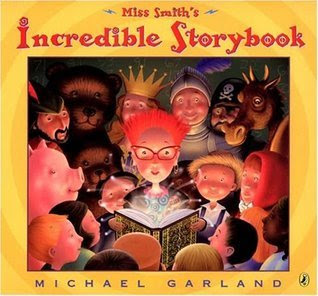
Miss Smith's Incredible Storybook (Michael Garland)


Love this story!! Nothing like having stories come to life and having the characters come right out of the book! 


Goodreads says:

When Zack meets his second-grade teacher, Miss Smith, he can tell right away that her class will be different. However, he has no idea just how different it will be.

Zack can't wait for Mrs. Smith to read out loud again from her incredible book. The first story fills the classroom with dueling pirates and the sound of their clashing swords. The second story transports Zack's class to the shady forest of the Big Bad Wolf. At the end of each spellbinding tale the characters slip quietly back into the book. But one day Mrs. Smith is late for school, and the principal takes charge. When he runs away in terror from a fire-breathing dragon, Zack and his classmates set free the rest of the story-book characters and have a morning of high-spirited fun... until they notice that the pirates have hoisted their Jolly Roger on the roof of the school.

Tuesday, April 30, 2024

A Place to Hang The Moon (Kate Albus)


I loved this book! I ended up reading it in a 24 hour period. It was a Children's Lit book club book but I kept putting off reading it because I figured it'd be a quick read plus I read a review that if you've read The War That Saved My Life, it's pretty much the same - which I have read. However, that reviewer was wrong! I don't think they're the same at all. 

I loved how the children in this story loved to read. It was really what led them to finding a new family after being orphaned and then having their grandmother die. Reading really does save lives.

The title comes from a saying that William tells his siblings his mom used to say - that her children could hang the moon, meaning that they were the most amazing humans. The children look for someone who feels the same way about them and in the end the person who does become their new family actualy ends up saying this very thing by chance.


p. 25 The first words of a new book are so delicious - like the first taste of a cookie fresh from the oven and not yet proerly cooled.

p. 102 "What about Anne of Green Gables?" she asked.
"Is it another orphan story?" Anna asked.
The librarian chuckled. "I suppose there are rather a lot of orphan stories out there."
"Why do grown-ups write so many of them?" William asked.
"I hadn't really thought about it, "Mrs. Muller confessed. "Perhaps they think children fancy the notion of living on their own, without adults to tell them what to do. It's quite daft, if you think about it."

p. 243 "I believe it was the poet, Mr. Yeats, who said that the world is full of magic things, patiently waiting for our senses to grow and sharper?" 

Setting: June 1940 in England

The Pearce family: Edmund (a bit of a trouble-maker type child), the youngest Anna, and William, who is 12.
Mrs Collins - their housekeeper
Harold Engersoll "does not have that gift for explain complex things to children"
Frances
Miss Caw
Mrs. Warren 
Ms Norton
Mrs. Griffith
Mrs Mueller

I looked up Operation Pied Piper and found some really interesting information. I shared this video, called The Mothers Who Waved Goodbye, at our book club meeting:


Goodreads says:
Set against the backdrop of World War II, Anna, Edmund, and William are evacuated from London to live in the countryside, bouncing from home to home in search of a permanent family.

It is 1940 and Anna, 9, Edmund, 11, and William, 12, have just lost their grandmother. Unfortunately, she left no provision for their guardianship in her will. Her solicitor comes up with a preposterous plan: he will arrange for the children to join a group of schoolchildren who are being evacuated to a village in the country, where they will live with families for the duration of the war. He also hopes that whoever takes the children on might end up willing to adopt them and become their new family--providing, of course, that the children can agree on the choice.

Moving from one family to another, the children suffer the cruel trickery of foster brothers, the cold realities of outdoor toilets, and the hollowness of empty tummies. They seek comfort in the village lending library, whose kind librarian, Nora Muller, seems an excellent candidate--except that she has a German husband whose whereabouts are currently unknown. Nevertheless, Nora's cottage is a place of bedtime stories and fireplaces, of vegetable gardens and hot, milky tea. Most important, it's a place where someone thinks they all three hung the moon. Which is really all you need in a mom, if you think about it.

Fans of The War That Saved My Life and other World War II fiction will find an instant classic in A Place to Hang the Moon.

Thursday, April 4, 2024

Stolen Focus (Johann Hari)


This is a great book. The author did a great job of researching and sharing the research many have worked on with focus. I will definitely implement some of his suggestions.

1. Stop multitasking. It doesn't work. Switching from one task to another takes much longer for our brain to reconfigure than we realize.

2. Read more books. I probably didn't need to read this to make that goal - but he certainly does make a good argument for why this is so important. Comprehension, focus and empathy are what we lose when we don't read.  I can resolve to take more time with a book though. Speed-reading is a detriment to comprehension and causes us to miss something.

3. Walk more...and without a podcast or book playing in headphones. Taking time to wander and to let our minds wander is key to creativity. He also has a really good argument for more unstructured play time and recess. I will definitely make sure there are more movement breaks and that everyone gets out for recess in my class.

4. Try to understand. Have conversations with people who believe totally different than you and try to really understand their perspective on an issue.

5. Limit Social Media and take big breaks from it. I've often heard people, especially church leaders in our church, tell us to do a social media fast. I've never been a big fan because so much communication happens in my circles with social media. His explanation of data tracking, AI and more was the most convincing thing I've read. He tells a really interesting story about a conversation with a scientist who shared with him about seeing a room full of people all wearing VR headsets....all but Mark Zuckerberg (who was at the front of the room speaking to the group). He said this is a metaphor for our future. We are being led, tracked and manipulated by social media. 

One part I wasn't sold on was his chapters on ADHD. He summarizes that the reason children have ADHD is because of stress imposed upon them in certain periods of life.

Some of my favorite take-aways:


Anne Mangan, a professor of literacy at the University of Stavanger in Norway, explained to me that in two decades of researching this subject, she has proved something crucial. Reading books trains us to read in a particular way - in a linear fashion, focused on one thing for a sustained period. Reading from screens, she has discovered, trains us to read in a different way - in a manic skip and jump from one thing to another...this [reading on screens] creates a different relationship with reading. It stops being a form of pleasurable immersion in another world and becomes more like dashing around a busy supermarket to grab what you need and then get out again. When this flip takes place - when our screen reading contaminates our book-reading - we lose some of the pleasures of reading books themselves  and they become less appealing.

It has other knock-on effects. Anne has conducted studies that split people into two groups, where one is given information in a printed book and the other is given the same information on a screen. Everyone is then asked questions about what they just read. When you do this, you find that people understand and remember less of what they absorb on screens. There's broad scientific evidence for this now, emerging from fifty-four studies, and she explained that it's referred to as "screen inferiority". This gap in understanding between books and screens is big enough that in elementary school children, it's the equivalent of two-thirds of a year's growth in reading comprehension. 

 --

When you read a novel, you are immersing yourself in what it's like to be inside another person's head. You are simulating a social situation. You are imagining other people and their experiences in a deep and complex way. So maybe, he said, if you read a lot of novels, you will become better at actually understanding other people off the page. Perhaps fiction is a kind of empathy gym, boosting your ability to empathize with other people - which is one of the most rich and precious forms of focus we have. Together, they decided to study this question scientifically.

--

We internalize the texture of the voices we're exposed to. When you expose yourself to complex stories about the inter lives of people over long periods of time, that will repattern your consciousness. You will become more perceptive, open, and empathetic. If, by contrast, you expose yourself for hours a day to the disconnected fragments of shrieking and fury that dominate social media, your thoughts will start to be shaped like that. Your internal voices will become cruder, louder, less able to hear more tender and gentle thoughts. Take care of what technologies you use, because your consciousness will, over time, come to be shaped like those technologies.

-- 

If enough people are spending enough of their time being angered, that starts to change the culture, ....it "turns hate into a habit." You can see this seeping into the bones of our society. When I was a teenager there was horrific crime in Britain, where two ten-year-old children murdered a toddler named Jamie Bulger. The Conservative prime minister at the time, John Major, responded by publicly saying that he believed we need "to condemn a little more, and understand a little less." I remembered thinking then, at the age of fourteen, that this was surely wrong - that' it's always better to understand why people do things, even (perhaps especially) the most heinous acts. But today, this attitude - condemn more, understand less - has become the default response to almost everyone, from the right to the left, as we spend our lives dancing to the tune of algorithms that reward fury and penalize mercy.

 --

The country that is often judged by international league tables to have the most successful schools in the world, Finland, is closer to these progressive models than anything we would recognize. Their children don't go to school at all until they are seven years old - before then, they just play. Between the ages of seven and sixteen, kids arrive at school at 9 am and leave at 2 pm. They are given almost no homework, and they take almost no tests until they graduate from high school. Free play is at the beating heart of Finnish kids' lives: by law, teachers have to give kids fifteen minutes of free play for every forty-five minutes of instructions. What's the outcome? Only 0.1 percent of their kids are diagnosed with attention problems, and Finns are among the most literate, numerate and happy people in the world.


Goodreads says:
Our ability to pay attention is collapsing. From the New York Times bestselling author of Chasing the Scream and Lost Connections comes a groundbreaking examination of why this is happening--and how to get our attention back.

In the United States, teenagers can focus on one task for only sixty-five seconds at a time, and office workers average only three minutes. Like so many of us, Johann Hari was finding that constantly switching from device to device and tab to tab was a diminishing and depressing way to live. He tried all sorts of self-help solutions--even abandoning his phone for three months--but nothing seemed to work. So Hari went on an epic journey across the world to interview the leading experts on human attention--and he discovered that everything we think we know about this crisis is wrong.

We think our inability to focus is a personal failure to exert enough willpower over our devices. The truth is even more disturbing: our focus has been stolen by powerful external forces that have left us uniquely vulnerable to corporations determined to raid our attention for profit. Hari found that there are twelve deep causes of this crisis, from the decline of mind-wandering to rising pollution, all of which have robbed some of our attention. In Stolen Focus, he introduces readers to Silicon Valley dissidents who learned to hack human attention, and veterinarians who diagnose dogs with ADHD. He explores a favela in Rio de Janeiro where everyone lost their attention in a particularly surreal way, and an office in New Zealand that discovered a remarkable technique to restore workers' productivity.

Crucially, Hari learned how we can reclaim our focus--as individuals, and as a society--if we are determined to fight for it. Stolen Focus will transform the debate about attention and finally show us how to get it back.

Saturday, March 16, 2024

Conferring With Readers (Jennifer Seravello)


I've heard lots of people talk about the importance of having reading conferences with students. This book lays out exactly what to say, how to do conferences, what to conference about, how to take notes. It's really helpful! It'll be on my list of books to read again and again.


Goodreads says:


A great reading conference only takes five minutes, but its impact can last a lifetime. That's because conferences are the critical, one-to-one teaching that forms the backbone of reading instruction. Conferring with Readers shows you how to confer well and demonstrates why a few moments with students every week can put them on the path to becoming better, more independent readers.

Conferring with Readers is a comprehensive guide that shows you how to determine what readers have learned and what they need to practice, then provides suggestions for targeting instruction to meet students' needs. It provides explicit teaching methods for use in effective conferences. You'll learn how to:

research a student's use of skills through questions and observations
compliment to support and build upon successes
follow up on prior instruction for accountability and depth of understanding
explain a reading strategy by providing an explicit purpose and context
model the strategy to make the invisible brainwork of reading more visible
guide a readerinpracticing the strategy
link the strategy to independent reading. Conferring with Readers presents repeatable frameworks for conferences that focus on six specific purposes of reading instruction:
matching students to just-right books reinforcing students' strengths supporting students during whole-class studies helping students move from one reading level to the next holding students accountable for previous learning deepening students' conversations about books in order to deepen their thinking. What's more, each purpose is bolstered by an appendix of conference transcripts that support your teaching. With all this plus ideas for planning instruction, keeping records of your conferences, and even conducting group sessions, Conferring with Readers will make a big difference in how you teach reading-helping you feel confident and well equipped to foster each student's growth and independence as a reader.

Thursday, January 25, 2024

The Miracle Morning (Hal Elrod)


I really loved this book. It validates my tendancy to be an early riser and he gives some great tips on how to spend that time as well as why to get up and practice positive habits each morning. I love the positivity he exudes as well. He's honest about struggles. 10/10 recommend! 

This guy has a ton of resources and says he's always willing to have people contact him and share struggles as well as successes.

Things to check out:

  • www.tmmbook.com
  • Hal Elrod podcasts
  • www.yourpalhal.com
  • Facebook group www.myTMMcommunity.com
Goodreads says:

Start waking up to your full potential every single day with the updated and expanded edition of the groundbreaking book with more than 2 million copies sold.

Getting everything you want out of life isn’t about doing more. It’s about becoming more. Hal Elrod and The Miracle Morning have helped millions of people become the person they need to be to create the life they’ve always wanted. Now, it’s your turn.

Hal’s revolutionary S.A.V.E.R.S. method is a simple, effective step-by-step process to transform your life in as little as six minutes per day:

Silence: Reduce stress and improve mental clarity by beginning each day with peaceful, purposeful quiet
Affirmations: Reprogram your mind to overcome any fears or beliefs that are limiting your potential or causing you to suffer
Visualization:Experience the power of mentally rehearsing yourself showing up at your best each day
Exercise: Boost your mental and physical energy in as little as 60 seconds
Reading: Acquire knowledge and expand your abilities by learning from experts
Scribing: Keep a journal to deepen gratitude, gain insights, track progress, and increase your productivity by getting clear on your top priorities

This updated and expanded edition has more than 40 pages of new content, including:

The Miracle Evening: Optimize your bedtime and sleep to wake up every day feeling refreshed and energized for your Miracle Morning
The Miracle Life: Begin your path to inner freedom so you can truly be happy and learn to love the life you have while you create the life you want

Wednesday, December 27, 2023

Forged By Reading (Beers and Probst)


I am a big fan of these two authors and have read a number of their books. This one spoke to my heart. The bottom line is that reading is what makes our world a better place and it should do something TO us. What happens in your head? What happens in your heart? And what will you do after reading what you've read?  (This is part of their BHH approach - only now they've added a D at the end for what are you going to DO) It's all about the power of a literate life. They're singing my song! 

Goodreads says:

Bestselling authors Kylene Beers and Robert E. Probst expand the vision of what it means to be an independent reader in our schools and in our nation by challenging our concepts of literacy. In an educational climate dictated by standards, tests, and mandates, Beers and Probst offer a needed vision of the interrelated nature of literacy and democracy, while they inspire us to do the hard work. Divided into three parts―Change, Power, and Hope―each section of the book helps us reenvision a world where all experience the power of a literate life.

Sunday, December 10, 2023

Tilly and the Bookwanderers (Anna James)


This is one of many series about books coming to life - either going into a book or characters coming out of the book. In this book, the main character I chose this as a read-aloud without reading it ahead of time. It is a lovely story and very imaginative, but it is tricky as a read aloud because some of the words were quite advanced for my students. I found myself reading ahead so I could figure out what to skip. There's a lot of description of people and places that causes my students to tune out. Once I got that figured out everyone became much more engaged in listening to the story. 


p. 108

...so many out-of-the way things happened to me that  I began to think that very few things are indeed really impossible. I know a woman - who spoke a lot of nonsense most of the time, it has to be said - but she once told me that she sometimes believe as many as six impossible things a day and all before breakfast! And so nowadays I try to make a little more space for the impossible to happen.


p. 157

"Oh Tilly. To my eternal sadness, we are not magical at all; we're just lucky enough to be able to use the natural magic of books and reading. It exists for everyone, but some of us can exert a little more control over it...."


p. 177 

Bookwandering if the ability to travel inside books and only a few readers can do it/ you could say we can read a bit harder than most people. Something tips us over from visiting the books purely inside our imagination to being physically transported there. We still don't know precisely how it happens, and why bookwandering magic affect s some people and not others. We think any reader probably has the potential to do it, but perhaps predictably there are very high numbers of booksellers a or librarians, as book wanderers almost always have a very special or particular relationship with books and reading. 


p. 178

The Underlibrary exists to protect readers, and our stories, we have important rules in place to help do this. As I'm sure you can imagine, some books are far safer than others to explore, and we've had some pretty close calls in the past when people have been pulled through all sorts of unsavory characters when their abilities awoke.


p. 193 Books can change minds and change worlds, open doors and open minds, and plant seeds that can grow into magical or even terrifying things. Stories are things to be loved and respected at the same time; never underestimate the power of them. It's why books are often casualties of censorship; those who ban or burn books are those who are scared of what can be found among their pages. But imagine what might happen if those people also knew there was a way to permanently damage those stories; it's why we are so secretive. What we do could be put to such terrible use in the wrong hands'. 

p. 207 Book wandering is only possible in bookshops and libraries in our experience. It just doesn't seem to work unless you are in a book emporium of some kind; you need the potency of all the different book worlds brought together in one space


Goodreads says:
A magical adventure to delight the imagination. A curl-up-on-the-sofa debut from a uniquely talented author.

Eleven year-old Tilly has lived above her grandparents' bookshop ever since her mother disappeared shortly after she was born. Like the rest of her family, Tilly loves nothing more than to escape into the pages of her favourite stories.

One day Tilly realises that classic children's characters are appearing in the shop through the magic of `book wandering' - crossing over from the page into real life.

With the help of Anne of Green Gables and Alice in Wonderland. Tilly is determined to solve the mystery of what happened to her mother all those years ago, so she bravely steps into the unknown, unsure of what adventure lies ahead and what dangers she may face.


Thursday, July 27, 2023

Reader, Come Home (Maryanne Wolf)


The author seems to say that digital reading is kind of like fast food. 

She starts off with a chapter on how the brain learns to read....and it was tough for me to slog through that. Truthfully, most of it was tough to slog through. I read it out of principle....I can handle tough text! However, I found her to be very wordy. Long sentences. Obscure words. It really wasn't easy reading....does she do that to make her point? I don't know. I think she could have said what she said in half the words though. 

She says that we are losing our ability to read deeply, to ponder on great words and thoughts and to build on them. Social Media has done this to adults so what is it doing to children? She says that we are reading just as much as we ever did, maybe even more, but we are skimming and missing the meat. People are less empathetic. They're easily led down conspiracy theory holes. They aren't thinking. I'm not a huge fan of e-books myself - but I don't agree that by themselves, reading is doomed. She doesn't offer much for a solution, especially with children. I guess I'm going back to Donalyn Miller's The Book Whisperer and Beers and Probst's Notice and Note for those kinds of tips. 


Goodreads says:

The author of the acclaimed Proust and the Squid follows up with a lively, ambitious, and deeply informative book that considers the future of the reading brain and our capacity for critical thinking, empathy, and reflection as we become increasingly dependent on digital technologies.


A decade ago, Maryanne Wolf’s Proust and the Squid revealed what we know about how the brain learns to read and how reading changes the way we think and feel. Since then, the ways we process written language have changed dramatically with many concerned about both their own changes and that of children. New research on the reading brain chronicles these changes in the brains of children and adults as they learn to read while immersed in a digitally dominated medium.

Drawing deeply on this research, this book comprises a series of letters Wolf writes to us—her beloved readers—to describe her concerns and her hopes about what is happening to the reading brain as it unavoidably changes to adapt to digital mediums. Wolf raises difficult questions, including:


Will children learn to incorporate the full range of "deep reading" processes that are at the core of the expert reading brain?
Will the mix of a seemingly infinite set of distractions for children’s attention and their quick access to immediate, voluminous information alter their ability to think for themselves?
With information at their fingertips, will the next generation learn to build their own storehouse of knowledge, which could impede the ability to make analogies and draw inferences from what they know?
Will all these influences, in turn, change the formation in children and the use in adults of "slower" cognitive processes like critical thinking, personal reflection, imagination, and empathy that comprise deep reading and that influence both how we think and how we live our lives?
Will the chain of digital influences ultimately influence the use of the critical analytical and empathic capacities necessary for a democratic society?
How can we preserve deep reading processes in future iterations of the reading brain?
Who are the "good readers" of every epoch?
Concerns about attention span, critical reasoning, and over-reliance on technology are never just about children—Wolf herself has found that, though she is a reading expert, her ability to read deeply has been impacted as she has become, inevitably, increasingly dependent on screens.

Wolf draws on neuroscience, literature, education, technology, and philosophy and blends historical, literary, and scientific facts with down-to-earth examples and warm anecdotes to illuminate complex ideas that culminate in a proposal for a biliterate reading brain. Provocative and intriguing, Reader, Come Home is a roadmap that provides a cautionary but hopeful perspective on the impact of technology on our brains and our most essential intellectual capacities—and what this could mean for our future.

Thursday, April 27, 2023

Digging For Words (Angela Burke Kunkel)


In our comfortable and plush lives we can hardly imagine anyone pulling stuff out of the garbage to make it useful.


Goodreads says:

Based on the life of Jose Alberto Gutierrez, a garbage collector in Bogota, Colombia who started a library with a single discarded book found on his route.

In the city of Bogata, in the barrio of La Nueva Gloria, there live two Joses. One is a boy who dreams of Saturdays-- that's the day he gets to visit Paradise, the library. The second Jose is a garbage collector. From dusk until dawn, he scans the sidewalks as he drives, squinting in the dim light, searching household trash for hidden treasure . . . books! Some are stacked in neat piles, as if waiting for Jose. Others take a bit more digging. Ever since he found his first book, Anna Karenina, years earlier, he's been collecting books--thick ones and thin ones, worn ones and almost new ones-- to add to the collection in his home. And on Saturdays, kids like little Jose run to the steps of Paradise to discover a world filled with books and wonder.

With an evocative text by a debut author, and rich, stunning illustrations from an up-and-coming Colombian illustrator, here is a celebration of perseverance, community, and the power of books.

Monday, March 20, 2023

Stacey's Remarkable Books (Stacey Abrams)


This was lovely!! Some of my students totally related to the idea of wanting to read at recess, having a book club and wanting to read EVERY book in the library. Others may have never conceived of such lunacy. LOL I love the illustrations in this one too. I love the friendliness of the librarian. I loved the friendships and learning words from different languages. Overall, 5/5!

I really admire Stacey Abrams too.

Goodreads says:
The companion to the #1 New York Times bestseller and NAACP Image Award winner Stacey's Extraordinary Words, from political leader Stacey Abrams and artist Kitt Thomas.

Stacey's favorite day of the week is Thursday, when the whole class goes to the library and she gets to lose herself in her beloved books.

On one of these special days, Stacey discovers that a new student named Julie has trouble reading in English, so they begin sharing books and stories to practice. Soon, more students start to join them.

Books take the group on magical adventures and reveal other worlds and cultures--but best of all, they bring them together as friends.

This is another inspiring tale, based on a true story from Stacey Abrams's childhood, about the life-changing power of books.

Thursday, February 9, 2023

A Walk in the Words


This is a fantastic metaphor for what it is like when you struggle with reading. I loved talking about how students do not need to worry about how fast someone else reads...and that savoring the words is a delicious experience. 

Goodreads says:

When Hudson Talbott was a little boy, he loved drawing, and it came naturally to him. But reading? No way! One at a time, words weren't a problem, but long sentences were a struggle. As his friends moved on to thicker books, he kept his slow reading a secret. But that got harder every year. He felt alone, lost, and afraid in a world of too many words.
Fortunately, his love of stories wouldn't let him give up. He started giving himself permission to read at his own pace, using the words he knew as stepping-stones to help draw him into a story. And he found he wasn't so alone--in fact, lots of brilliant people were slow readers, too. Learning to accept the fact that everyone does things in their own unique way, and that was okay, freed him up and ultimately helped Hudson thrive and become the fabulous storyteller he is today.

Monday, January 23, 2023

Once Upon A Wardrobe


I have really loved this book. As Megs, a caracter who leans more towards math and science, discovers the power of story, I was finding myself giving resounding sounds of agreement at the beauty and magic of story. It is a testament of the importance of imagination and the importance of reading.

Through a series of interviews with CS Lewis and his brother, Warnie, Meg discovers how CS Lewis came up with the story of Narnia. I listened to the audio book and read the physical copy sometimes and my ability to keep track of all the various parts of his life were quite muddled and so I don't have anything to record about that. It's a shame. Patti Callihan came up with him very probable connections between his story and his life. 


Goodreads says:

From Patti Callahan, the bestselling author of Becoming Mrs. Lewis, comes another enchanting story that pulls back the curtain on the early life of C. S. Lewis.

“Where did Narnia come from?”

The answer will change everything.

Megs Devonshire is brilliant with numbers and equations, on a scholarship at Oxford, and dreams of solving the greatest mysteries of physics.

She prefers the dependability of facts—except for one: the younger brother she loves with all her heart doesn’t have long to live. When George becomes captivated by a copy of a brand-new book called The Lion, the Witch and the Wardrobe and begs her to find out where Narnia came from, there’s no way she can refuse.

Despite her timidity about approaching the famous author, Megs soon finds herself taking tea with the Oxford don and his own brother, imploring them for answers. What she receives instead are more stories . . . stories of Jack Lewis’s life, which she takes home to George.

Why won’t Mr. Lewis just tell her plainly what George wants to know? The answer will reveal to Meg many truths that science and math cannot, and the gift she thought she was giving to her brother—the story behind Narnia—turns out to be his gift to her, instead: hope.
 

Saturday, October 15, 2022

Albert's Quiet Quest (Isabelle Arsenault)

 This reminds me of one time when I was at the pool waiting for my kids to finish swim practice and I was reading. Someone came up to me because they were looking for someone to attend a Swim AB meeting. He said, "Are you doing anything?" My thought was, "Um....ya. I'm reading. Can't you tell?" I could also add in: go away! LOL

Sometimes life gets that way too. So much gets packed in that there's no time to just sit and be quiet and read. 

We need more of that.


Goodreads says:

Albert just wants to read his book in peace . . . why won't his friends give him some quiet? A delightful picture book about finding alone time from an internationally acclaimed illustrator.

There are so many distractions in Albert's Mile End neighborhood, what's a book-loving introvert to do? Desperate for a quiet place to read, Albert storms out to the alley behind his house where his friends and neighbors often meet to play. Lucky him -- not only is no one around today, but he finds an old painting of a beach scene that someone's left for the trash. The painting sparks Albert's imagination, spurring him on a zen-like quest for a quiet reading break on a sunset beach, a moment to unplug and find peace. And he almost does too, except for those meddling Mile End kids . . . who just want to have some fun, as LOUDLY as possible. Will Albert ever find a moment of quiet to enjoy his book? Or could his friends be looking for a book break of their own?

Readers will love this adorably relatable story of a quiet kid, his big imagination and bringing friends together through the magic of reading.