Showing posts with label teaching. Show all posts

Monday, July 28, 2025

We Are All Equal (P. Crumble)


Quick read. Super simple....as equality should be. 

No one is better than another because of their appearance, advantages, social standings, financial background, or education. 

This is something I would use to show how everyone in the classroom is different in their own way. Even though we all have differences, does not mean they should be treated different. Everyone should treat everyone the way they want to be treated, no matter how similar or different they are.


Goodreads says:

No matter who you are, where you come from, where you live, what you look like, who you love, whether you are small or tall, whether you walk or run, this book celebrates the richness in our differences and the joy that we are all equal.

Wednesday, October 23, 2024

Outsmart Your Brain (Daniel T Willingham, PhD)


I got this book from the library after following the author on TikTok. I didn't read all of it - but I did read the instructor tips.  His TikTok account is a brilliant way to share good tips from the book as well a the other things he knows about the science of learning. 

The thing about this book is that it is full of great tips - but I don't know if people who struggle in school read these kinds of books. The "for the instructor" of each section was really good too. My wish is for everyone to enjoy and do well in school and his book is a great tool for making that happen.

In the chapter, "How to Read Difficult Books" he made me feel good about my habit of note taking when I read non-fiction books. Most, I get from the library so I can't highlight them. Instead I write notes and he says that is a great learning strategy. Yay! He says taking notes keeps you mentally on task and the notes will help refresh your memory later. He also suggests posting a question when you begin a section of a book...and then when you finish that section, go back and see if your question was satisfactorily answered and whether or not you caught the gist of the section.

Goodreads says:

In this revolutionary, comprehensive, and accessible guide on how the brain learns, discover how to study more efficiently and effectively, shrug away exam stress, and most of all, enjoy learning.

When we study, we tend to focus on the tasks we can most easily control—such as highlighting and rereading—but these practices only give the illusion of mastery. As Dan Willingham, professor of psychology and bestselling author, explains, familiarity is not the same as comprehension.

Perfect for teachers and students of all ages, Outsmart Your Brain provides real-world practices and the latest research on how to train your brain for better learning. Each chapter provides clear and specific strategies while also explaining why traditional study processes do not work. Grounded in scientifically backed practical advice, this is the ultimate guide to improving grades and better understanding the power of our own brains.

Sunday, May 7, 2023

Reclaiming Our Students (Hannah Beach and Tamara Neufeld Strijack)


 I needed this book. This year, more than ever, I was coming home physically exhausted from problems at school. The authors say: What has changed is the culture in which children are being raised, a culture in which children no longer automatically seek the wisdom and leadership of the adults in their life. This cultural shift has disconnected children from the adults who care for them and it has taken away the cultural context that supports children in naturally being open to the guidance of adults. (p. 18)

As I read, I thought of many things I could have been doing differently this year. My plan is to start right away....and continue next year.


Goodreads says:

Children are more anxious, aggressive, and shut down than ever.

Faced with this epidemic of emotional health crises and behavioural problems, teachers are asking themselves what went wrong. Why have we lost our students? More importantly: How can we get them back? Hannah Beach, a celebrated educator and specialist in the field of emotional health, and Tamara Neufeld Strijack, clinical counsellor and academic dean of the acclaimed Neufeld Institute, provide a thoughtful guide to restoring the student-teacher relationship and creating the conditions for change. Reclaiming Our Students empowers teachers with relationship-based strategies to restore their leadership role and build emotional safety in the classroom.

You’ll learn:
• How to build, feed, and protect the student-teacher relationship
• Why children are anxious or bossy, aggressive or checked out, and what you can do to address these behavioural issues at their root
• How you can help students and classes shift their identity as the “problem student” or “bad class”
• Experiential activities for students of all ages that preserve and restore emotional health and well-being

Plus, you’ll find special considerations and information for parents, principals, counsellors, and home educators for building safety and support in the learning environment.

Combining Hannah’s groundbreaking experiential approach to creating emotional health and community in the classroom with the Neufeld Institute’s insightful approach to building relationships and making sense of children, Reclaiming Our Students is required reading for teachers who not only want to understand and overcome daily challenges, but also re-connect to their calling as educators.

Saturday, April 29, 2023

54 Things Wrong With Gwendolyn Rogers (Caela Carter)


I read this book with my Children's Lit book club. It seemed like a great read for all the time we have spent thinking and talking and working on inclusion. We weren't disappointed. I think this would be a great book for every teacher to read! The author did a great job creating a character (maybe because she was like herself!) who could explain how it feels to struggle with school and life. 

Goodreads says:

An own voices story that shines a light on how one girl's learning differences are neither right nor wrong...just perfectly individual.

No one can figure out what Gwendolyn Rogers's problem is--not her mom, or her teachers, or any of the many therapists she's seen. But Gwendolyn knows she doesn't have just one thing wrong with her: she has fifty-four.

At least, according to a confidential school report (that she read because she is #16. Sneaky, not to mention #13. Impulsive). So Gwendolyn needs a plan, because if she doesn't get these fifty-four things under control, she's not going to be able to go to horse camp this summer with her half-brother, Tyler.

But Tyler can't help her because there's only one thing "wrong" with him: ADHD.

And her best friend Hettie can't help her because there's nothing wrong with Hettie. She's perfect.

So Gwendolyn is hopeless until she remembers the one thing that helped her mother when her own life was out of control. Or actually, the twelve things. Can these Twelve Steps that cured her mother somehow cure Gwendolyn too?

Sunday, March 12, 2023

All Things Being Equal (John Mighton)


I'd really like to meet John Mighton one day or hear him speak in person to see if he is as effusive about teaching math in person as I perceive him to be from his books. This is the third book of his that I have read. I find his enthusiasm to be quite contagious. It seems weird to say, but I really enjoyed reading this math book!

I've been teaching JUMP for a few years and this was a really good refresher. I've been hearing people say some things lately (JUMP means you can JUMP from one lesson to another, or the practice and review book is something you can skip, if you want, for example) that were not ringing true for me. Reading this book, I feel like I'm back to the groundedness of JUMP. His philosophy really does fit well with our school's version of direct instruction. I especially appreciated his list of principles of effective instruction:

1. Begin a lesson with a short review of previous lessons.

2. Present new material in small steps with sufficient practice after each step.

3. Ask a large number of questions and check the responses of all students.

4. Provide models.

5. Guide student practice.

6. Check for understanding.

7. Obtain a high success rate.

8. Provide scaffolds for difficult tasks.

9. Require and monitor independent practice.

10. Engage students in weekly and monthly review.

Barak Rosenshine, "Principles of Instruction: Research-Based Strategies That All Teachers Should Know," American Educator 36, no. 1 (Spring 2012): 12.

I really like the idea of weekly and monthly reviews. I could do well to start that practice Barak Rosenshine suggests reviewing the previous week's work every Monday and the month's work the last Monday of the month. 

Saturday, October 15, 2022

Mrs Spitzer's Garden (Edith Pattou)


No children are mentioned in this book, but the connection between what the teacher does to nurture and help children grow spoke to my heart. 

This would be a great book to give someone when they graduate in education or when they retire. The author write up says that she wrote it originally to give to her daughter's kindergarten teacher.


Goodreads says:

A beautiful, moving story and the perfect teacher appreciation gift

Mrs. Spitzer is a wise teacher who knows many things. She knows about gardens. She knows about children. She knows how similar they are, and how both will flourish if tended lovingly.

There are many remarkable teachers like Mrs. Spitzer in the world, and Edith Pattou's simple, moving story along with Tricia Tusa's inspired, whimsical illustrations celebrate all they do, year after year, to help our children grow and blossom.

Wednesday, June 29, 2022

Love is (Diane Adams)


I chose this book for our last day of school. The main character has a little duckling that she loves. As I read the words about how much she loved the little duckling and then read about how he grew and learned and was ready for a new pond, I couldn't quite read the words. I had to get the kids to read the different pages. They were a little confused about why I was teary and I explained how it reminded me that they are like my little ducklings and now they're ready for a new pond. We went back and read it again to grasp the emotion of it all. It was beautiful and I felt good about expressing my love to my students this way. 


Goodreads says:
Perfect for Valentine's Day—or any tender moment—this story of a girl and a duckling who share a touching year together will melt hearts old and young. In this tenderly funny book, girl and duckling grow in their understanding of what it is to care for each other, discovering that love is as much about letting go as it is about holding tight. Children and parents together will adore this fond exploration of growing up while learning about the joys of love offered and love returned.

Monday, May 16, 2022

Ethics in a Digital World (Kristen Mattson)


I attended an ATLE conference this year that was amazing. Out of it came a book club on teaching with technology. We met once a month and planned to discuss two or three chapters each month and we rarely got through one chapter each time. This book is chock-full of many relevant, interesting and complicated issues with technology and teaching! Our meetings culminated in having the author join us and lead us through many more issues and ideas on how to address them in the classroom. This is another one of those topics that is key and is supposedly intertwined all through the curriculum and truthfully, in the end, never seems to get addressed well enough. It could and should be a subject all on its own in the classroom. 

Goodreads has no summary on this book!


Tuesday, June 22, 2021

Game Changer! (Donalyn Miller and Colby Sharp)


Just like The Book Whisperer and Reading in the Wild, this is a book to revisit regularly. It is full of great ideas for ways to help kids get access to books and fall in love with reading. What could be more important?! 

I follow Donalyn Miller and Colby Sharp on social media and think they're both great! They're people I'd love to have as friends.


Goodreads says:

Literacy advocates with a deep passion for books, bestselling author Donalyn Miller and 5th grade teacher Colby Sharp, showcase the power of children's access to books, providing teachers and administrators with the tools and information they need to increase children's meaningful interaction with books and to launch or sustain book access initiatives in their communities.

Through research and testimonials from voices in the field and their own classroom experiences, Miller and Sharp provide practical and resourceful information on a range of topics and areas, (including successful school and classroom libraries, the power of book ownership, the importance of cultural and social access to books, and meaningful family-community reading engagement) designed to help dramatically increase children's access to and life-changing engagement with books.

Saturday, May 8, 2021

You Can't Teach Through a Rat (Marvin W Berkowitz)


This book reminded me (again!) about why it's so important to always be reading something about teaching. It was inspiring and there were many days where I was able to use something from what I was reading. Reading is powerful!


Some things I've never thought of: p. ix  why would a school that teaches caring, student-centered, value and purpose-driven education have a caricature of a feral beast (wildcat) as a mascot? 
Re: Pirates as mascots: interesting choice for an elementary school. Pirates rape, pillage and murder

p. 11 To educate a person in mind and not in morals is to educate a menace to society (Theodore Roosevelt)

He talks about Golden Children and Tarnished Children....which seemed a little offensive at first to me. It does, however, make a lot of sense.

p. 23 Golden Children: the children that are a joy to have in class. They're ready to learn. They have supportive families. They grow up to be smart ang good. They look you in the eye, smile at you, greet you sincerely and enthusiastically because they like school and learning and are self-confident and socially and emotionally competent. They're the ones we love to spend our time with as teachers. But they don't need you. They will continue to sparkle, unblemished by your mediocrity and even ineptitude as a teacher. You are therefore, in a sense, wasting your time (sadly a disproportionate amount of time at that) on such children. 

p. 25 The Tarnished Children: .....need you desperately....you can be the single factor that changes the entire trajectory of that child's life. 

p. 29 Even though most teachers care about their students, it can be a challenge to form caring relationships with students who are difficult...these children often find it hard to believe that their teachers really care about them, despite the evidence that they do. 
When teachers have a framework that allows them to believe that even their most disruptive and disrespectful students want, deep down in their hearts, to be liked and respected, it will be possible to engage all students as partners who need assurances that they are worthy of care, as well as guidance and support, in their struggle to come competent members of the classroom community. It's important to be patient. Creating a classroom in which students and teacher alike feel trusted and cared for takes time. But it is that atmosphere of mutual trust and care that will lead to a naturally well-managed and disciplined classroom.   

p. 59 I have come to the frightening conclusion that I am the decisive element. It is my personal approach that creates the climate. It si my daily mood that makes the weather. I possess a tremendous power to make a life miserable to joyous. I can be a tool of torture, or an instrument of inspiration. I can humiliate or humor, hurt or heal. In all situations, it is my response that decides whether a crisis will be escalated or de-escalated, and a person humanized or dehumanized. 


p. 32 ...every adult in a school who comes into contact with children impacts their character development, for better or for worse. You cannot NOT (double negative intended) be a character educator. Character education is an enterprise from which you cannot abstain. It is not a personal choice, just as being a role model is not a personal choice. There is no off switch to character education, and there is no Harry Potter clock of invisibility for educators. Every day, for good or ill, students are seeing you, and that includes all of your blemishes and missteps, and you are always impacting their character development


Chapter 10: Hearing Voices: A Pedagogy of Empowerment Character lesson idea: Let the older kids teach the younger kids or let them teach their peers


Characteristics of our best teachers:

  • build personal relationships with students
  • make learning (and classrooms) fun
  • set high standards (expect high performance)
  • model a passion for learning and knowledge
  • see the potential in students that others don't see
  • they go above and beyond the standard boundaries of the normal school day
Characteristics of our worst teachers:
  • they are mean to students, often for categorical reasons (eg race, ethnicity, gender, religion and appearance)
  • they are insensitive to student pain, crisis, etc.
  • they are rigid, inflexible and unfair
  • they simply don't seem to care about students and/or teaching

Goodreads says: Whatever is on the mind of a child can be more important to the child than a lesson at school. This book is a collection of insights, designed and tested from decades of teaching, workshops and lessons learned, to help educators stimulate their epiphanies about how best to serve the academic and developmental needs of students. It is user-friendly, provocative, and humorous and intended for all who work with and love working with children. PERFECT for a total staff reading!

Wednesday, January 20, 2021

Smart But Scattered (Dawson and Guare)


This book will give me a good foundation for conversations with parents of children that have ADHD or similar tendencies that make for a challenge in the classroom. Lots of good strategies!


Goodreads says:

There's nothing more frustrating than watching your bright, talented son or daughter struggle with everyday tasks like finishing homework, putting away toys, or following instructions at school. Your "smart but scattered" 4- to 13-year-old might also have trouble coping with disappointment or managing anger. Drs. Peg Dawson and Richard Guare have great news: there's a lot you can do to help. The latest research in child development shows that many kids who have the brain and heart to succeed lack or lag behind in crucial "executive skills"--the fundamental habits of mind required for getting organized, staying focused, and controlling impulses and emotions. Learn easy-to-follow steps to identify your child's strengths and weaknesses, use activities and techniques proven to boost specific skills, and problem-solve daily routines. Helpful worksheets and forms can be downloaded and printed in a convenient 8 1/2" x 11" size. Small changes can add up to big improvements--this empowering book shows how.

See also the authors' Smart but Scattered Teens and their self-help guide for adults. Plus, an academic planner for middle and high school students and related titles for professionals

Saturday, July 16, 2016

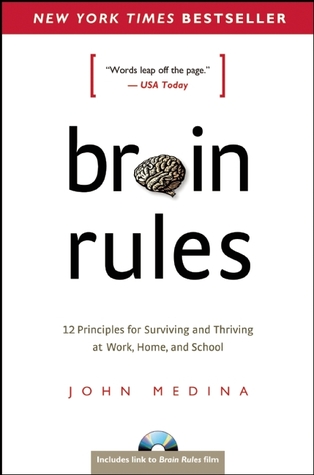
Brain Rules: 12 Principles for Surviving and Thriving at Work, Home, and School (John Medina)

2251306


The brain fascinates me. I loved this book because it explains the science in ways I can understand (I'm really not a science person!) I also liked how he added ideas for ways to implement these ideas in regular work, home and school life.


The 12 rules are:
EXERCISE | Rule #1: Exercise boosts brain power.
SURVIVAL | Rule #2: The human brain evolved, too.
WIRING | Rule #3: Every brain is wired differently.
ATTENTION | Rule #4: We don't pay attention to boring things.
SHORT-TERM MEMORY | Rule #5: Repeat to remember.
LONG-TERM MEMORY | Rule #6: Remember to repeat.
SLEEP | Rule #7: Sleep well, think well.
STRESS | Rule #8: Stressed brains don't learn the same way as non-stressed
SENSORY INTEGRATION | Rule #9: Stimulate more of the senses.
VISION | Rule #10: Vision trumps all other senses.
GENDER | Rule #11: Male and female brains are different.
EXPLORATION | Rule #12: We are powerful and natural explorers.


Goodreads summary:


Most of us have no idea what’s really going on inside our heads. Yet brain scientists have uncovered details every business leader, parent, and teacher should know—like the need for physical activity to get your brain working its best.

How do we learn? What exactly do sleep and stress do to our brains? Why is multi-tasking a myth? Why is it so easy to forget—and so important to repeat new knowledge? Is it true that men and women have different brains?

In Brain Rules, Dr. John Medina, a molecular biologist, shares his lifelong interest in how the brain sciences might influence the way we teach our children and the way we work. In each chapter, he describes a brain rule—what scientists know for sure about how our brains work—and then offers transformative ideas for our daily lives.

Medina’s fascinating stories and infectious sense of humor breathe life into brain science. You’ll learn why Michael Jordan was no good at baseball. You’ll peer over a surgeon’s shoulder as he proves that most of us have a Jennifer Aniston neuron. You’ll meet a boy who has an amazing memory for music but can’t tie his own shoes.

You will discover how:

Every brain is wired differently
Exercise improves cognition
We are designed to never stop learning and exploring
Memories are volatile
Sleep is powerfully linked with the ability to learn
Vision trumps all of the other senses
Stress changes the way we learn

In the end, you’ll understand how your brain really works—and how to get the most out of it.

Friday, January 2, 2015

Because of Mr. Terupt (Rob Buyea)

This book was recommended by Erin Soderberg, when we skyped with her. It took me a little while to get into it, and I found I had to keep notes on each of the characters because I wasn't keeping them straight in my head - but once I got into it it got easier.


Goodreads Summary:


It’s the start of fifth grade for seven kids at Snow Hill School. There’s . . . Jessica, the new girl, smart and perceptive, who’s having a hard time fitting in; Alexia, a bully, your friend one second, your enemy the next; Peter, class prankster and troublemaker; Luke, the brain; Danielle, who never stands up for herself; shy Anna, whose home situation makes her an outcast; and Jeffrey, who hates school.

Only Mr. Terupt, their new and energetic teacher, seems to know how to deal with them all. He makes the classroom a fun place, even if he doesn’t let them get away with much . . . until the snowy winter day when an accident changes everything—and everyone.


This story made me reflect on how everyone has a story and everyone deserves a little extra kindness. The influence of a good teacher made my heart swell. The story is told from each student's perspective, similar to how Wonder is told. It was a really effective way to tell the story.


Far be it from me to ever disagree with Donalyn Miller - until today. In her review she thought the student's voices were too mature for grade 5. I don't know though. Kids can have a lot of depth and I didn't find it too unrealistic.


The teacher, Mr. Terupt, is new and is a fabulous teacher. He helps his students work together and realize they're stronger when they're united. He teaches them to be kind through experiences with students with special needs. He allows them choice. He gives them rewards. He is real and open with them....and he changes a lot of lives.


The end of the story made me cry. I was reading in a public place. Be warned! You might want to be alone for the ending.

Thursday, June 12, 2014

The Myth of Ability (John Mighton)

I recently attended a JUMP math workshop and am very excited about the program. John Mighton is a fascinating person. The success rates from this program that they claim are astounding. I'm excited to teach it!

The author is fascinating as well. Who writes plays, gets a PhD in math, and starts a non-profit for teaching math to elementary students, and writes books on the side?

The premise behind this book is that we don't have a 'math gene' that makes us good at math. Everyone can learn it, if taught properly.

GoodReads Summary:

For decades teachers and parents have accepted the judgment that some students just aren’t good at math. John Mighton—the founder of a revolutionary math program designed to help failing math students—feels that not only is this wrong, but that it has become a self-fulfilling prophecy.

A pioneering educator, Mighton realized several years ago that children were failing math because they had come to believe they were not good at it. Once students lost confidence in their math skills and fell behind, it was very difficult for them to catch up, particularly in the classroom. He knew this from experience, because he had once failed math himself.
Using the premise that anyone can learn math and anyone can teach it, Mighton’s unique teaching method isolates and describes concepts so clearly that students of all skill levels can understand them. Rather than fearing failure, students learn from and build on their own successes and gain the confidence and self-esteem they need to be inspired to learn. Mighton’s methods, set forth in The Myth of Ability and implemented in hundreds of Canadian schools, have had astonishing results: Not only have they helped children overcome their fear of math, but the resulting confidence has led to improved reading and motor skills as well.

The Myth of Ability will transform the way teachers and parents look at the teaching of mathematics and, by extension, the entire process of education.(