Showing posts with label time management. Show all posts

Sunday, July 5, 2026

What Most Successful People Do Before Breakfast (Laura Vanderkam)


This is a quick one hour audio book read by the author. She says: 

  • The hopeful hours before breakfast are far to precious to waste.
  • Small rituals can accomplish great things.
    • A habit has the force of the water drop that hollows the stone. A small daily task, if it be really daily, will beat the laborers of a spasmatic Hercules. 
    • When you make over your mornings, you can make over your life.
  • Self-discipline is a muscle and it depletes over time - this is why you should do the most. important things in the morning. It is usually the time when you have fewer interruptions. 
  • evenings are when diets are broken, crimes are committed, commitments are broken.
  • the best things for mornings rituals are the things that result in long term benefits.
  • Pick one new habit and work on it until you have made it part of your life. As you go, track your progress.
  • The reason we stay in bed in the morning is we think of all the things we need to do instead of the things you look forward to. Plan to do things you look forward to.
  • Tune up as necessary. Life changes and routines should change along with life's changes.
What most successful people use morning time for:
  • nurturing their careers: strategizing and focused work
  • nurturing their relationships: giving their families and friends their best
  • nurturing themselves: exercise and spiritual and creative practices
  • choose things you actually enjoy (no self-flagging!)

Other interesting facts she shares:

People more likely to achieve tenure, working on writing on a daily business.
The networking breakfast concept is incredibly underrated.
If you want to get more out of your time, track your time.

Goodreads summary:

Mornings are a madcap time for many of us. We wake up in a haze--often after hitting snooze a few times. Then we rush around to get ready and out the door so we can officially start the day. Before we know it, hours have slipped by without us accomplishing anything beyond downing a cup of coffee, dashing off a few emails, and dishing with our coworkers around the water cooler. By the time the workday wraps up, we're so exhausted and defeated that any motivation to accomplish something in the evening has vanished.

But according to time management expert Laura Vanderkam, mornings hold the key to taking control of our schedules. If we use them wisely, we can build habits that will allow us to lead happier, more productive lives.


Drawing on real-life anecdotes and scientific research that shows why the early hours of the day are so important, Vanderkam reveals how successful people use mornings to help them accomplish things that are often impossible to take care of later in the day. While many of us are still in bed, these folks are scoring daily victories to improve their health, careers, and personal lives without sacrificing their sanity. For instance, former PepsiCo chairman and CEO Steve Reinemund would rise at 5:00 a.m., run four miles, pray, and eat breakfast with his family before heading to work to run a Fortune 500 company.


"What the Most Successful People Do Before Breakfast" is a fun, practical guide that will inspire you to rethink your morning routine and jump-start your life before the day has even begun.

168 Hours: You Have More Time Than You Think (Laura Vanderkam)


I really enjoyed this book and I buy into her theories. Some of the reviews I read were quite critical and not complimentary. When I read a book like this, I tend to take what might work for me and don't worry about the rest - and I think she means that as she writes it. It has a ton of ideas. Take what works for you and leave the rest. You can fit in what really matters to you. For example, I want to be an exerciser - but even in summer break I can't seem to fit it in. Clearly, that's a matter of priorities. She says that if the average person started exercising every time he was tempted to turn on the tube, he could be doing triathlons competitively within a few years (chapter 8: A Full Life).

What works for me:

  • She says that most of us are not as busy as we think. I believe that is true. There is always room to assess how we're spending out time. She really advocates for tracking your time. I would like to do that - but I would like an easy system - preferably on my phone. Is there an app?
    • After you have tracked your time, start totaling the categories and do a personal self-evaluation about how you're spending your time
  • She encourages you to make a list of 1000 dreams (chapter 2). Pick the activities that really matter to you and schedule them in first. 
    • 100 things you'd like to do during your life time (pick your categories and list 10 things)
      • 10 places you want to visit
      • 10 books you want to rest
      • 10 restaurants you want to try
      • 10 skills you want to learn
      • 10 financial goals you have for yourself
      • 10 books (articles) you want to publish
        • etc!
  • Figure out what your core competencies are (what matters most and what you are actually good at doing) and outsource the rest, if you can
  • Create a block schedule where you plan to fit in the things that are most important to you (in other words, the big rocks first theory)
  • Give yourself time to do the things you love. You'll be happier.

I read this on my kobo. When I was finished, it told me how long I took to read it that I spent an average of 11 minutes per reading session - which surprised me. My goal is to spend 30 minutes reading every morning....and frankly, I thought I was doing that - but apparently I read this more in smaller spurts than that.

Goodreads says:

There are 168 hours in a week. This is your guide to getting the most out of them.

It's an unquestioned truth of modern life: we are starved for time. We tell ourselves we'd like to read more, get to the gym regularly, try new hobbies, and accomplish all kinds of goals. But then we give up because there just aren't enough hours to do it all. Or if we don't make excuses, we make sacrifices- taking time out from other things in order to fit it all in.

There has to be a better way...and Laura Vanderkam has found one. After interviewing dozens of successful, happy people, she realized that they allocate their time differently than most of us. Instead of letting the daily grind crowd out the important stuff, they start by making sure there's time for the important stuff. When plans go wrong and they run out of time, only their lesser priorities suffer.

Vanderkam shows that with a little examination and prioritizing, you'll find it is possible to sleep eight hours a night, exercise five days a week, take piano lessons, and write a novel without giving up quality time for work, family, and other things that really matter.

Thursday, November 2, 2023

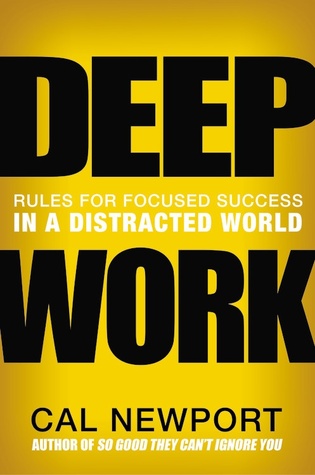
Deep Work (Cal Newport)

25744928


This is seriously good stuff. I totally buy in. The trick for me is how do I find the time to really get into deep work? #momtroubles #RCsolutions

I'm going to start by tracking my time and perhaps seriously slashing social media time as he suggests (well, he suggests to quit it, but I'm not quite ready for that). 

This book is going to go on my list of books to re-read regularly.

Goodreads says:

One of the most valuable skills in our economy is becoming increasingly rare. If you master this skill, you'll achieve extraordinary results.

Deep work is the ability to focus without distraction on a cognitively demanding task. It's a skill that allows you to quickly master complicated information and produce better results in less time. Deep work will make you better at what you do and provide the sense of true fulfillment that comes from craftsmanship. In short, deep work is like a super power in our increasingly competitive twenty-first century economy. And yet, most people have lost the ability to go deep-spending their days instead in a frantic blur of e-mail and social media, not even realizing there's a better way.

In Deep Work, author and professor Cal Newport flips the narrative on impact in a connected age. Instead of arguing distraction is bad, he instead celebrates the power of its opposite. Dividing this book into two parts, he first makes the case that in almost any profession, cultivating a deep work ethic will produce massive benefits. He then presents a rigorous training regimen, presented as a series of four "rules," for transforming your mind and habits to support this skill.

A mix of cultural criticism and actionable advice, Deep Worktakes the reader on a journey through memorable stories-from Carl Jung building a stone tower in the woods to focus his mind, to a social media pioneer buying a round-trip business class ticket to Tokyo to write a book free from distraction in the air-and no-nonsense advice, such as the claim that most serious professionals should quit social media and that you should practice being bored. Deep Work is an indispensable guide to anyone seeking focused success in a distracted world.
 

Wednesday, July 3, 2019

Eat That Frog (Brian Tracy)

I love this type of book. I listened to this audio book. It is read by the author, who has a surprisingly calm voice. He doesn't sound as A-type and aggressive about life as the ideas are in the book. Actually, they're not overly aggressive, actually quite logical. This one would be good to read annually. Lots of good tips and very positive. The concept of eating the big frog first is great. I need a sign for my desk that says, "Eat the frog first."

Goodreads says:

The legendary Eat That Frog! (more than 450,000 copies sold and translated into 23 languages) provides the 21 most effective methods for conquering procrastination and accomplishing more. This new edition is revised and updated throughout, and includes brand new information on how to keep technology from dominating our time.

Friday, February 10, 2017

The Happiness Equation (Neil

I read this book because I loved The Book of Awesome. When I first started this book, I wasn't that impressed. The more I read the more I loved it though. I even loved it enough to keep it two days past when it was due at the library (this morning you could have seen me outside the library finishing off the last chapter as I attempted to return it before yet another day of overdue fines accrued). Some books are definitely worth keeping past the due date. I think this is one worth buying.

I am a goal oriented person. In the beginning, he talks about how you just need to be happy where you are. Just decide. Just decide to be happy. Quit pushing yourself. This idea didn't fit in my picture of self-improvement. However, the more I read, the more persuaded I became that he is right.

He says that success does not lead to happiness. I think he's right. It doesn't mean that you shouldn't try to be successful. It means that if you aren't happy along the way, when you arrive at the destination, it is likely that you still won't be happy because when you drill down, happiness is a choice. I would agree.

His theory that multitasking is a myth is also very persuasive. I'm going to quit trying to pursue that (although, I have to balance that with Gretchen Rubin's Coupling Tasks theory).

He also says that retirement is a broken theory. He talks about having something worthwhile to do. In our world we seem to esteem leisure over everything else, and really, it is a false happiness. I like his idea of always having something you're working on. I think it keeps you young.

He also talks about three tests to measure life: The Saturday Morning Test (what do you do when you have nothing to do on a Saturday morning...that reveals what you really love), The Bench Test ( ) and the Five People Test (you are the average of the five people you spend the most time with.

I like his advice on making fewer decisions. I am going to follow his advice by planning less variance in meals. It will make life much easier if I'm not spending time labouring over things that really don't deserve the time. I'm okay with eating the same thing for breakfast and lunch every day (might have to remain in creative mode for dinner though just to be safe). He says the elimination of options actually leads to more choice. Irony at it's finest.

I thought it was ironic that he ends the book with the idea that you should never take advice. The translation is the D&C 9:7-9 principle. Study it out in your mind then follow your gut (or the spirit...however you want to put it).

Goodreads summary:

What’s the formula for a happy life?  

Neil Pasricha is a Harvard MBA, a Walmart executive, a New York Times–bestselling author, and a husband and dad. After selling more than a million copies of his Book of Awesome series, he now shifts his focus from observation to application.

In The Happiness Equation, Pasricha illustrates how to want nothing, do anything, and have everything. If that sounds like a contradiction, you simply haven’t unlocked the 9 Secrets to Happiness.

Each secret takes a common ideal, flips it on its head, and casts it in a completely new light. Pasricha then goes a step further by providing step-by-step guidelines and hand-drawn scribbles that illustrate exactly how to apply each secret to live a happier life today.

Controversial? Maybe. Counterintuitive? Definitely.

The Happiness Equation will teach you such principles as:
· Why success doesn’t lead to happiness 
· How to make more money than a Harvard MBA 
· Why multitasking is a myth 
· How eliminating options leads to more choice

The Happiness Equation is a book that will change how you think about everything—your time, your career, your relationships, your family, and, ultimately, of course, your happiness. 

Monday, July 1, 2013

Extreme Productivity (Robert C Pozen)

Cover Art for Extreme productivity : boost your results, reduce your hours

I'm always interested in these kinds of books. It's partly a curse from being told that I have the ability to accomplish a lot. That seems to cause me to take on too much.

I'm always interested in being more productive. That being said, I am becoming less and less interested in these books. It reminds me of how I know what to do to lose weight, but am not so good at doing it. I get all the theory behind how to be more productive. I'm just not sure I always have the energy or discipline to make it happen.

Oh well. This one seemed like a good one. Read it if you want....or not, like I did. I skimmed all the main bullet points at the end of each chapter. Good enough for me.