Showing posts with label French. Show all posts
Saturday, December 21, 2019
All The Light We Cannot See (Anthony Doerr)
I had a lot of people recommend this book to me. It took me a LONG time to read it because I got busy with work projects and didn't have much time for reading. It was hard to follow since I had spread it over such a long period of time. Once I got back to it and got into it, I quite enjoyed it. The chapters are short and bounce between the character's stories. Once I got the rhythm of it, I quite enjoyed it. I do love World War II stories. It is amazing the courage so many people showed during that time.
One story is about a boy in Nazi Germany who lives in a orphanage with his sister. He is gifted at fixing radios and also has a keen interest in many other things. He listens to a nightly science program broadcast from France. Because he is so good at fixing radio and gifts in math and science, he wins a spot in a Hitler Youth Academy. He is happy to have something to do beyond working in the coal mines that killed his father, however, he has to start to not think about what goes on in the Hitler Youth Academy.
The other story is about a young blind girl named Marie-Laure who lives in Paris. She is cared for by her father who works at a museum. She became blind as a little girl. Her father builds a miniature model of their neighborhood, so she can memorize every street, building and corner. When the war comes to Paris, she and her father go to Saint-Malo to live with a great-uncle who lives in a tall, storied house next to a sea wall.
What does the title mean?
"The title is a reference first and foremost to all the light we literally cannot see: that is, the wavelengths of the electromagnetic spectrum that are beyond the ability of human eyes to detect (radio waves, of course, being the most relevant). It’s also a metaphorical suggestion that there are countless invisible stories still buried within World War II — that stories of ordinary children, for example, are a kind of light we do not typically see. Ultimately, the title is intended as a suggestion that we spend too much time focused on only a small slice of the spectrum of possibility."
- Anthony Doerr
Goodreads says:
From the highly acclaimed, multiple award-winning Anthony Doerr, the stunningly beautiful instant New York Times bestseller about a blind French girl and a German boy whose paths collide in occupied France as both try to survive the devastation of World War II.
Marie-Laure lives in Paris near the Museum of Natural History, where her father works. When she is twelve, the Nazis occupy Paris and father and daughter flee to the walled citadel of Saint-Malo, where Marie-Laure’s reclusive great uncle lives in a tall house by the sea. With them they carry what might be the museum’s most valuable and dangerous jewel.
In a mining town in Germany, Werner Pfennig, an orphan, grows up with his younger sister, enchanted by a crude radio they find that brings them news and stories from places they have never seen or imagined. Werner becomes an expert at building and fixing these crucial new instruments and is enlisted to use his talent to track down the resistance. Deftly interweaving the lives of Marie-Laure and Werner, Doerr illuminates the ways, against all odds, people try to be good to one another.
Friday, October 18, 2019
White Bird (RJ Palacio)
Sometimes, when looking at all the follow up books after Wonder, I snubbed them. Too much of a good thing? This one is definitely worth the time. I loved the story. It's a great twist that Julian was named after someone so brave and kind. I hope he lives up to his name!
Goodreads says:
In Auggie & Me, which expands on characters in Wonder, readers were introduced to Julian's grandmother, Grandmère. Palacio makes her graphic novel debut with Grandmère's story as a young Jewish girl hidden away by a family in Nazi-occupied France during World War II. Her experience demonstrates the power of kindness to change hearts, build bridges, and even save lives.
Labels:
Communism,
compassion,
courage,
French,
grandparents,
graphic novels,
grief,
growing up,
guilt,
history,
misunderstandings,
politics,
War
Wednesday, October 16, 2019
The Perfect Nanny (Leila Slimani)
This one is a quick read, but a little disturbing! I enjoyed that it was set in Paris since my daughter lives there right now. I found myself looking up places mentioned to see how close they are to where she lives.
The author did a great job of taking a story and turning it into something that really made you think. She is a journalist and this story is based on a real event that happened. I think one of the big themes was that everyone is a little disturbed and if we're not careful and don't follow our gut, we'll all end up dead! Literally. It's all wrapped up in people's inability to deal with problems in their life rather than run away from them. The nanny, whose life is messed up, presents the image of being perfect. However, it isn't long before her problems start to affect her perfect work.
I read this for my book club and most of the people at book club didn't like it, but we sure had a lot to discuss! A lot of people at book club felt like many of the themes and characters weren't developed enough, but I wondered if that was by design. After all, we all form rock-solid opinions based on the little information we get in the news.
Goodreads says:
When Myriam, a French-Moroccan lawyer, decides to return to work after having children, she and her husband look for the perfect nanny for their two young children. They never dreamed they would find Louise: a quiet, polite, devoted woman who sings to the children, cleans the family's chic apartment in Paris's upscale tenth arrondissement, stays late without complaint, and hosts enviable kiddie parties. But as the couple and the nanny become more dependent on one another, jealousy, resentment, and suspicions mount, shattering the idyllic tableau
The author did a great job of taking a story and turning it into something that really made you think. She is a journalist and this story is based on a real event that happened. I think one of the big themes was that everyone is a little disturbed and if we're not careful and don't follow our gut, we'll all end up dead! Literally. It's all wrapped up in people's inability to deal with problems in their life rather than run away from them. The nanny, whose life is messed up, presents the image of being perfect. However, it isn't long before her problems start to affect her perfect work.
I read this for my book club and most of the people at book club didn't like it, but we sure had a lot to discuss! A lot of people at book club felt like many of the themes and characters weren't developed enough, but I wondered if that was by design. After all, we all form rock-solid opinions based on the little information we get in the news.
Goodreads says:
When Myriam, a French-Moroccan lawyer, decides to return to work after having children, she and her husband look for the perfect nanny for their two young children. They never dreamed they would find Louise: a quiet, polite, devoted woman who sings to the children, cleans the family's chic apartment in Paris's upscale tenth arrondissement, stays late without complaint, and hosts enviable kiddie parties. But as the couple and the nanny become more dependent on one another, jealousy, resentment, and suspicions mount, shattering the idyllic tableau
Labels:
Abuse,
babysitters,
children,
death,
family,
French,
gender roles,
loneliness,
relationships
Tuesday, December 26, 2017
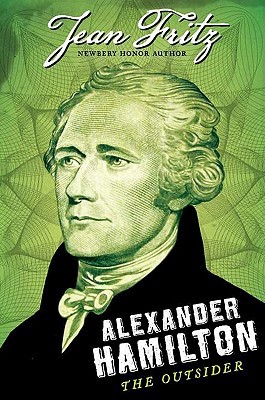
Alexander Hamilton (Jean Fritz)

Now I want to see the play! After I finished reading this, I spent time listening to the songs on YouTube from the musical.
This was a good short version of Alexander Hamilton's life. It was a quick read. The subtitle, 'The Outside' was a good one. He was an outsider because his parents never married, because his step brother took what he loved, was poor but found a way to get a good education and was a great leader in the early years of the US government. The musical starts off with:
How does a bastard, orphan, son of a whore and a Scotsman, dropped in the middle of a forgotten spot in the Caribbean by providence impoverished, in squalor grow up to be a hero and a scholar?
I loved reading about how he loved to learn and how aggressive he was about it. He would get up early and read and then go walking and work on memorizing the information he had read by reciting it. People thought he was a little crazy when they saw him walking and talking to himself.
I enjoyed reading about how banks started. Many people thought they were akin to gambling and would rather be seen in a brothel than a bank....perhaps still a legit concern. :)
In the end, he died in a duel, just a few years after his son died the same way. I thought it was bizarrely dumb way for such a smart guy to die.
When I read books like this, I wish someone had written some similarly great stories about people in Canadian history!
Goodreads says:
Acclaimed biographer Jean Fritz writes the remarkable story of Alexander Hamilton, one of America's most influential and fascinating founding fathers, and his untimely death in a duel with Aaron Burr.
Born in the British West Indies, Hamilton arrived in New York as an "outsider." He fought in the Revolution and became Washington's most valuable aidede- camp. He was there with Washington, Madison, and the others writing the Constitution. He was the first Secretary of the Treasury as the country struggled to become unified and independent.
Fritz's talent for bringing historical figures to life is at its best as she shares her fascination with this man of action who was honorable, ambitious, and fiercely loyal to his adopted country.
Sunday, June 26, 2016
The Invention of Hugo Cabret (Brian Selznick)
I'm not one to re-read books very often. I have read this book a number of times though and love it every time. I have done this as a read-aloud before (good thing for smart boards where you can easily show all the pictures!) and this year I decided to do it as a novel study. I have done other Brian Selznick books before. It has always been a fantastic experience. The tricky part is getting enough copies of the book. It is an expensive book to buy so I haven't even dared ask the school to buy a class set. Instead, the Calgary Public Library kindly got enough copies that we could share a book amongst two students. It was wonderful!
I love it how kids take more care with illustrations. In this book you cannot ignore the illustrations. They tell the story as much as the words do, and sometimes tell you parts of the story the words have not told you.
Most of my students have not read a book as big as this one (although many claim they have...they are really moreso in the Geronimo Stilton mode as a whole, it seems). This one is a great stretcher and hopefully they will go on to read Wonderstruck and The Marvels this summer.
Recently, I have been reading Notice and Note and have tried to implement its strategies when I'm reading. I definitely plan to start using these strategies next year with book club.
Some of my favorite quotes and some of the Notice and Note signposts I noticed:
This is a great look into how we often can't know everything about someone else. Sometimes people do things that seem mean and they would totally not give themselves the same label because they have reasons for what they're doing.
p. 168 Hugo blinked. He had never thought of himself as mean before. The old man was mean, not him. Hugo had no choice...he had to keep secrets, but he couldn't explain this to the girl.
Again and again (Everytime Hugo is about to steal something he tubs his buttons):
p. 186 Hugo continued flipping through the book, seeing if there was anything at all about automata, but the book was silent on the subject. Still, Hugo wanted it very much. He knew that Monsieur Labisse lent books to Isabelle, but Hugo didn't want to just borrow this one. He wanted to own it.
He slipped it under his arm and inched toward the door. He rubbed the remaining buttons on his jacket...
Ah ha moment (Hugo and Isabelle realize maybe they can help Papa Georges find happiness):
p. 374 "Did you ever notice that all machines are made for some reason?" he asked Isabelle. "They are built ot make you laugh, like a mouse here, or to tell the time, like clocks, or to fill you with wonder, like the automaton. Maybe that's why a broken machines always makes me a little sad, because it isn't able to do what it was meant to do."
Isabelle picked up the mouse, wound it again, and set it down.
"Maybe it's the same with people," Hugo continued. "If you lose your purpose...it's like you're broken."
then on p. 494 Isabelle and Hugo find out that Papa Georges was the one who painted an interesting picture of Prometheus that they saw. He says: "Then you know that Prometheus was rescued in the end. His chains were broken, and he was finally set free." The old man squinted one of his eyes and added, "How about that."
Goodreads summary:
Orphan, clock keeper, and thief, Hugo lives in the walls of a busy Paris train station, where his survival depends on secrets and anonymity. But when his world suddenly interlocks with an eccentric, bookish girl and a bitter old man who runs a toy booth in the station, Hugo's undercover life, and his most precious secret, are put in jeopardy. A cryptic drawing, a treasured notebook, a stolen key, a mechanical man, and a hidden message from Hugo's dead father form the backbone of this intricate, tender, and spellbinding mystery.
I love it how kids take more care with illustrations. In this book you cannot ignore the illustrations. They tell the story as much as the words do, and sometimes tell you parts of the story the words have not told you.
Most of my students have not read a book as big as this one (although many claim they have...they are really moreso in the Geronimo Stilton mode as a whole, it seems). This one is a great stretcher and hopefully they will go on to read Wonderstruck and The Marvels this summer.
Recently, I have been reading Notice and Note and have tried to implement its strategies when I'm reading. I definitely plan to start using these strategies next year with book club.
Some of my favorite quotes and some of the Notice and Note signposts I noticed:
This is a great look into how we often can't know everything about someone else. Sometimes people do things that seem mean and they would totally not give themselves the same label because they have reasons for what they're doing.
p. 168 Hugo blinked. He had never thought of himself as mean before. The old man was mean, not him. Hugo had no choice...he had to keep secrets, but he couldn't explain this to the girl.
Again and again (Everytime Hugo is about to steal something he tubs his buttons):
p. 186 Hugo continued flipping through the book, seeing if there was anything at all about automata, but the book was silent on the subject. Still, Hugo wanted it very much. He knew that Monsieur Labisse lent books to Isabelle, but Hugo didn't want to just borrow this one. He wanted to own it.
He slipped it under his arm and inched toward the door. He rubbed the remaining buttons on his jacket...
Ah ha moment (Hugo and Isabelle realize maybe they can help Papa Georges find happiness):
p. 374 "Did you ever notice that all machines are made for some reason?" he asked Isabelle. "They are built ot make you laugh, like a mouse here, or to tell the time, like clocks, or to fill you with wonder, like the automaton. Maybe that's why a broken machines always makes me a little sad, because it isn't able to do what it was meant to do."
Isabelle picked up the mouse, wound it again, and set it down.
"Maybe it's the same with people," Hugo continued. "If you lose your purpose...it's like you're broken."
then on p. 494 Isabelle and Hugo find out that Papa Georges was the one who painted an interesting picture of Prometheus that they saw. He says: "Then you know that Prometheus was rescued in the end. His chains were broken, and he was finally set free." The old man squinted one of his eyes and added, "How about that."
Goodreads summary:
Orphan, clock keeper, and thief, Hugo lives in the walls of a busy Paris train station, where his survival depends on secrets and anonymity. But when his world suddenly interlocks with an eccentric, bookish girl and a bitter old man who runs a toy booth in the station, Hugo's undercover life, and his most precious secret, are put in jeopardy. A cryptic drawing, a treasured notebook, a stolen key, a mechanical man, and a hidden message from Hugo's dead father form the backbone of this intricate, tender, and spellbinding mystery.
Labels:
Abuse,
addictions,
Art history,
chasing dreams,
dads,
death,
Fears,
French,
friendship,
goals,
graphic novels,
Historical fiction,
homelessness,
movies,
mystery,
orphans,
Re-reading,
trains
Wednesday, March 2, 2016
Moonlight Over Paris (Jennifer Robson)
I loved this book. You can't tell by how long it took me - but I found myself wanting to just immerse myself in Paris life as I read. It is report card season right now so I had less time to read - but when I did I found myself reading for an hour and not even realizing I had been immersed in the book that long.
I loved how Helena followed her dreams, messing up along the way, but persisting. I found myself wondering if it was a true reflection of what life was like in Paris back then and, given Jennifer Robson's great historian skills, I tend to think it was pretty spot on. I marvelled at people wanting to separate themselves from family fortunes. Really?! What harm is there in having a big pile of money?! :)
This is a book (series!) I'll definitely read again.
Goodreads summary:
USA Today and internationally bestselling author Jennifer Robson takes readers to 1920s Paris in an enthralling new historical novel that tells the riveting story of an English lady who trades in her staid aristocratic life for the mesmerizing salons and the heady world of the Lost Generation.
It’s the spring of 1924, and Lady Helena Montagu-Douglas-Parr has just arrived in France. On the mend after a near-fatal illness, she is ready to embrace the restless, heady allure of the City of Lights. Her parents have given her one year to live with her eccentric aunt in Paris and Helena means to make the most of her time. She’s quickly drawn into the world of the Lost Generation and its circle of American expatriates, and with their encouragement, she finds the courage to pursue her dream of becoming an artist.
One of those expats is Sam Howard, a journalist working for the Chicago Tribune. Irascible, plain-spoken, and scarred by his experiences during the war, Sam is simply the most fascinating man she has ever met. He’s also entirely unsuitable.
As Paris is born anew, rising phoenix-like from the ashes of the Great War, Helena realizes that she, too, is changing. The good girl she once was, so dutiful and obedient, so aware of her place in the world, is gone forever. Yet now that she has shed her old self, who will she become, and where, and with whom, does she belong…?
Labels:
adventure,
art,
Art history,
Canadian authors,
chasing dreams,
French,
friendship,
LGBQ,
War,
Writing
Thursday, December 31, 2015
The Marvels (Brian Selznick)
I was going to read this book months ago. I had borrowed it from the library and it was in my car when my car was stolen! Fortunately, car thieves tend to ignore books and I got it back. I returned it to the library and it took a few months to get it again.
I love this book!! Brian Selznick has done something amazing again. He seems to have a thing about theatre, runaways, history and French.
This story is based on a real story - someone who tried to save stories, like the characters in this story. One interesting thing was that the real person this story was based on was greatly influenced by Peter Ackroyd's writing!
I love the touch of French, the quest to learn about a family's past, and although it seems like a little thing, the gold edges on the pages. It is a beautiful story!
Goodreads summary:
Caldecott Award winner and bookmaking trailblazer Brian Selznick once again plays with the form he invented and takes readers on a voyage!
Two seemingly unrelated stories--one in words, the other in pictures--come together. The illustrated story begins in 1766 with Billy Marvel, the lone survivor of a shipwreck, and charts the adventures of his family of actors over five generations. The prose story opens in 1990 and follows Joseph, who has run away from school to an estranged uncle's puzzling house in London, where he, along with the reader, must piece together many mysteries.
Labels:
courage,
family history,
French,
Historical fiction,
runaways,
Theatre
Subscribe to:
Posts (Atom)